
Monstera Thai Constellation Identification Guide
Identify Monstera 'Thai Constellation' by its creamy speckled, star-like variegation on fenestrated Monstera deliciosa leaves.
Read the full Monstera Thai Constellation encyclopedia entry →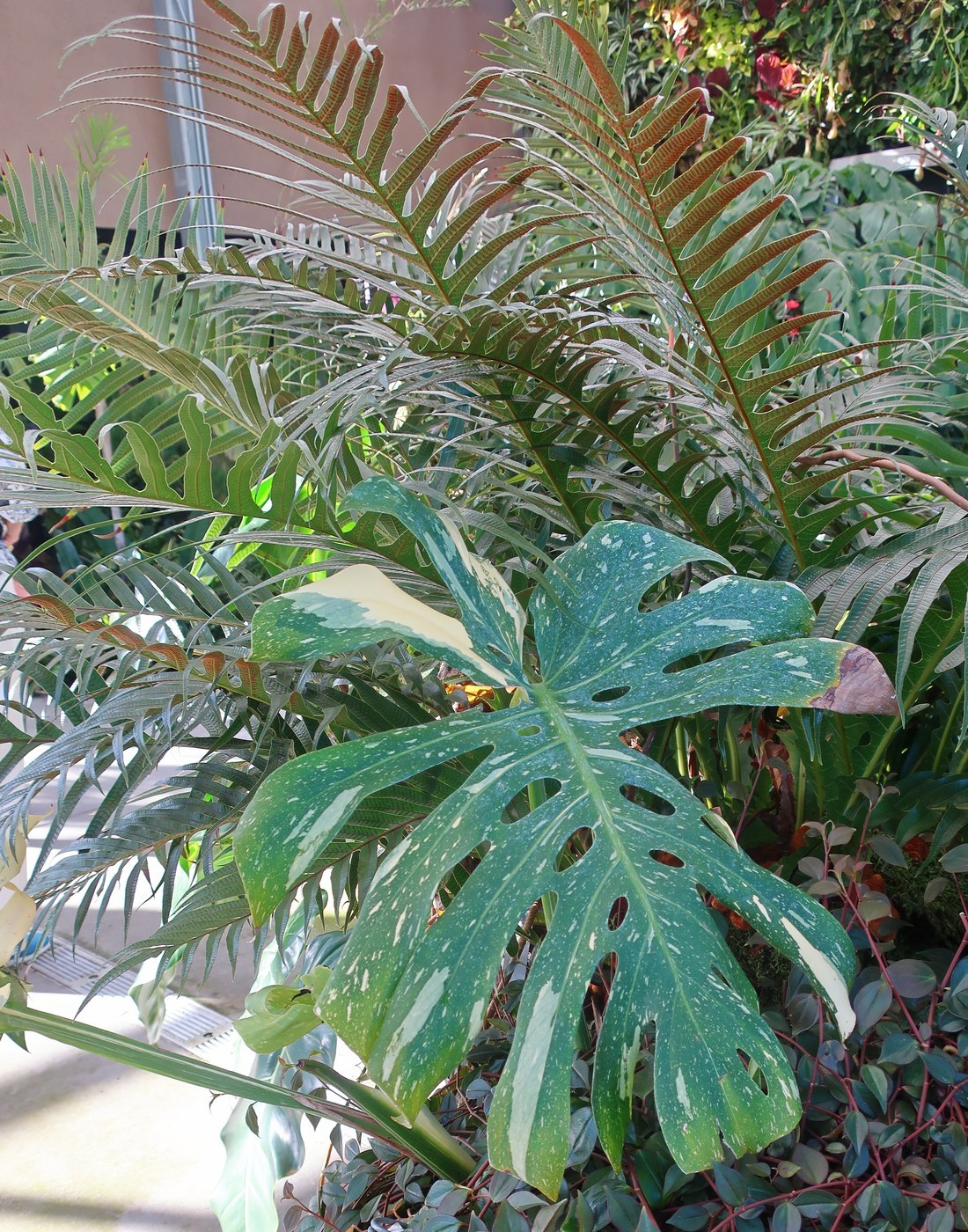
Key Identifying Features
Monstera 'Thai Constellation' is a stable, tissue-cultured variegated Monstera deliciosa developed in Thailand. Identify it by:
- Creamy-yellow to white speckled, splattered variegation scattered like stars across the leaf
- The standard Monstera deliciosa leaf with marginal splits and oval holes
- Stable, evenly distributed flecking (not big solid white blocks)
- Thick climbing stems with aerial roots
The galaxy-like sprinkle of cream speckles over a green fenestrated leaf is its namesake trait.
Leaves & Stems
Leaves carry the classic deliciosa form — large, glossy, heart-shaped, developing splits and holes with maturity — overlaid with fine, dappled cream/butter-yellow variegation that looks like a starry sky. Because it's tissue-cultured and chimeric-stable, the speckling is consistent and well-spread, rarely producing fully white leaves or sharp half-moons (unlike Albo). New growth shows a creamy-yellow tint rather than pure white. The stem and petioles are also flecked, and the plant climbs via aerial roots.
Flowers & Fruit
As a deliciosa cultivar it can theoretically produce the white-spathe/spadix inflorescence and cob-like fruit, but indoor flowering is rare; it's grown for foliage. All parts contain irritating calcium oxalate.
How to Tell It Apart from Look-Alikes
- Monstera 'Albo Variegata' has pure-white, blocky, irregular and unstable variegation (half-moons, full-white leaves); Thai is creamy, speckled, even, and stable.
- Monstera 'Aurea' shows deeper yellow-gold blocky variegation, not fine speckling.
- Plain Monstera deliciosa has no variegation.
Key test: if variegation is creamy-yellow, finely speckled, and uniform with no fully white leaves, it's Thai Constellation; if it's pure-white, blocky and erratic, it's Albo.
Where You'll Find It
It's a lab-produced cultivar (no wild population), mass-propagated by tissue culture and sold worldwide as a premium houseplant for bright indirect light. Because it's tissue-cultured, plants are fairly uniform and don't lose variegation the way cutting-grown chimeras can.
Quick ID Checklist
- Monstera deliciosa leaf with splits and holes
- Creamy-yellow speckled, star-like variegation
- Variegation even and stable, rarely full-white leaves
- Cream-tinted new growth
- Flecked stems and petioles
- Climbing habit with aerial roots
Match these and you have a Thai Constellation. The fast, surest way to separate it from Albo: Thai is creamy and evenly speckled and stable; Albo is pure-white, blocky, and unpredictable.
Frequently asked questions
How do I tell Thai Constellation from Monstera Albo?
Thai Constellation has creamy-yellow, finely speckled, evenly distributed and stable variegation, while Albo has pure-white, blocky, irregular variegation that varies wildly and can produce full-white leaves.
Is its variegation stable?
Yes. Thai Constellation is tissue-cultured and its chimeric variegation is stable and uniform, so it doesn't revert to green the way some cutting-grown variegated plants do.
Why is the variegation cream instead of white?
Its variegation contains some carotenoid pigment, giving a buttery cream-to-yellow tone rather than the pure chlorophyll-free white seen in Albo.
Does it grow holes and splits like a normal Monstera?
Yes. It's a Monstera deliciosa cultivar, so mature leaves develop the same marginal splits and oval fenestrations, just overlaid with speckled variegation.
Why is it expensive despite being tissue-cultured?
Tissue culture of the variegated line is slow and finicky with a high failure rate, keeping supply limited relative to strong demand.