Monterey Cypress Identification Guide
Identify Monterey Cypress (Cupressus macrocarpa) by its dense green scale foliage, large round woody cones, and wind-sculpted coastal form.
Read the full Monterey Cypress encyclopedia entry →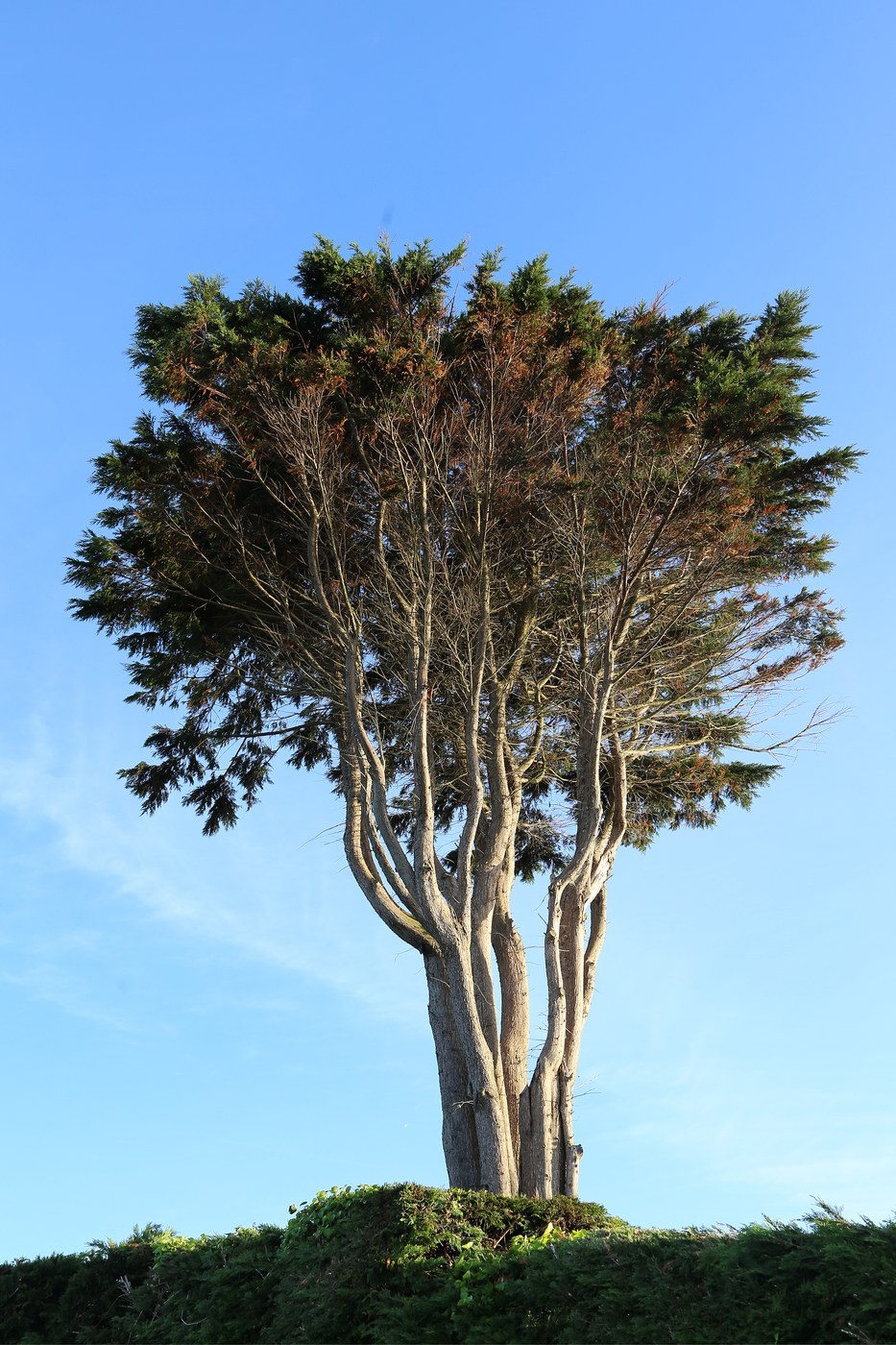
Key Identifying Features
Monterey Cypress (Cupressus macrocarpa) is a large evergreen conifer famous for the wind-sculpted specimens on the California coast. Identify it by bright to dark green scale-like foliage in cord-like branchlets, large round woody cones (the species name macrocarpa means "large-fruited"), and, on exposed sites, a broad flat-topped, asymmetrical wind-pruned crown.
- Dense green (not blue) scale foliage
- Round woody cones 1-1.5 inches across
- Young trees conical; old coastal trees broad and flat-topped
- Aromatic, lemony resinous foliage when crushed
Leaves & Stems
Leaves are tiny scale-like leaves in opposite pairs, closely pressed to the branchlets, which are rounded and cord-like rather than flattened into ferny sprays. Wild foliage is rich green to gray-green; the cultivar 'Goldcrest' (Lemon Cypress) is golden. Crush the foliage for a resinous, lemony scent. The fine, dense texture and three-dimensional branchlets distinguish it from flat-sprayed arborvitae and Lawson Cypress.
Flowers & Fruit
Male pollen cones are small and yellowish at the shoot tips. The seed cones are round, woody, and 1-1.5 inches in diameter — notably larger than most cypress cones — with 8-14 shield-shaped scales, each with a small central boss. Cones are grayish-brown, mature in about two years, and may stay closed on the tree for a long period.
How to Tell It Apart from Look-Alikes
- Arizona Cypress: foliage distinctly blue-gray; Monterey is green. Cones are similar but Arizona is drier-climate adapted.
- Leyland Cypress (a hybrid of this species): faster, denser, finer foliage and smaller, rarer cones.
- Arborvitae (Thuja): flat ferny sprays and small elongated cones, not round woody ones.
- Lawson Cypress: flattened sprays with white X-marks beneath and tiny pea-sized cones.
Green cord-like scale foliage plus large round woody cones, especially on the California coast, confirm Monterey Cypress.
Where You'll Find It
Natively confined to two small groves on the Monterey Peninsula, California (notably Point Lobos and Cypress Point), where salt wind sculpts dramatic gnarled specimens. It is widely planted elsewhere as a coastal windbreak and ornamental, and is the parent of the popular Leyland and Lemon cypresses. It thrives in mild, moist coastal climates.
Quick ID Checklist
- Dense green scale foliage in cord-like branchlets
- Large round woody cones over an inch wide
- Lemony resinous scent when crushed
- Flat-topped wind-sculpted crown on exposed coasts
- Native to the Monterey, California coast
Green scale foliage with big round cones and a wind-pruned coastal form is Monterey Cypress.
Frequently asked questions
How do I tell Monterey Cypress from Arizona Cypress?
Monterey Cypress foliage is green to gray-green, while Arizona Cypress is distinctly blue-gray. Both have round woody cones, but their colors and preferred climates differ.
What does 'macrocarpa' mean?
It means 'large-fruited,' referring to the relatively big round woody cones, which are larger than those of most other cypress species.
Is Lemon Cypress the same plant?
Yes. Lemon Cypress is the golden cultivar 'Goldcrest' of Monterey Cypress, selected for bright yellow, lemon-scented foliage.
Why are coastal Monterey Cypress trees so twisted and flat-topped?
Constant salt-laden ocean wind prunes and sculpts the exposed trees, producing the dramatic gnarled, flat-topped silhouettes seen along the Monterey coast.
Monterey Cypress identified by the community
Recent Monterey Cypress specimens identified with Plant Identifier.