
Moon Cactus Identification Guide
How to identify the grafted Moon cactus by its brightly colored top globe sitting on a green rootstock stem.
Read the full Moon Cactus encyclopedia entry →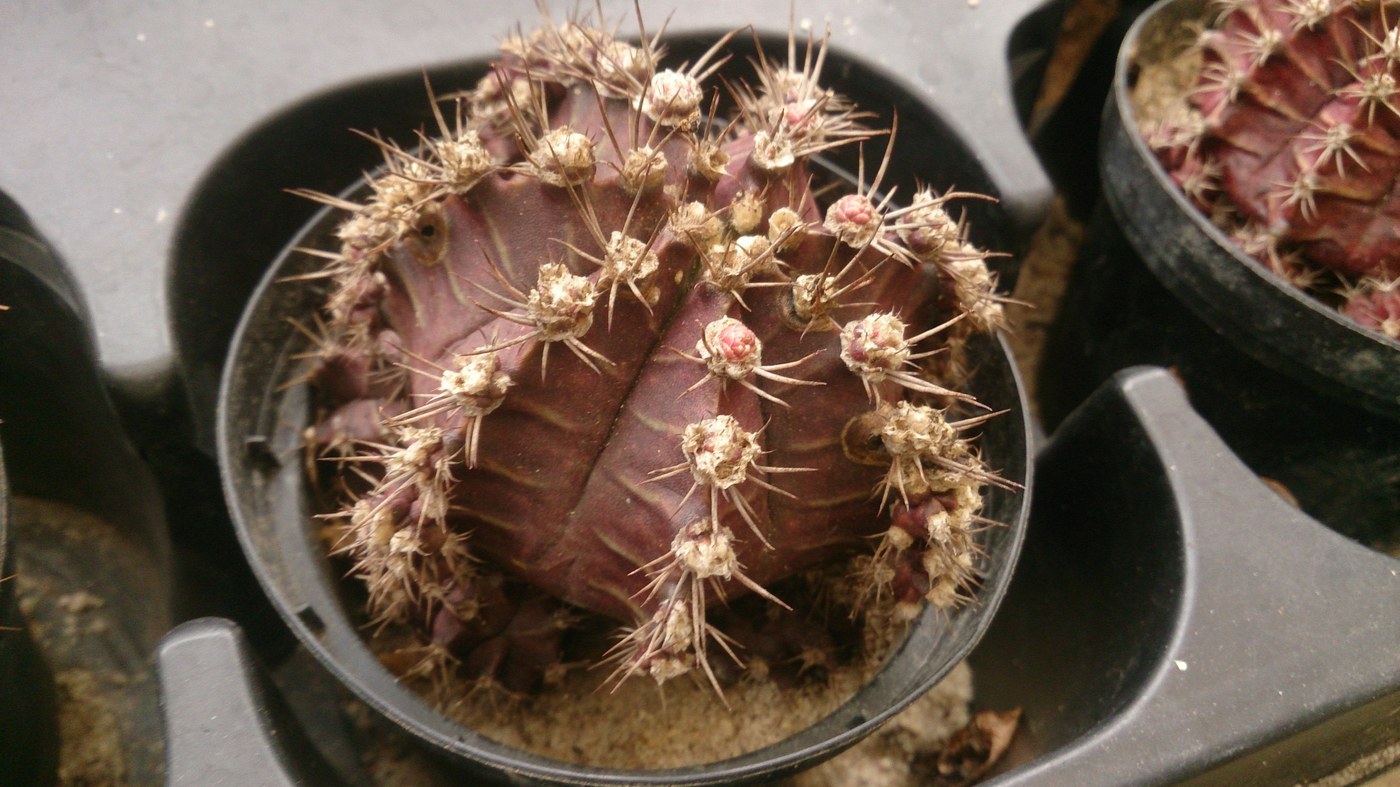
Key Identifying Features
The Moon Cactus is a grafted novelty plant combining a brightly colored top cactus (Gymnocalycium mihanovichii mutant) onto a green rootstock (usually Hylocereus).
- Small, brightly colored ball (red, pink, orange, yellow, or purple) on top
- A green columnar stem (the rootstock) beneath it
- Obvious graft joint where the two pieces meet
- Small overall — top globe usually 1–2 in (3–5 cm) wide
Stems & Spines
The colored top is a ribbed globe (typically 8 ribs) with small areoles bearing short, curved, soft spines and no chlorophyll — it survives only because it's grafted, since it can't photosynthesize on its own. The rootstock is a three-sided or angular green stem (commonly the dragonfruit cactus Hylocereus) that does the feeding. The seam between them, the graft union, is the single clearest identifier: a colored sphere will never naturally grow from a green stem.
Flowers & Fruit
Moon cacti can occasionally bloom with small, funnel-shaped pale pink or greenish flowers emerging from the colored top, inherited from the Gymnocalycium parent. Flowering is uncommon indoors. Fruit is rarely produced.
How to Tell It Apart from Look-Alikes
- Naturally red cacti: a genuinely all-red cactus is exceptionally rare; if you see a vivid ball on a contrasting green stem, it's a graft.
- Christmas/holiday cacti: flat segmented stems, not a grafted globe.
- Ungrafted Gymnocalycium: green-bodied, normal flowering barrel; the moon cactus is its color-mutant form kept alive on rootstock.
The two-tone, two-part construction — bright top + green base + visible seam — is the definitive tell.
Where You'll Find It
You'll find Moon Cactus almost exclusively as an indoor houseplant or gift plant sold in small pots at garden centers and supermarkets. It needs bright indirect light (direct sun can scorch the colored top), warmth, and sparse watering. Because the colorful top has no chlorophyll, the plant's lifespan is limited compared to ordinary cacti.
Quick ID Checklist
- Bright red/pink/orange/yellow ball on top
- Green angular stem (rootstock) below
- Clear graft seam between the two
- Small ribbed globe with short curved spines
- Sold as a small indoor gift plant
- Colored portion can't survive on its own
Frequently asked questions
Why is the top of my moon cactus a different color than the bottom?
It's two plants grafted together. The colored ball is a mutant cactus with no chlorophyll, fused onto a green rootstock that feeds it.
Can a moon cactus survive without grafting?
The colorful top cannot. Because it lacks chlorophyll, it depends entirely on the green rootstock to make food, so it must stay grafted.
Why is my moon cactus turning brown or shriveling at the joint?
The graft union can fail over time, or the rootstock may be rotting from overwatering. Browning at the seam often means the graft is dying.
Do moon cacti flower?
Occasionally. Small pale pink or greenish funnel-shaped flowers can emerge from the colored top, though blooming is uncommon indoors.