
Moon Valley Pilea Identification Guide
Identify Moon Valley Pilea (Pilea mollis 'Moon Valley') by its deeply textured, quilted bright-green leaves with sunken bronze veins resembling a lunar landscape.
Read the full Moon Valley Pilea encyclopedia entry →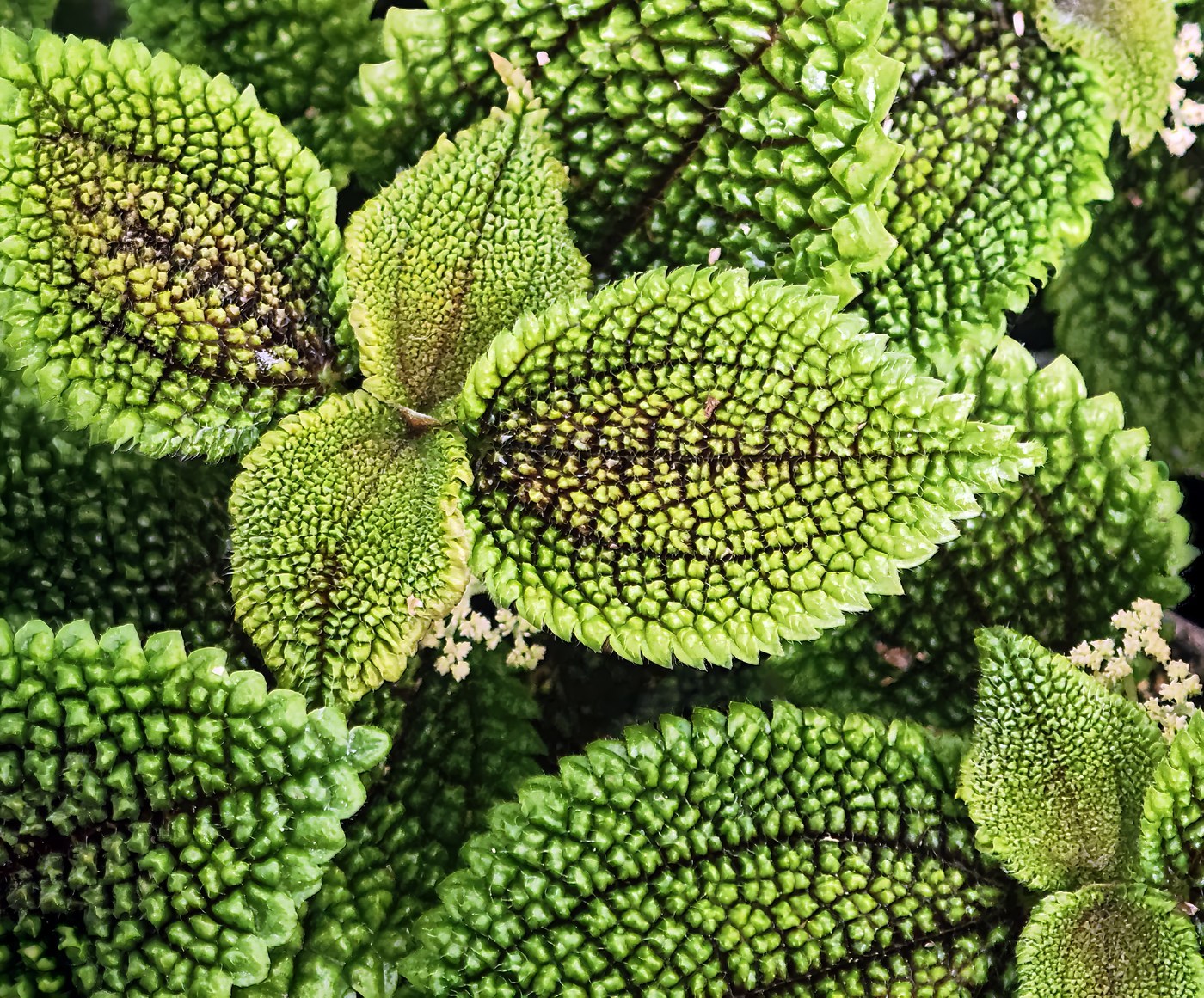
Key Identifying Features
Moon Valley Pilea (Pilea mollis 'Moon Valley', sometimes listed under Pilea involucrata) is named for its deeply quilted, crater-like leaf texture that looks like the surface of the moon. The leaves are bright apple-green with sunken, contrasting bronze-to-chocolate veins.
- Heavily textured, puckered (bullate) leaves with a 'moon crater' look
- Bright chartreuse-green raised areas with dark bronze/copper sunken veins
- Toothed (serrated) leaf margins
- Bushy, mounding, soft-stemmed habit
Leaves & Stems
Leaves are ovate, 5–8 cm long, in opposite pairs, with a deeply embossed surface where the tissue bulges up between the impressed veins, creating valleys and ridges. The contrast of lime-green ridges and dark reddish-bronze veining is the key visual. Leaf edges are finely serrated (toothed). Stems are soft, green and slightly hairy, branching to form a compact bushy mound 20–30 cm tall. The whole plant has a soft, almost fuzzy appearance.
Flowers & Fruit
Flowers are tiny, greenish to pinkish-white and insignificant, clustered in small heads — typical of the nettle family (Urticaceae) to which Pilea belongs. They are not used for identification; the textured foliage is the defining trait.
How to Tell It Apart from Look-Alikes
- vs. Pilea cadierei (Aluminum Plant): that has smooth, flat leaves with silver patches, not the deep moon-crater texture
- vs. Pilea peperomioides (Chinese Money Plant): that has round, flat, coin-shaped leaves on long petioles — completely different
- vs. Episcia/Flame Violet: similar quilted texture but Episcia is a gesneriad with colorful tubular flowers; Moon Valley is a toothed-leaf nettle relative
- vs. Iron Cross Begonia: that has a dark central cross and asymmetric leaves; Moon Valley has symmetric toothed leaves and dark veins throughout
The lime-green quilted leaf with dark sunken veins and serrated edges is diagnostic.
Where You'll Find It
A compact, humidity-loving houseplant good for terrariums and bright windowsills. Derived from species native to the tropical forests of Central and South America.
Quick ID Checklist
- Deeply quilted 'moon crater' leaf texture
- Bright lime-green with dark bronze sunken veins
- Toothed (serrated) leaf margins
- Leaves in opposite pairs on soft hairy stems
- Compact bushy mound, tiny insignificant flowers
Frequently asked questions
Why is it called Moon Valley?
The leaf surface is so deeply quilted, with raised lime-green ridges and sunken dark veins, that it resembles the cratered landscape of the moon.
How is it different from the Chinese Money Plant?
The Chinese Money Plant (Pilea peperomioides) has round, flat, coin-shaped leaves on long stalks. Moon Valley Pilea has textured, toothed, oval leaves with dark veins.
What gives the leaves their two-tone color?
The raised tissue is bright chartreuse-green while the deeply impressed veins are bronze to chocolate, producing the characteristic contrast.
Does Moon Valley Pilea have showy flowers?
No. As a member of the nettle family it produces only tiny, insignificant greenish flowers. It is grown entirely for its dramatic leaf texture.