
Musk Thistle Identification Guide
Identify musk thistle (Carduus nutans), a spiny biennial with large nodding rose-purple flower heads backed by broad spine-tipped bracts. Covers its deeply lobed spiny leaves and how to separate it from bull and Canada thistle.
Read the full Musk Thistle encyclopedia entry →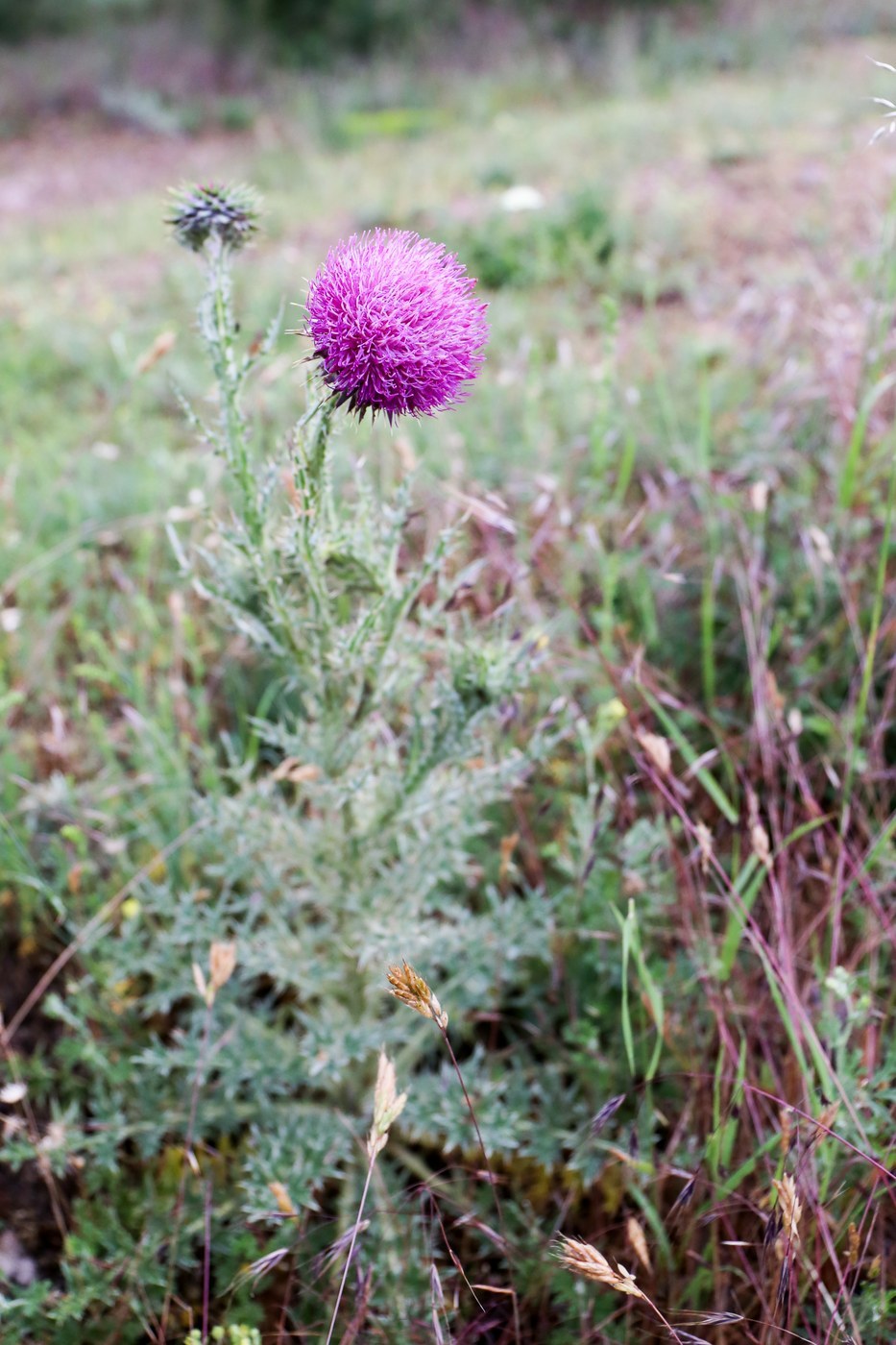
Key Identifying Features
Musk thistle (Carduus nutans), also called nodding thistle, is a spiny biennial noxious weed with strikingly large flower heads. Its signature is the big, solitary, rose-purple flower head that nods or droops to one side, backed by broad, spine-tipped triangular bracts that flare out like a many-pointed star. The plant is heavily armed with spines.
- Large nodding rose-purple to crimson flower heads, 1.5 to 3 inches across
- Broad, spiny reflexed bracts beneath the head
- Deeply lobed, very spiny leaves with a pale midrib
- Spiny wings running down the stem
- Biennial: rosette first year, tall bolting stem the second
Leaves & Stems
First-year plants form a large flat rosette of dark green, deeply lobed leaves edged with stout yellowish to white spines, often with a whitish midrib and sometimes a frosty margin. In the second year the plant bolts into a stout, branched stem 2 to 6 feet tall. The stems bear spiny, leaf-like wings along their length except just below the flower head, where the stem is bare. The whole plant is conspicuously armed, making it painful to handle.
Flowers & Fruit
The flower heads are the most memorable feature: large, 1.5 to 3 inches wide, deep rose-purple to reddish-purple, and distinctly nodding (bent over) at maturity, hence "nodding thistle." Surrounding each head are broad, flat, triangular bracts that are spine-tipped and bend backward, giving a star-like or artichoke-like collar. A faint musky scent may be detectable. Seeds are small achenes topped by a plume of whitish bristles that carry them on the wind. Flowering runs from late spring through summer.
How to Tell It Apart from Look-Alikes
- Bull thistle (Cirsium vulgare): Heads are more upright and gumdrop-shaped with narrow spiny bracts (not broad flat reflexed ones), and leaves are spiny-haired on top.
- Canada thistle (Cirsium arvense): Has many small (under 1 inch) pale lilac heads, spreads by rhizomes, and is a perennial; musk thistle has few very large heads and is biennial.
- Plumeless thistle (Carduus acanthoides): Has smaller, more upright heads and narrower bracts.
The combination of a large, nodding, rose-purple head with broad spine-tipped reflexed bracts is diagnostic for musk thistle.
Where You'll Find It
Musk thistle invades pastures, rangeland, roadsides, fields, and disturbed open ground across much of North America, where it is a regulated noxious weed. It favors full sun and tolerates a wide range of soils, often dominating overgrazed or neglected land. Each plant can produce thousands of wind-blown seeds.
Quick ID Checklist
- Spiny biennial, 2 to 6 ft when bolting
- Large nodding rose-purple flower heads
- Broad spine-tipped bracts that flare backward
- Deeply lobed, very spiny leaves, pale midrib
- Spiny-winged stems
- Open sunny disturbed ground; noxious weed
Frequently asked questions
Why is it called nodding thistle?
The large flower heads bend over and nod to one side as they mature, a distinctive habit that, along with the broad spiny bracts, identifies musk thistle.
How do I tell musk thistle from Canada thistle?
Musk thistle is a biennial with a few very large (up to 3 inch) nodding rose-purple heads, while Canada thistle is a rhizomatous perennial with many small (under 1 inch) pale lilac heads.
What do the bracts look like?
Beneath each flower head are broad, flat, triangular bracts that are tipped with spines and bend backward, forming a star-like or artichoke-like collar unique among common thistles.
Is musk thistle a regulated weed?
Yes. It is listed as a noxious weed in many parts of North America because it spreads aggressively by wind-blown seed and crowds out forage in pastures and rangeland.