New England Aster Identification Guide
Recognize New England Aster (Symphyotrichum novae-angliae) by its dense, many-rayed purple flowers and clasping hairy leaves. This guide highlights features that separate it from other asters.
Read the full New England Aster encyclopedia entry →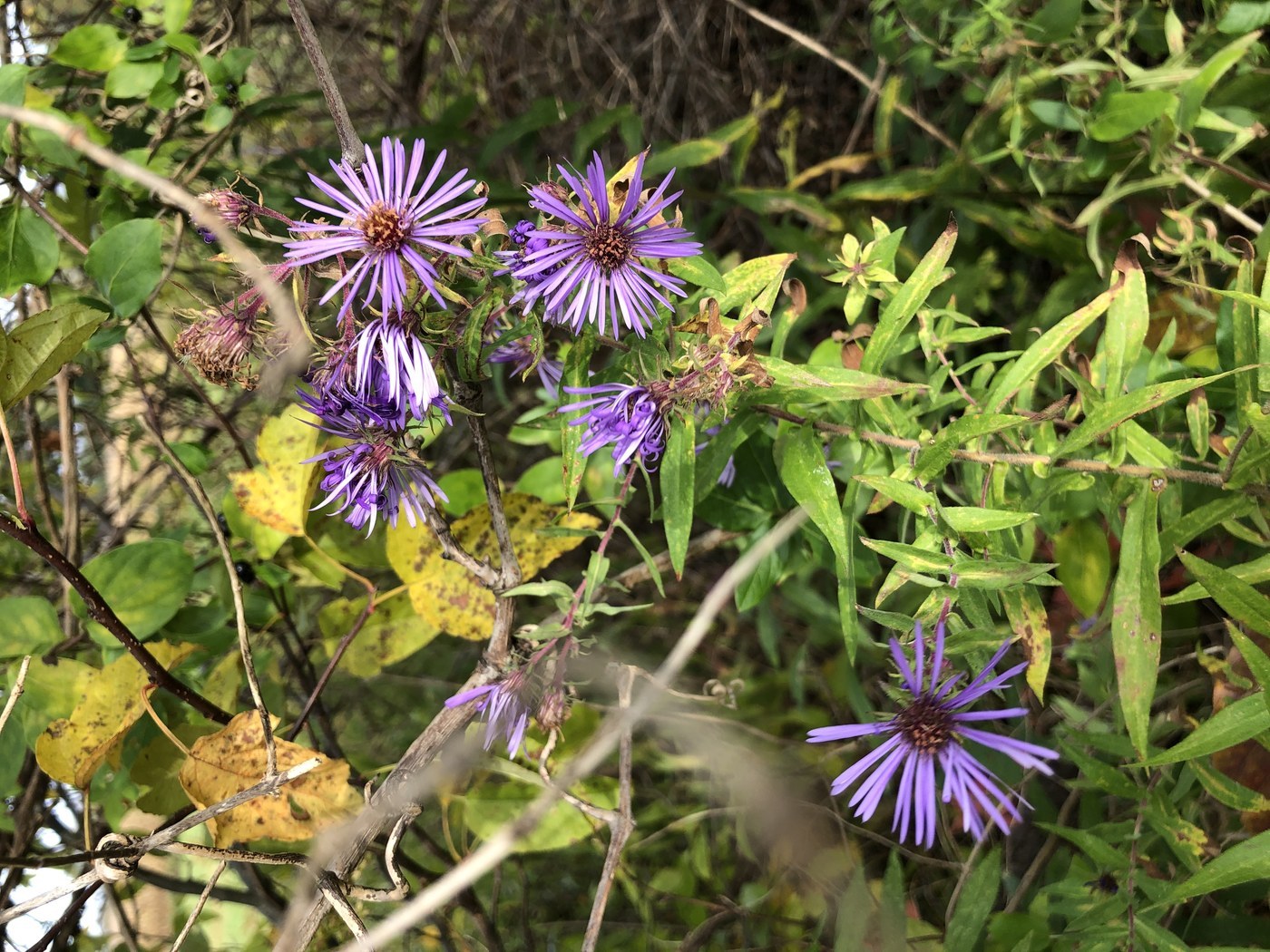
Key Identifying Features
New England Aster (Symphyotrichum novae-angliae) is a robust fall-blooming perennial prized for its showy purple to violet daisy-like flowers with bright yellow centers. Plants are bushy and tall, typically 3 to 6 feet (90 to 180 cm), and bloom heavily in late summer through autumn when many other wildflowers have faded.
- Numerous ray petals (30 to 40+) in rich purple, violet, or magenta-pink
- Yellow center disk turning reddish-purple with age
- Hairy stems and clasping leaves
- A tall, bushy multi-stemmed habit
Leaves & Stems
Stems are stout, hairy, and often branching in the upper portion. The key leaf feature is that they are lance-shaped and clasp the stem with two small lobes (ear-like auricles) at the base, wrapping around it. Leaves are alternate, entire (untoothed), and rough-hairy on both sides. This clasping, hairy leaf base is a strong identification point.
Flowers & Fruit
Flower heads cluster at branch tips in showy masses. Each head has a fringe of many narrow ray florets around a yellow disk. The color is typically a deep purple but ranges to violet, lavender, or rosy-pink. The involucre (base) bracts are sticky-hairy and spreading. Blooming peaks August to October. Fruits are small seeds topped with fluffy bristles (pappus) for wind dispersal.
How to Tell It Apart from Look-Alikes
- New York aster (S. novi-belgii): has smooth stems and leaves and fewer ray petals; New England aster is hairy with clasping leaves.
- Smooth aster (S. laeve): hairless with a waxy bloom on the foliage.
- Other purple asters: usually have fewer rays and non-clasping leaves.
The combination of hairy stems, clasping leaf bases, and 30+ purple rays distinguishes New England aster.
Where You'll Find It
New England Aster grows in moist meadows, prairies, fields, roadsides, and stream edges across eastern and central North America. It favors full sun and damp, fertile soil and is a major fall nectar source for migrating monarch butterflies and late-season bees.
Quick ID Checklist
- 30 to 40+ purple/violet ray petals per flower head
- Yellow center disk
- Hairy stems throughout
- Leaves clasp the stem with ear-like lobes
- Blooms late summer to fall
- Moist sunny meadows and roadsides
Frequently asked questions
How do I tell New England aster from New York aster?
New England aster has hairy stems and leaves that clasp the stem with small ear-like lobes, plus a high count of narrow purple rays. New York aster has smooth, hairless stems and leaves and fewer ray petals.
What color are New England aster flowers?
Most are deep purple to violet, but they can also appear in shades of lavender, magenta, or rosy-pink, always with a bright yellow center that may darken to reddish-purple as it ages.
When does New England aster bloom?
It blooms in late summer through autumn, roughly August to October, making it one of the most important late-season nectar plants for monarch butterflies and bees.
How tall does it get?
It is a tall, bushy perennial, commonly reaching 3 to 6 feet, with multiple branching stems that can flop or be pinched back earlier in the season to keep them more compact.
New England Aster identified by the community
Recent New England Aster specimens identified with Plant Identifier.