
Nordmann Fir Identification Guide
How to identify Nordmann fir (Abies nordmanniana) by its dense, soft, forward-pointing needles that hide the top of the shoot, plus large upright cones. Covers needles, bark, and look-alikes.
Read the full Nordmann Fir encyclopedia entry →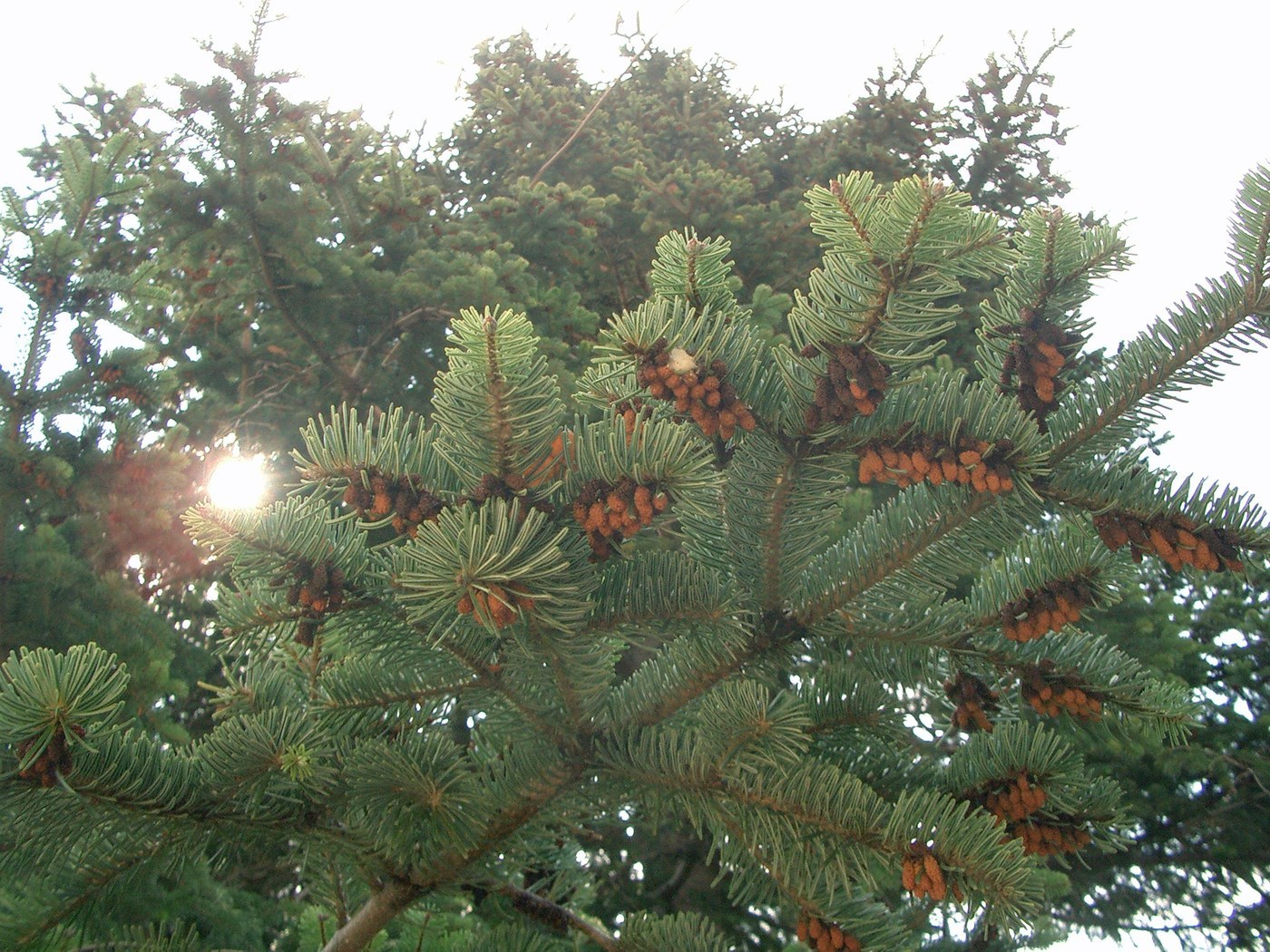
Key Identifying Features
Nordmann fir (Abies nordmanniana), the classic non-drop Christmas tree, is recognized by its dense, soft, glossy dark-green needles that sweep forward and overlap the top of the shoot, hiding it. The foliage feels lush and full, and needles are blunt-tipped and soft to the touch.
- Dense needles covering the top of the shoot (forward-pointing)
- Soft, flexible, blunt or notched dark-green needles
- Two pale (greenish-white) bands beneath each needle
- Large upright cones; conical, well-furnished crown
Leaves & Stems
Needles are 2–3.5 cm long, flattened, glossy deep green above with two narrow whitish bands underneath. A hallmark is their arrangement: rather than parting cleanly, they angle forward and upward to cover the top of the twig, giving dense, brush-like cover from above. Tips are rounded or slightly notched, never prickly, so the foliage is soft to handle. Shoots are pale grey-buff, often minutely hairy, with smooth round leaf scars (no pegs). Buds are reddish-brown and not resinous. Bark is smooth grey when young, becoming fissured into plates with age.
Flowers & Fruit
Cones are large, upright, cylindrical, 10–20 cm long, green ripening reddish-brown, with down-curved exserted bracts projecting between the scales. They sit erect on upper branches and break apart on the tree like all firs. Male cones are small and reddish, clustered under the shoots in spring.
How to Tell It Apart from Look-Alikes
- Silver fir (A. alba): Needles parted to expose the top of the shoot, with brighter white bands; Nordmann's needles cover the top.
- Spruce (Picea): Sharp four-sided needles on woody pegs; hanging cones that fall whole.
- Fraser/balsam fir: Strongly aromatic, more two-ranked needles, smaller cones.
- Grand fir (A. grandis): Needles of clearly unequal lengths in flat combs; strong citrus scent when crushed.
Where You'll Find It
Native to mountains around the eastern Black Sea (Caucasus, northern Turkey, Georgia), forming tall forests. It is now one of the most widely grown premium Christmas trees in Europe and is planted as an ornamental specimen. Look for a symmetrical, densely foliaged conical tree with rich glossy green needles that hold well after cutting.
Quick ID Checklist
- Dense needles sweeping forward over the top of the shoot
- Soft, glossy dark green, blunt or notched needles
- Two pale bands beneath each needle
- Smooth round leaf scars (no pegs)
- Large upright cones that shatter on the tree
- Full, symmetrical conical habit
A soft, glossy, very dense fir whose needles hide the top of the shoot is Nordmann fir.
Frequently asked questions
Why is Nordmann fir so popular as a Christmas tree?
Its soft, glossy needles are not prickly and resist dropping for weeks after cutting, while the dense forward-pointing foliage gives a full, lush appearance.
How do I separate Nordmann fir from silver fir?
Nordmann fir needles angle forward and cover the top of the shoot, with paler bands beneath, whereas silver fir needles part to expose the shoot top and have brighter white undersides.
Are Nordmann fir needles sharp?
No. The needles are soft, flexible, and blunt or slightly notched at the tip, making the foliage pleasant to handle, unlike sharp-needled spruces.
Where is Nordmann fir originally from?
It is native to the mountains around the eastern Black Sea, including the Caucasus, northern Turkey, and Georgia.