
Norway Spruce Identification Guide
Identify Norway spruce by its long hanging cones, sharp four-sided needles on woody pegs, and drooping branchlets.
Read the full Norway Spruce encyclopedia entry →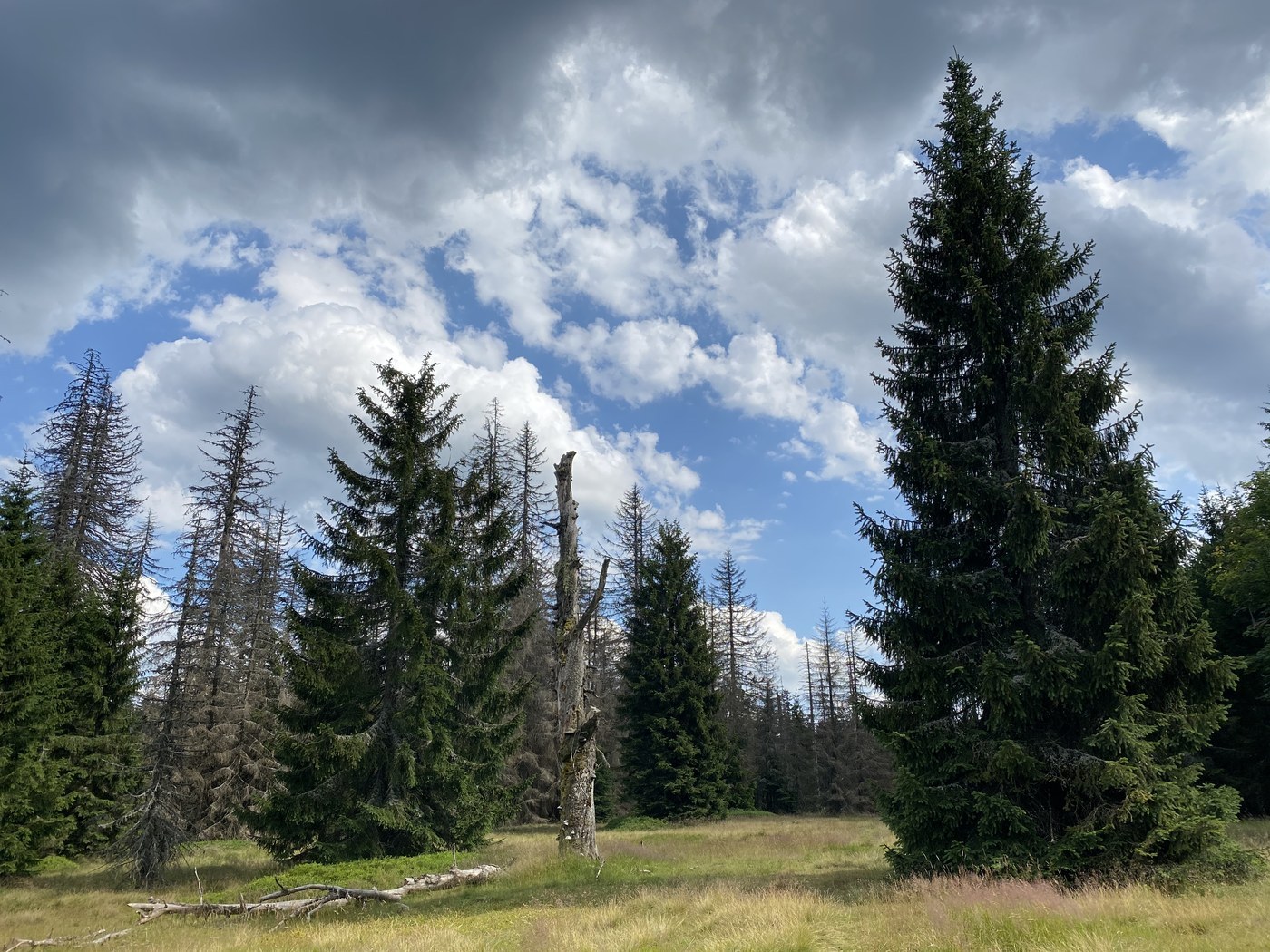
Key Identifying Features
Norway spruce (Picea abies) is a fast-growing European conifer widely planted for timber, windbreaks, and Christmas trees, and easily recognized by the longest cones of any spruce.
- Long, cylindrical, hanging cones (10-18 cm), the longest of any spruce
- Stiff, sharp, four-sided needles set singly on small woody pegs
- Branches with conspicuously drooping side branchlets (curtain-like)
- Reddish-brown twigs and a tall, conical crown
Leaves & Stems
Needles are dark green, stiff, four-sided (square in cross-section, so they roll between the fingers), sharp-pointed, and 1-2.5 cm long, attached individually all around the twig on tiny raised woody pegs (sterigmata). When a needle drops it leaves the peg, making old twigs feel rough and bumpy. Each needle has faint white stomatal lines on all sides.
Twigs are reddish-brown to orange-brown and usually hairless. The tree forms a tall, narrowly conical crown, and mature trees develop a distinctive habit of long main branches that arch out while their secondary branchlets hang straight down in curtains. Bark is thin, coppery to gray-brown, flaking into small rounded scales.
Flowers & Fruit
Norway spruce bears small reddish pollen and seed cones in spring. The mature seed cones are long, narrow, cylindrical, 10-18 cm, light brown, and hang down from the upper branches, with thin, stiff, irregularly toothed scales. They mature in a single season and release winged seeds, often dropping intact (unlike fir cones).
How to Tell It Apart from Look-Alikes
- Other spruces (white, blue, Serbian): All have shorter cones; Norway's very long hanging cones are unique among common spruces.
- Firs (Abies): Have flat, soft needles that leave round flat scars and upright cones that disintegrate.
- Pines: Bear needles in bundles of 2-5, not singly.
- Hemlock: Soft flat needles and tiny cones.
Long pendulous cones plus sharp square needles on pegs plus drooping branchlets confirm Norway spruce.
Where You'll Find It
Native to the mountains of central and northern Europe, and extensively planted across temperate North America and Europe in plantations, shelterbelts, parks, and large gardens. It tolerates cold and a range of soils and is a common ornamental and Christmas tree.
Quick ID Checklist
- Long cylindrical hanging cones, 10-18 cm
- Stiff, sharp, four-sided needles that roll in the fingers
- Needles on small woody pegs; rough twigs when shed
- Drooping curtain-like secondary branchlets
- Reddish-brown twigs, conical crown
Frequently asked questions
What is the easiest way to identify Norway spruce?
The long, narrow, hanging cones (up to 18 cm) are the longest of any spruce and immediately distinguish it from other spruces.
How do I know a needle belongs to a spruce, not a fir?
Spruce needles are stiff, sharp, and four-sided so they roll between your fingers and sit on tiny woody pegs, while fir needles are flat and soft and leave smooth round scars.
Why do the branches look like they have curtains?
Mature Norway spruce develops long main branches whose secondary branchlets hang straight down, creating a draped, curtain-like appearance.
Is Norway spruce native to North America?
No, it is native to Europe but has been very widely planted in North America for timber, windbreaks, ornamentals, and Christmas trees.