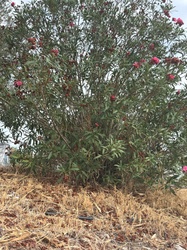
Oleander Identification Guide
Identify Oleander (Nerium oleander) by its narrow leathery whorled leaves, showy clusters of five-petaled flowers, and milky sap.
Read the full Oleander encyclopedia entry →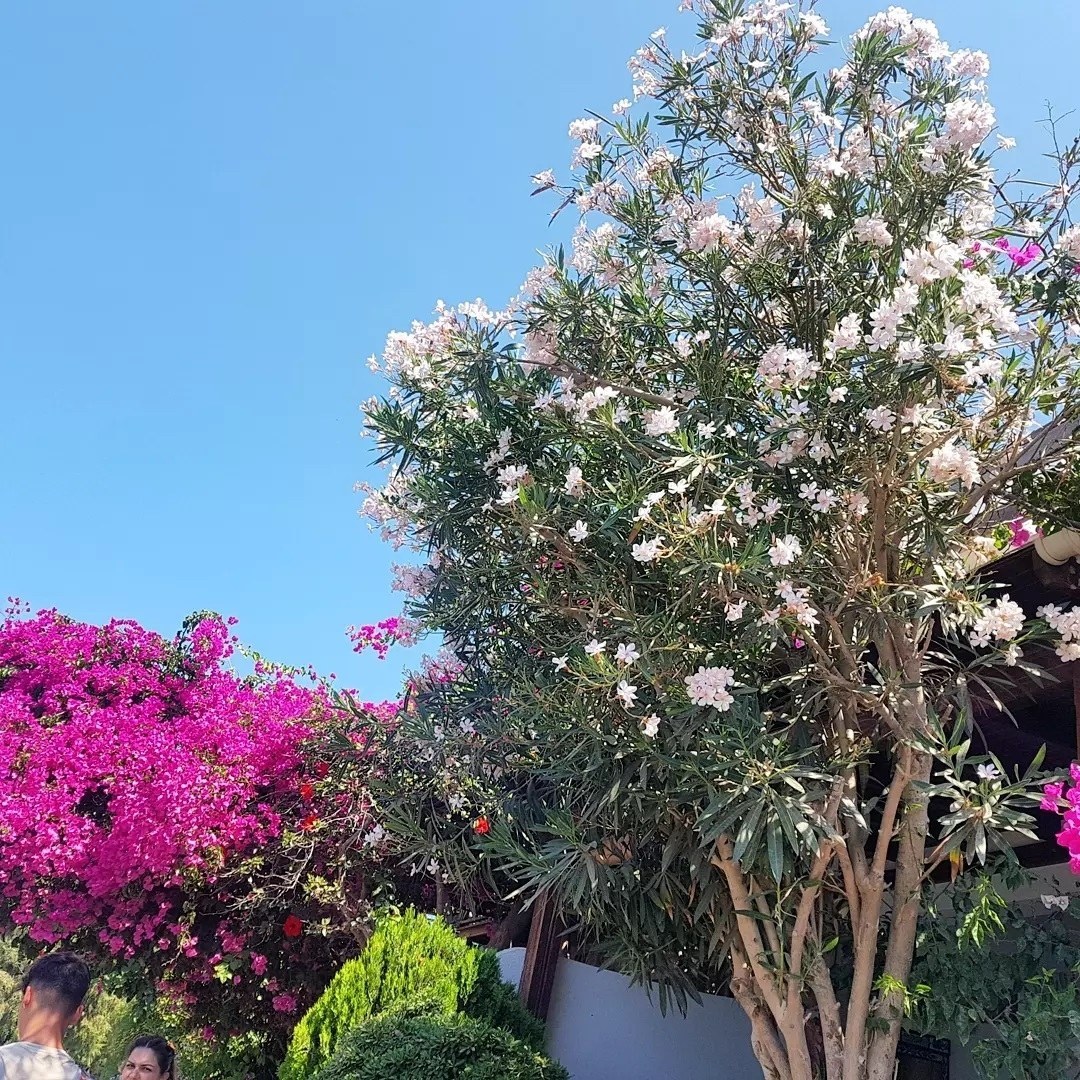
Key Identifying Features
Oleander (Nerium oleander) is a large evergreen shrub in the dogbane family (Apocynaceae). It is recognized by its long, narrow, leathery leaves arranged in whorls of three, showy clusters of funnel-shaped five-petaled flowers in white, pink, red, or salmon, and milky sap.
- Large evergreen shrub, commonly 6–12 ft (to 20 ft) tall, multi-stemmed
- Narrow, lance-shaped leaves in whorls of three
- Clustered, often fragrant, funnel-shaped flowers all summer
- Milky sap
Leaves & Stems
Leaves are narrow, lance-shaped (linear-lanceolate), 4–8 in long, thick, leathery, and dark green with a prominent pale midrib and many fine, parallel side veins. They are typically arranged in whorls of three (sometimes opposite) around the stem. Stems are upright, gray-green, and exude clear-to-milky latex sap when cut. The overall look is vase-shaped to rounded.
Flowers & Fruit
Flowers are showy, 1–2 in across, with five (often slightly twisted, pinwheel-like) spreading petals and a fringed central throat, borne in dense clusters at the branch tips. Colors include white, pink, red, salmon, and apricot; double-flowered forms exist, and some are fragrant. Bloom is long, from late spring through fall in warm climates. Fruit is a long, narrow paired seed pod (follicle) that splits to release fluffy, plumed seeds.
How to Tell It Apart from Look-Alikes
- Desert willow (Chilopsis): Has similar narrow leaves and trumpet flowers, but is deciduous with orchid-like flowers and lacks milky sap and the whorled-three leaf pattern.
- Willow (Salix): Similar narrow leaves but alternate, with catkin flowers, not showy clusters.
- Yellow oleander (Cascabela/Thevetia): Related, with yellow funnel flowers and broader-tipped narrow leaves.
The whorls of three narrow leathery leaves + clustered five-petaled funnel flowers + milky sap combination is diagnostic.
Where You'll Find It
Native to the Mediterranean region and southwest Asia; ubiquitous in warm climates (USDA zones 8–11) along highways, freeway medians, coastal gardens, and as screening hedges, thanks to its heat, drought, and salt tolerance.
Quick ID Checklist
- Large evergreen multi-stemmed shrub
- Narrow, leathery, dark-green leaves in whorls of three
- Prominent pale midrib; fine parallel veins
- Milky sap when stems or leaves are cut
- Clusters of five-petaled funnel flowers (white/pink/red), long bloom
- Long paired seed pods with plumed seeds
Frequently asked questions
How are oleander leaves arranged?
The narrow, leathery, lance-shaped leaves are usually arranged in whorls of three around the stem, a key identifying trait.
What color are oleander flowers?
They come in white, pink, red, salmon, and apricot, in clusters of funnel-shaped five-petaled flowers that bloom from late spring through fall.
Does oleander have milky sap?
Yes, cut stems and leaves exude a clear-to-milky latex sap, consistent with its membership in the dogbane family.
What is the quickest way to recognize oleander?
Look for narrow leathery leaves in whorls of three with a prominent pale midrib, milky sap when cut, and dense terminal clusters of five-petaled funnel-shaped flowers on a large multi-stemmed evergreen shrub.
Oleander identified by the community
Recent Oleander specimens identified with Plant Identifier.