
Orchid Tree Identification Guide
How to identify the Orchid Tree (Bauhinia) by its distinctive two-lobed butterfly leaves, orchid-like flowers, and flat woody seed pods.
Read the full Orchid Tree encyclopedia entry →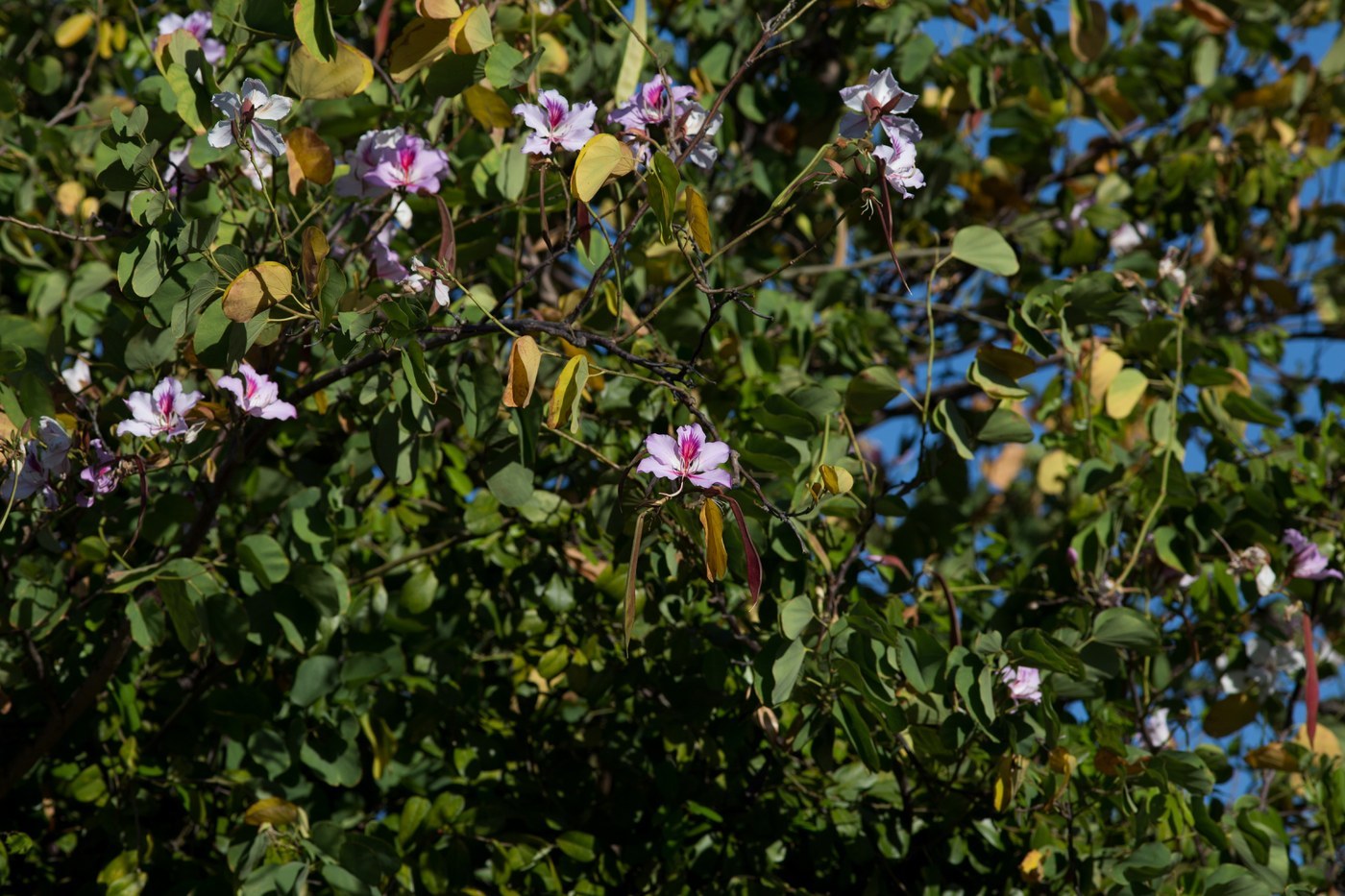
Key Identifying Features
Orchid Trees (Bauhinia species, especially Bauhinia variegata and B. × blakeana, the Hong Kong orchid tree) are tropical and subtropical trees known for two unmistakable traits: distinctive bilobed 'butterfly' leaves and large, fragrant, orchid-like flowers.
- Two-lobed leaves shaped like a butterfly, camel's hoof, or cloven heart
- Showy five-petaled flowers in pink, purple, magenta, or white
- Flat, woody, bean-like seed pods (in seed-bearing species)
- Small-to-medium tree, 5-12 m tall, with a spreading crown
Leaves & Stems
The leaf is the most reliable feature year-round. Each leaf is rounded and deeply notched at the tip, splitting into two rounded lobes — resembling a butterfly's wings or a camel's footprint. Leaves are 5-15 cm wide, with prominent palmate veins, green and smooth, arranged alternately. This bilobed shape is shared across all Bauhinia and is the genus's signature.
The tree is often briefly deciduous in the dry/cool season. Bark is gray-brown and smooth to slightly fissured; branches spread and can be somewhat zigzag.
Flowers & Fruit
- Flowers are large (7-12 cm wide), fragrant, and orchid-like, with five spreading petals of unequal size — one upper petal usually streaked or darker. Colors range from pink and magenta to purple, lavender, or white, often with contrasting veins. B. variegata blooms in late winter/spring; the sterile hybrid B. × blakeana flowers heavily for months.
- Fruit (absent in the sterile Hong Kong orchid tree) is a long, flat, woody, bean-like pod 15-30 cm long that dries brown and splits to fling out hard seeds.
How to Tell It Apart from Look-Alikes
- Redbud (Cercis) has rounded heart-shaped leaves but they are not split into two lobes, and its flowers are small pea-flowers on bare twigs.
- Royal Poinciana / Jacaranda have fern-like compound leaves — completely unlike the simple butterfly leaf.
- The bilobed butterfly leaf is essentially unique to Bauhinia among ornamental trees; combined with the orchid-like flowers it confirms the ID immediately.
Where You'll Find It
Native to tropical Asia and parts of Africa, orchid trees are planted worldwide as ornamental street and garden trees in frost-free and mild climates — common in southern California, Florida, Hawaii, India, southern China, and Southeast Asia. The Hong Kong orchid tree is the floral emblem of Hong Kong.
Quick ID Checklist
- Two-lobed butterfly/camel-hoof leaves with palmate veins
- Large orchid-like five-petaled flowers (pink, purple, magenta, or white)
- Flat woody bean-like pods (in fertile species)
- Spreading crown, small-to-medium tree
- Often briefly leafless when flowering
Frequently asked questions
Why are the leaves shaped like a butterfly?
All Bauhinia species have a leaf deeply notched at the tip into two rounded lobes, which can look like butterfly wings or a camel's split hoof. This distinctive bilobed shape is the genus's most reliable identification feature.
Is the orchid tree actually related to orchids?
No. It is a member of the legume family (Fabaceae) and produces bean pods. The name comes only from the orchid-like appearance and fragrance of its showy five-petaled flowers.
Why does my orchid tree never set seed pods?
It is likely Bauhinia × blakeana, the Hong Kong orchid tree, which is a sterile hybrid propagated by cuttings. It blooms profusely for months but produces no pods, unlike fertile species such as B. variegata.
When do orchid trees bloom?
Bauhinia variegata typically flowers in late winter and spring, often on nearly bare branches, while the sterile Hong Kong hybrid can flower for much of the cool season, from autumn into spring.