
Pentas Identification Guide
Identify Pentas (Egyptian star cluster) by its domed clusters of five-pointed star flowers and fuzzy, prominently veined leaves.
Read the full Pentas encyclopedia entry →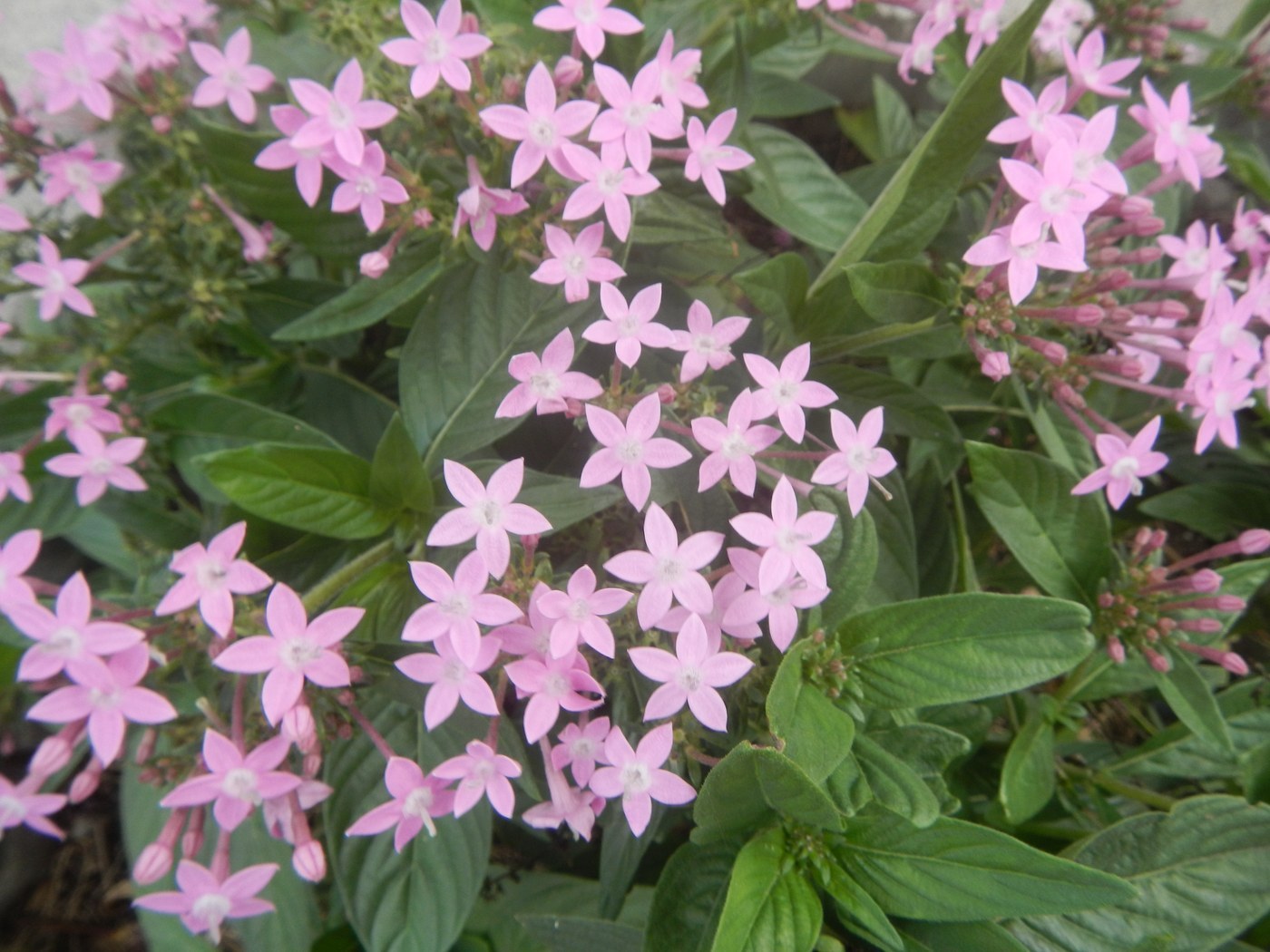
Key Identifying Features
Pentas (Pentas lanceolata), also called Egyptian star cluster, is a tender perennial grown as a warm-season annual and prized by butterflies and hummingbirds. Its name comes from the Greek pente (five), referring to the five-pointed star shape of every flower.
- Bushy, upright habit, 12-36 in (30-90 cm) tall
- Flowers grouped in rounded, domed clusters at stem tips
- Each flower is a slender tube opening into five pointed star-like lobes
- Colors: red, pink, lavender, magenta, and white
- Blooms continuously through heat and humidity
Leaves & Stems
Leaves are opposite, lance-shaped to oval, 2-6 in long, with a distinctly fuzzy texture and deeply impressed (quilted) veins that give a slightly puckered, hairy surface. They are medium to dark green. Stems are upright, somewhat hairy, and branching, becoming woody at the base on older plants. The prominent veining and soft hair are good supporting ID clues.
Flowers & Fruit
Each flower is a narrow corolla tube flaring into five sharply pointed lobes, arranged in dense flat-topped to domed clusters (cymes) of 20 or more. The star shape is consistent and easy to see. Pentas is in the madder/coffee family (Rubiaceae), sharing the opposite leaves and tubular flowers of that group. Fruits are small capsules, rarely conspicuous in cultivation.
How to Tell It Apart from Look-Alikes
- Lantana: also forms rounded flower clusters loved by butterflies, but lantana flowers are tiny four-lobed tubes in multicolor heads with rough, pungent aromatic leaves; pentas flowers are clearly five-pointed stars with fuzzy quilted leaves.
- Verbena: clustered too, but with five flat lobes and a different leaf texture.
- Phlox: five-petaled flowers, but petals are rounded, not star-pointed, and the cluster form differs.
- The five-pointed star tubular flowers in domed clusters + fuzzy deeply veined opposite leaves confirm pentas.
Where You'll Find It
Pentas is a top pollinator and container plant for sunny, hot beds, patios, and butterfly gardens, especially in warm and subtropical regions where it can be perennial. It thrives in heat and humidity, blooming nonstop from late spring to frost. You'll see it massed in summer borders and in nectar gardens designed to attract butterflies and hummingbirds.
Quick ID Checklist
- Bushy upright annual with domed flower clusters
- Flowers are tubular, opening into five pointed star lobes
- Red, pink, lavender, magenta, or white blooms
- Opposite, fuzzy leaves with deeply impressed quilted veins
- Magnet for butterflies and hummingbirds
- Blooms steadily through summer heat
Frequently asked questions
Why is pentas shaped like a star?
Each flower is a narrow tube that flares into five sharply pointed lobes, creating a five-pointed star. The genus name Pentas (from Greek for 'five') refers directly to this shape.
How do I tell pentas from lantana?
Both attract butterflies with rounded flower clusters, but lantana flowers are tiny four-lobed tubes and its leaves are rough and pungent. Pentas flowers are five-pointed stars and its leaves are soft, fuzzy, and deeply veined.
Is pentas an annual or a perennial?
It is a tender perennial, grown as a warm-season annual in cooler climates but living for years in frost-free subtropical and tropical regions.
What pollinators does pentas attract?
Its nectar-rich star flowers are a strong magnet for butterflies and hummingbirds, so finding it surrounded by pollinators is a good supporting clue to its identity.