
Periwinkle Identification Guide
Identify periwinkle (Vinca) by its trailing evergreen stems, glossy opposite leaves, and five-lobed pinwheel flowers in blue-violet. Includes how to separate Vinca minor from Vinca major.
Read the full Periwinkle encyclopedia entry →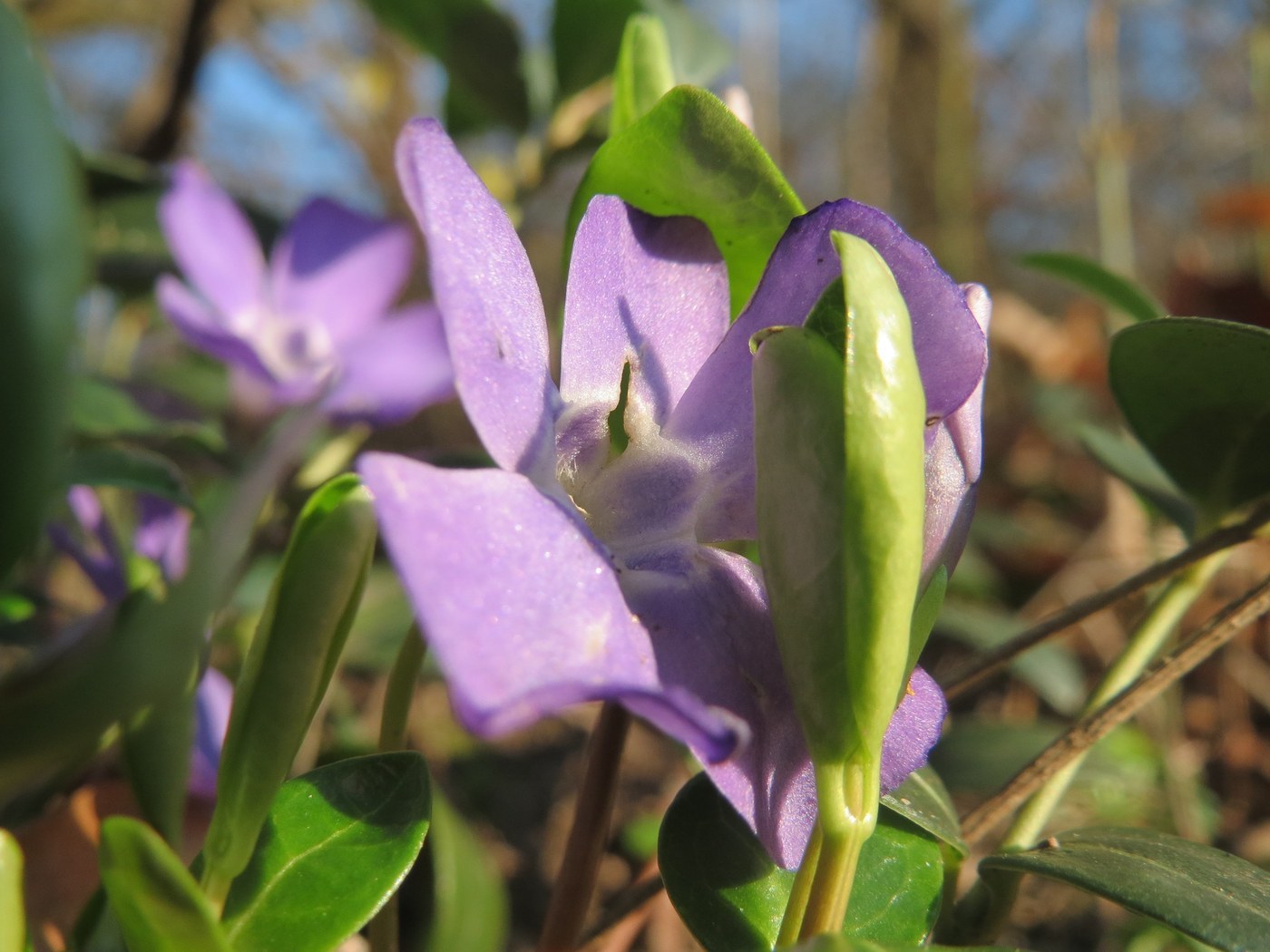
Key Identifying Features
Periwinkle (genus Vinca) is a trailing evergreen groundcover with glossy leaves and distinctive pinwheel-shaped, five-lobed blue-violet flowers. It forms dense mats that carpet shady ground.
- 5 flat petal lobes arranged like a pinwheel (asymmetrically angled), not rounded
- A small pale, often white, star at the throat
- Classic 'periwinkle' blue-violet color (also white or pale forms)
- Trailing, mat-forming evergreen habit
Leaves & Stems
Leaves are opposite, simple, oval, glossy dark green, and untoothed (entire), often with a leathery feel. Stems trail along the ground and root where nodes touch soil, letting the plant spread widely. Cut stems exude a milky sap (it is in the dogbane family, Apocynaceae). Vinca minor has small leaves (1-2 in) and stems hugging the ground; Vinca major is larger and coarser with bigger leaves and flowers and more upright trailing stems.
Flowers & Fruit
Flowers are borne singly in leaf axils on short upright stalks. Each is a flat tube flaring into 5 lobes, the lobes set at a slight angle giving the signature pinwheel/propeller look. Bloom peaks in spring with scattered flowers into summer. Fruit (paired slender follicles) is rarely conspicuous as the plant spreads mainly by stems.
How to Tell It Apart from Look-Alikes
- Annual vinca (Catharanthus roseus, Madagascar periwinkle): similar 5-lobed flowers but is an upright bushy heat-loving annual with pink/white flat-faced flowers, not a trailing evergreen.
- Myrtle/other groundcovers: Vinca's glossy opposite leaves, milky sap, and pinwheel blue flowers are distinctive.
- Bigleaf vs common periwinkle: large leaves and flowers = Vinca major; small neat mat = Vinca minor.
- Trailing evergreen mat + glossy opposite leaves + pinwheel violet flowers + milky sap confirms periwinkle.
Where You'll Find It
Periwinkle is widely planted as a shade groundcover under trees, on slopes, and in borders. It tolerates dry shade and spreads vigorously—often escaping into woodlands where it is considered invasive in parts of North America. It stays green through winter in mild climates.
Quick ID Checklist
- Trailing evergreen mat that roots at nodes
- Glossy, opposite, untoothed leaves
- Pinwheel 5-lobed blue-violet flowers
- Pale star at the flower throat
- Milky sap in cut stems
- Thrives in shade
A shade-carpeting evergreen with glossy paired leaves and angled pinwheel violet flowers is periwinkle (Vinca).
Frequently asked questions
What is the difference between Vinca minor and Vinca major?
Vinca minor is a small-leaved, ground-hugging mat, while Vinca major has larger, coarser leaves and bigger flowers with more upright trailing stems.
Is Madagascar periwinkle the same plant?
No. Madagascar periwinkle (Catharanthus roseus) is an upright heat-loving annual; true periwinkle (Vinca) is a trailing evergreen groundcover, though both have five-lobed flowers.
Why is periwinkle considered invasive?
Its trailing stems root wherever they touch soil, forming dense mats that spread aggressively and can crowd out native plants in woodlands.
Does periwinkle have milky sap?
Yes. As a member of the dogbane family, cut Vinca stems release a milky latex sap, a helpful identifying feature.