
Persian Ironwood Identification Guide
Recognize Parrotia persica by its spectacular flaking camouflage bark, tiny red spider-like late-winter flowers, witch-hazel-like leaves, and brilliant multicolored fall foliage.
Read the full Persian Ironwood encyclopedia entry →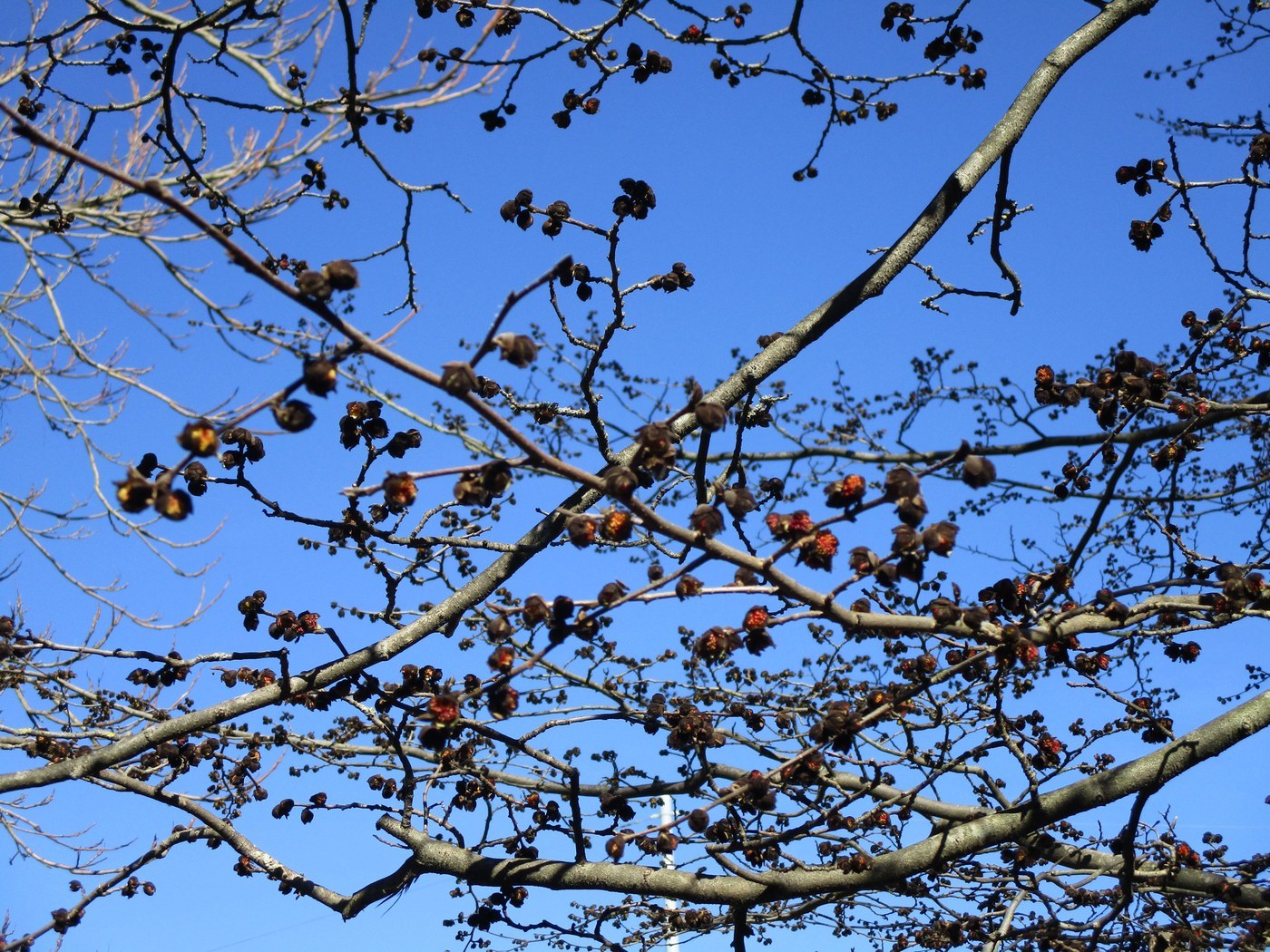
Key Identifying Features
Persian ironwood (Parrotia persica), a member of the witch-hazel family, is a slow-growing small tree celebrated for bark and autumn color. Identify it by:
- Stunning exfoliating bark that flakes in patches of gray, green, tan, and cinnamon-brown, like a sycamore in miniature
- Tiny petal-less flowers with tufts of red stamens on bare branches in late winter/early spring
- Wavy-edged, oval leaves resembling witch hazel, turning vivid yellow, orange, red, and purple in fall
- A wide-spreading, often multi-stemmed, rounded form
Leaves & Stems
Leaves are alternate, simple, obovate to oval, 2.5-5 inches long, with wavy, shallowly toothed margins toward the tip and a slightly lopsided base — very like its relative witch hazel. They emerge reddish-purple, mature to glossy dark green, and finish the year in a dramatic mix of yellow, orange, scarlet, and burgundy, often on the same branch.
The bark is the headline feature: smooth gray when young, it begins to flake away in irregular plates on older trunks, exposing a mosaic of pale green, cream, tan, and brown. Stems are often zigzag and the tree typically branches low into a broad, layered crown.
Flowers & Fruit
Flowers appear before the leaves, in February-March, and are small and easy to overlook: they lack petals and consist of dense clusters of maroon-red stamens emerging from brown furry bud scales, dotting the bare twigs with a reddish haze. Fruit is a small, inconspicuous woody two-beaked capsule, not ornamental.
How to Tell It Apart from Look-Alikes
- Witch hazel (Hamamelis): very similar leaves but flowers have strappy yellow, orange, or red petals, and witch hazel is a shrub without the spectacular flaking bark.
- Sycamore/plane tree (Platanus): also has camouflage exfoliating bark but bears large maple-like lobed leaves and round seed balls — completely different foliage.
- Stewartia: similar mottled bark but has white camellia-like summer flowers.
The mosaic flaking bark + witch-hazel-shaped wavy leaves + petal-less red-stamen winter flowers combination is unique to Parrotia.
Where You'll Find It
Native to the Alborz mountains and Caspian forests of Iran (Persia) and the Caucasus, Persian ironwood is planted as a specimen tree in USDA zones 4-8 in gardens, arboreta, and parks across temperate regions. It tolerates a range of soils and is largely pest-free. You will encounter it as a deliberately planted ornamental, prized for four-season interest.
Quick ID Checklist
- Slow-growing, wide, often multi-stemmed small tree
- Patchwork exfoliating bark (gray, green, tan, brown)
- Wavy-margined oval leaves like witch hazel
- Petal-less flowers with red stamen tufts on bare twigs in late winter
- Spectacular multicolored fall foliage
- Small woody two-beaked seed capsules
A broad small tree with sycamore-like camouflage bark, witch-hazel leaves blazing in autumn, and reddish stamen-flowers in late winter is Persian ironwood.
Frequently asked questions
Why is it called ironwood?
The wood is exceptionally hard and dense, hence the common name. The genus Parrotia honors the naturalist F. W. Parrot, and 'persica' refers to its native range in Persia (Iran).
How do I distinguish Persian ironwood from witch hazel?
Their leaves look nearly identical, but Persian ironwood is a tree with showy flaking mosaic bark and petal-less flowers of red stamens, while witch hazel is a shrub with smooth bark and flowers bearing distinctive strappy ribbon-like petals.
What makes the bark look like a sycamore's?
On older trunks the outer bark exfoliates in irregular plates, revealing patches of green, gray, cream, and brown underneath, creating a camouflage mosaic similar to a plane tree but on a smaller, finer scale.
When does it flower and is it showy?
It flowers in late winter to early spring before the leaves, but the flowers are small and subtle, made of clusters of maroon-red stamens with no petals. The real ornamental show comes from the bark and the brilliant fall color.