
Phlox Identification Guide
Identify phlox by its clusters of five-petaled, flat-faced tubular flowers, opposite untoothed leaves, and the contrast between tall garden phlox and low creeping types.
Read the full Phlox encyclopedia entry →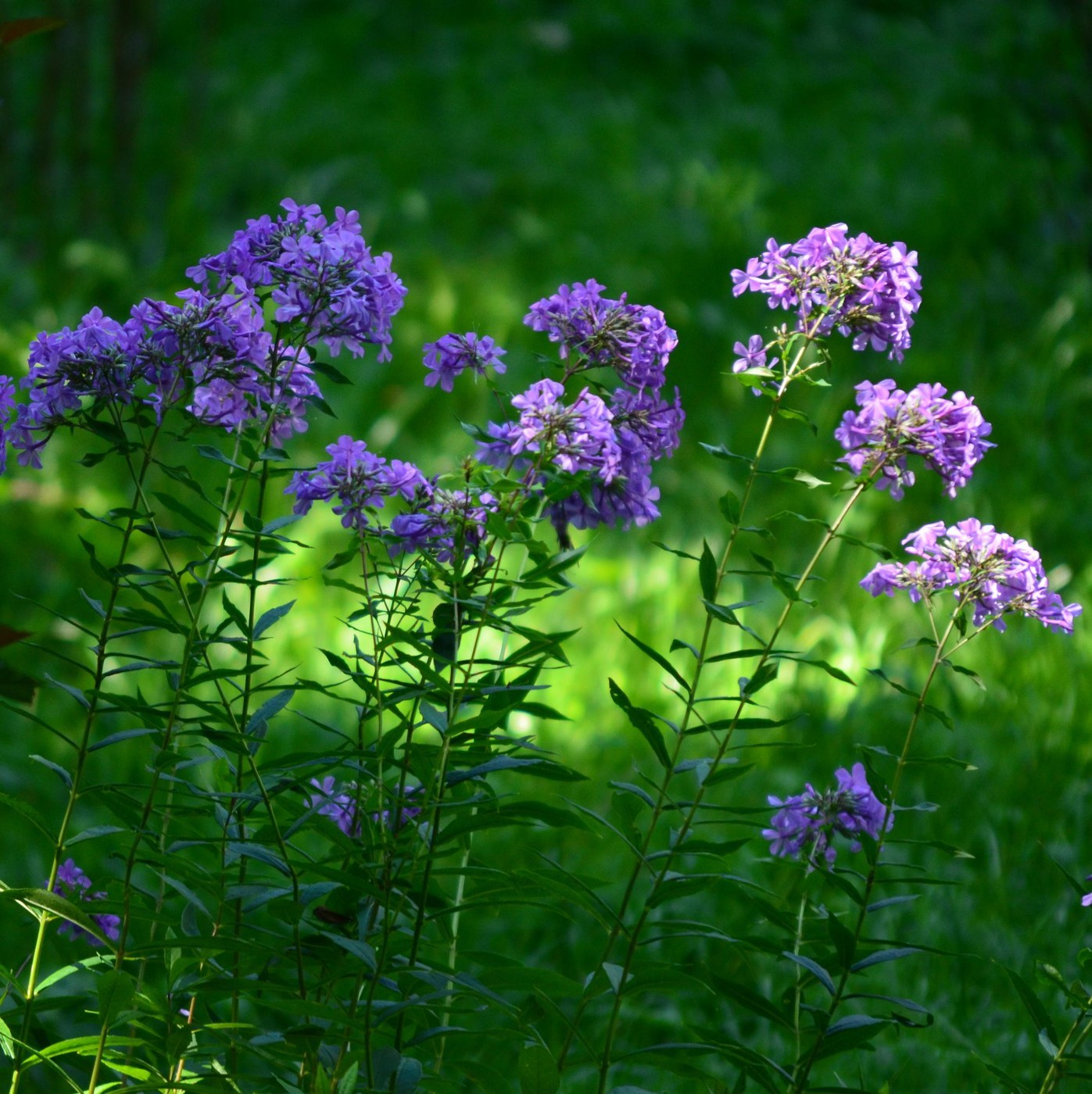
Key Identifying Features
Phlox are North American perennials and annuals grown for showy clusters of fragrant, flat-faced flowers. The flowers have a distinctive form: a slender tube opening abruptly into 5 flat petal lobes, like a small pinwheel.
- 5 flat, slightly notched or rounded petals spreading from a narrow tube
- Flowers in rounded or dome-shaped clusters
- Colors: pink, magenta, lavender, blue, white, often with a contrasting eye
- Many are fragrant, especially in the evening
Leaves & Stems
Leaves are opposite (paired), simple, lance-shaped to narrow, and untoothed (entire margins). Tall garden phlox (Phlox paniculata) is upright (2-4 ft) with broad leaves and large terminal flower clusters in summer. Creeping/moss phlox (Phlox subulata) is a low mat with needle-like leaves that blankets the ground in spring color. Woodland phlox (P. divaricata) is intermediate and spring-blooming.
Flowers & Fruit
Each flower's petals join into a long thin tube where nectar collects—so phlox is favored by butterflies and long-tongued moths. The fruit is a small capsule. Garden phlox often shows a small central eye in a contrasting color where the lobes meet the tube.
How to Tell It Apart from Look-Alikes
- Dianthus (pinks): similar five-petal pink flowers, but dianthus petals are usually fringed/toothed and leaves are grassy and grayish; phlox petals are smooth-edged and tube longer.
- Verbena: clustered small flowers too, but verbena has toothed leaves and square stems; phlox has untoothed opposite leaves and round stems.
- Impatiens/vinca: flat 5-part flowers but different leaf and habit.
- Flat 5-lobed flowers from a long tube + opposite untoothed leaves identify phlox.
Where You'll Find It
Phlox grow in borders, rock gardens, slopes, and woodland gardens, and wild species occur in prairies, open woods, and rocky banks across North America. Creeping phlox is a classic spring groundcover spilling over walls; tall phlox is a summer border staple. They prefer sun to part shade and moist, well-drained soil.
Quick ID Checklist
- 5 flat petals from a slender tube (pinwheel look)
- Flowers in rounded clusters
- Opposite, untoothed leaves
- Often fragrant, with a contrasting eye
- Tall upright OR low creeping mat forms
- Pink, lavender, blue, or white
Clusters of flat five-lobed flowers flaring from a narrow tube above paired smooth-edged leaves are the mark of phlox.
Frequently asked questions
What is the difference between creeping phlox and garden phlox?
Creeping phlox (Phlox subulata) is a low spring-blooming mat with needle-like leaves, while garden phlox (Phlox paniculata) is an upright summer perennial with broad leaves and large flower clusters.
How do I tell phlox from dianthus?
Phlox petals are smooth-edged and emerge from a long tube with untoothed opposite leaves, while dianthus has fringed petals and grassy grayish foliage.
Is phlox fragrant?
Many phlox, especially tall garden phlox, are fragrant, often most noticeably in the evening, which helps attract moth and butterfly pollinators.
What pollinates phlox?
Because nectar sits at the base of a long narrow floral tube, phlox is mainly pollinated by butterflies and long-tongued moths able to reach it.