
Pignut Hickory Identification Guide
How to identify Pignut Hickory (Carya glabra) by its tight gray bark, 5-7 smooth leaflets, brown buds, and distinctive pear-shaped nuts.
Read the full Pignut Hickory encyclopedia entry →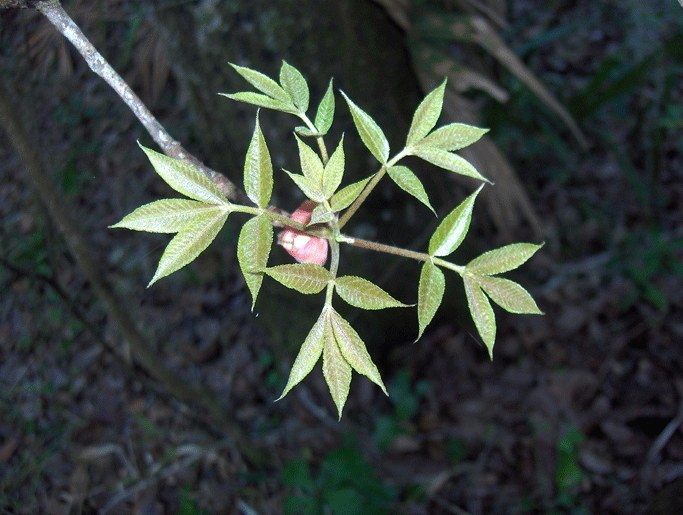
Key Identifying Features
Pignut Hickory (Carya glabra) is a common upland tree of dry eastern forests, growing 50-80 feet tall with a tall, straight trunk. Its common name reflects an old association with pigs that rooted beneath the trees. Two combined features identify it: tight, gray bark with shallow, criss-crossing (diamond-patterned) ridges that does not peel in shaggy strips, and a distinctly pear- or pumpkin-shaped husk that splits only partway down.
- Tight gray bark with interlacing diamond ridges
- Compound leaves with 5 (sometimes 7) smooth leaflets
- Small pear-shaped husked nut, thin husk
Leaves & Stems
Leaves are pinnately compound, 8-12 inches long, usually with 5 leaflets (occasionally 7). The terminal three leaflets are notably larger than the lower pair. Leaflets are lance-shaped to oblong, finely toothed, and smooth and nearly hairless (the species name glabra means smooth/hairless), shiny dark green above and paler below. Fall color is golden yellow.
Twigs are slender, reddish-brown, and hairless. The terminal buds are brown, ovoid, and small to medium — not yellow (bitternut) and not large and fuzzy (mockernut). This bud size and smoothness help separate it from its relatives.
Flowers & Fruit
Greenish male catkins dangle in spring in branched clusters; female flowers are tiny spikes at twig tips. The fruit is a small, pear-shaped (obovoid) nut, often with a slight neck at the base where the husk narrows. The thin husk is smooth, splits only halfway or stays partly closed, and the nut shell is unwinged with a small kernel.
How to Tell It Apart from Look-Alikes
- Bitternut hickory: yellow buds and 7-11 leaflets; pignut has brown buds and 5-7.
- Shagbark hickory: shaggy peeling bark and large buds; pignut bark is tight and ridged.
- Mockernut hickory: large fuzzy buds, densely hairy leaves, thick husk; pignut leaves are smooth and the husk is thin.
- Black walnut / butternut: chambered pith and far more leaflets; hickories have solid pith.
The combination of tight diamond-patterned bark, smooth 5-leaflet leaves, and a thin pear-shaped husk pins down pignut.
Where You'll Find It
Pignut Hickory thrives on dry ridges, upland slopes, and well-drained hillsides in oak-hickory forests across the eastern United States, from New England and southern Ontario south to Florida and west to the Mississippi Valley and eastern Texas. It is a classic component of dry upland hardwood stands and is more drought-tolerant than the bottomland hickories.
Quick ID Checklist
- Tight gray bark with shallow interlacing diamond ridges (not shaggy)
- 5-7 smooth, hairless leaflets per leaf
- Brown terminal buds (not yellow, not large/fuzzy)
- Pear-shaped, thin-husked nut splitting only partway
- Dry upland slopes and ridges in oak-hickory forest
Frequently asked questions
How do I distinguish pignut from shagbark hickory?
Bark is the quickest tell: shagbark peels in long, loose vertical strips, while pignut bark stays tight with shallow diamond-shaped ridges. Pignut also has fewer, smaller buds and a thinner husk.
Why is it called pignut?
The common name comes from an old association with pigs that historically rooted beneath these upland trees; it has nothing to do with the tree's appearance.
How many leaflets does pignut hickory have?
Typically 5, sometimes 7 — fewer than bitternut hickory, and the leaflets are smooth and hairless, matching the species name glabra.
What shape is the pignut hickory husk?
The husk is distinctly pear- or pumpkin-shaped, often with a slight neck at the base, thin-walled, and splits only partway down rather than opening fully.