
Pink Princess Philodendron Identification Guide
Identify the Pink Princess Philodendron (Philodendron erubescens 'Pink Princess') by its dark olive-to-black leaves splashed with bubblegum-pink variegation.
Read the full Pink Princess Philodendron encyclopedia entry →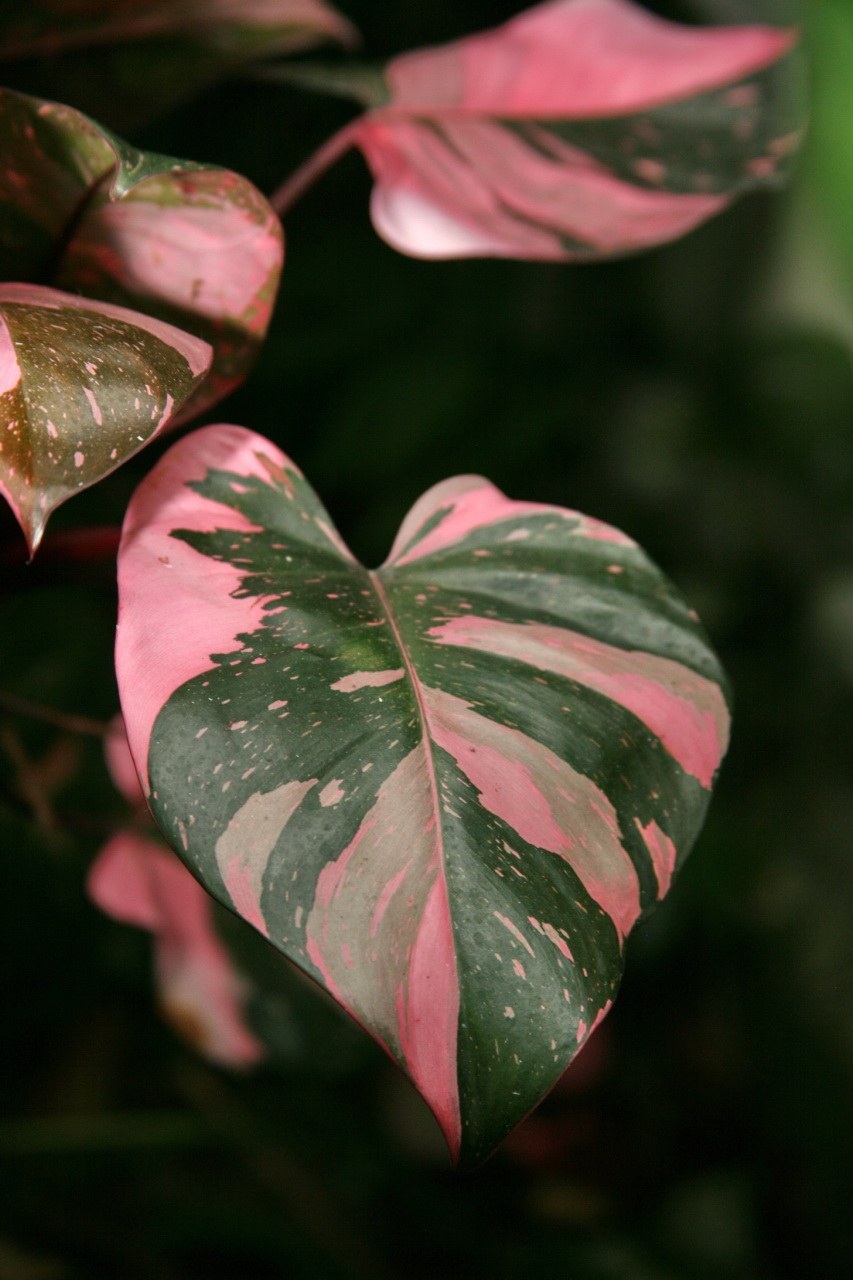
Key Identifying Features
The Pink Princess Philodendron (Philodendron erubescens 'Pink Princess', often abbreviated PPP) is a collector vining aroid known for one thing:
- Dark green-to-near-black leaves marked with bright bubblegum-pink variegation
- Arrow/heart-shaped leaves on a climbing vine
- Reddish to maroon stems and leaf undersides
- Irregular pink splashes, blocks, or half-moons
The near-black leaf with hot-pink patches and a dark red stem is unmistakable among houseplants.
Leaves & Stems
Leaves are elongated heart- to arrow-shaped (sagittate), 4-9 inches long, with a glossy, deep olive-green to almost black surface. The pink variegation appears as splashes, speckles, sectors, or half-leaf blocks; it is chimeric and unstable, varying leaf to leaf. New growth and the undersides often flush burgundy-red, and the stems are reddish-maroon — the species epithet erubescens means "blushing." It climbs by aerial roots and benefits from a support.
Flowers & Fruit
Indoors it rarely blooms. When it does, it makes a typical philodendron inflorescence: a deep maroon-to-greenish spathe surrounding a pale spadix. It's grown entirely for foliage.
How to Tell It Apart from Look-Alikes
- Philodendron 'Pink Congo' has uniform pink leaves produced by chemical treatment that revert to all green within months — a fraud; true PPP has stable, irregular pink patches and dark stems.
- Caladiums and pink syngoniums have pink coloring but thin, papery leaves and different (non-climbing or rosette) habits and lack the dark near-black background.
- Philodendron 'Pink Princess Marble' shows heavier, marbled pink but is the same species/cultivar lineage.
If you see bubblegum-pink patches on dark leaves with red stems and burgundy new growth, it's the real Pink Princess.
Where You'll Find It
Philodendron erubescens is native to Colombian rainforests, but 'Pink Princess' is a cultivated, tissue-/cutting-propagated houseplant found in collections worldwide. It thrives in bright indirect light, which is needed to maintain the pink.
Quick ID Checklist
- Dark olive-to-black, glossy arrow/heart-shaped leaves
- Bubblegum-pink irregular variegation (splashes/half-moons)
- Reddish-maroon stems; burgundy new growth and undersides
- Climbing vine with aerial roots
- Variegation differs leaf to leaf (chimeric)
- Sold as cuttings, premium-priced
Match these and you have a genuine Pink Princess. Beware the chemically dyed 'Pink Congo' — its pink is temporary. Give PPP bright indirect light to keep its pink from fading to green.
Frequently asked questions
How is the Pink Princess different from a Pink Congo?
Pink Princess has stable, irregular pink patches on dark near-black leaves with red stems, while Pink Congo's uniform pink is chemically induced and reverts to plain green within months.
Why are my plant's new leaves coming in all green?
Insufficient light causes reversion to green. Pink Princess needs bright indirect light to produce and keep its pink variegation; prune back to a node with pink to encourage variegated growth.
Are the pink patches the same on every leaf?
No. The variegation is chimeric and unstable, so the amount and placement of pink varies from leaf to leaf, including occasional half-pink 'half-moon' leaves.
What does erubescens mean?
It means 'blushing,' referring to the reddish stems, burgundy new growth, and red-tinted leaf undersides characteristic of the species.