
Piñon Pine Identification Guide
How to identify piñon pine (Pinus edulis) by its short paired needles, rounded bushy form, and large wingless seeds. Covers needles, cones, bark, and look-alikes.
Read the full Piñon Pine encyclopedia entry →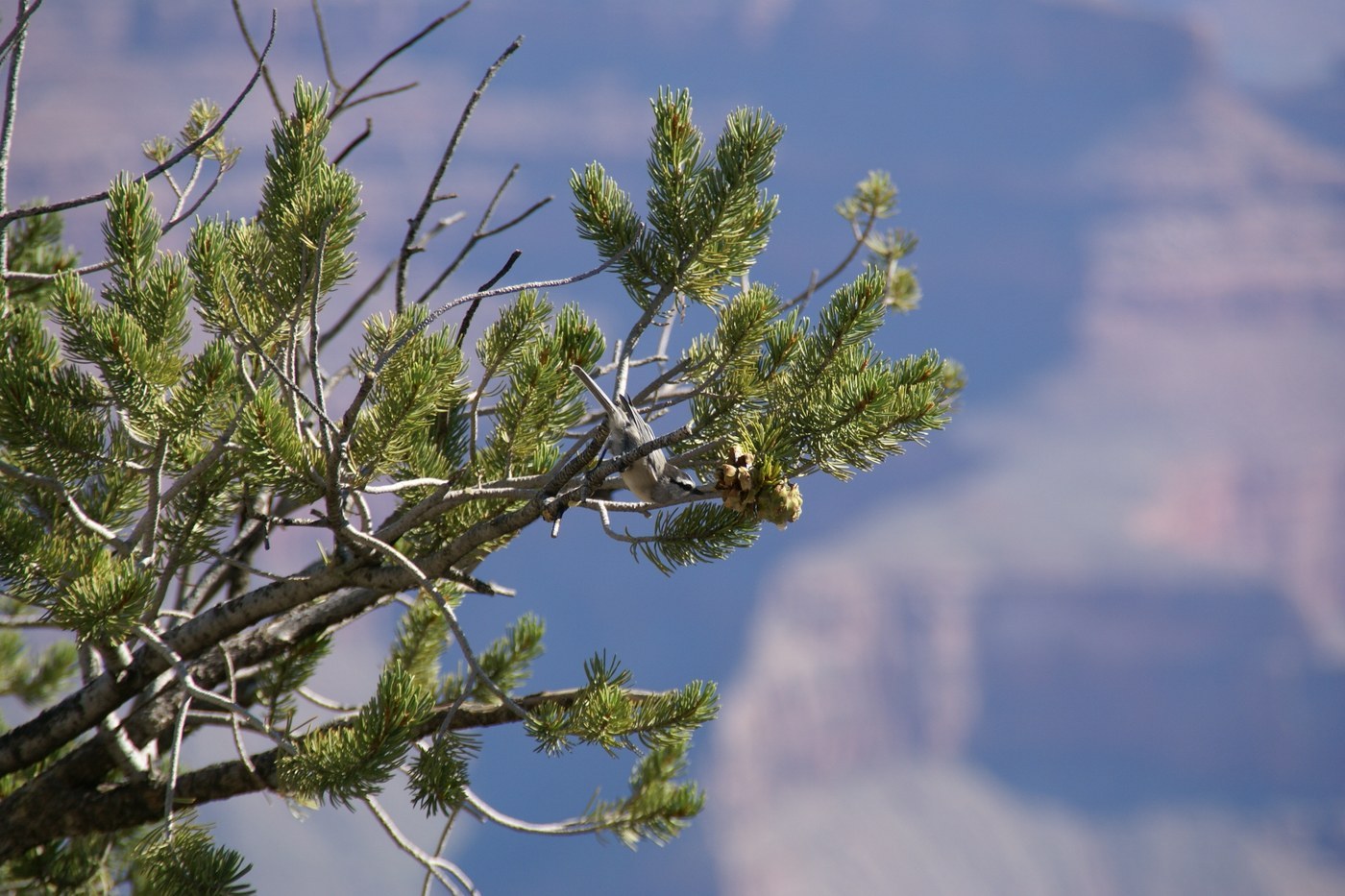
Key Identifying Features
Two-needle piñon (Pinus edulis) is a small, rounded pine of the American Southwest, recognized by short, stiff needles usually in twos, a shrubby, bushy, often broader-than-tall crown, and small round cones holding fat wingless seeds.
- Needles mostly in pairs (twos), short (2–4 cm), stiff
- Compact, rounded to bushy small tree
- Cones small, rounded, opening wide to drop large seeds
- Big, wingless seeds
Leaves & Stems
Needles are short (2–4 cm), stout, and curved, mid- to dark green, usually bundled in twos (occasionally singly or threes in related forms), with a short sheath that falls away. They are held a few years, giving the tree a dense, leafy look on stout twigs. Crushed foliage is resinous and fragrant. Young shoots are orange-brown. The bark is grey to reddish-brown, ridged and furrowed, and the overall habit is a slow-growing, low, rounded tree often only 3–6 m tall, frequently with a short trunk and broad crown.
Flowers & Fruit
Cones are small (3–5 cm), ovoid to nearly round, yellow-brown, with few thick blunt scales and no prickle. When ripe they open widely to a rose-like shape and release large, hard-shelled, wingless seeds (piñones), an important resource for wildlife. Cones mature over two years. Male cones are small and clustered at the shoot base in spring.
How to Tell It Apart from Look-Alikes
- Single-leaf piñon (P. monophylla): Needles solitary (one per bundle) and rounder; co-occurs in the West.
- Ponderosa/other tall pines: Long needles (12–25 cm) in twos or threes, large tall trees.
- Junipers: Share the piñon-juniper woodland but have scale-like or awl leaves and berry-like cones, not needles.
- Mexican pinyons (P. cembroides): Needles often in threes.
Where You'll Find It
A defining tree of the 'piñon-juniper woodland' across the southwestern United States (Colorado, New Mexico, Arizona, Utah) on dry foothills, mesas, and plateaus at 1,500–2,500 m. Look for low, rounded green pines dotting arid slopes alongside junipers.
Quick ID Checklist
- Short, stiff needles mostly in pairs
- Small, rounded/bushy tree, often wider than tall
- Small round cones opening wide, no prickle
- Large wingless seeds (piñon nuts)
- Dry Southwest foothills, with junipers
A short, two-needled, bushy little pine of the arid Southwest is piñon pine.
Frequently asked questions
How many needles does piñon pine have per bundle?
Pinus edulis usually has two needles per bundle, which separates it from single-leaf piñon (P. monophylla) that has solitary needles and from Mexican pinyon that often has threes.
Why is piñon pine so short and bushy?
It is a slow-growing tree of dry, harsh sites, typically forming a low, rounded crown 3–6 m tall, often as broad as it is high, well adapted to arid Southwestern woodlands.
What grows alongside piñon pine?
It is the namesake of piñon-juniper woodland, growing with junipers, which differ in having scale-like leaves and berry-like cones rather than needles.
What do piñon pine cones look like?
Cones are small (3–5 cm), ovoid to nearly round, yellow-brown, with few thick blunt scales and no prickle, opening widely to a rose-like shape when ripe.