
Pitch Pine Identification Guide
How to identify Pitch Pine (Pinus rigida) by its stiff three-needle bundles, prickly cones, and the unusual tufts of needles sprouting directly from the trunk. Covers look-alikes and barrens habitat.
Read the full Pitch Pine encyclopedia entry →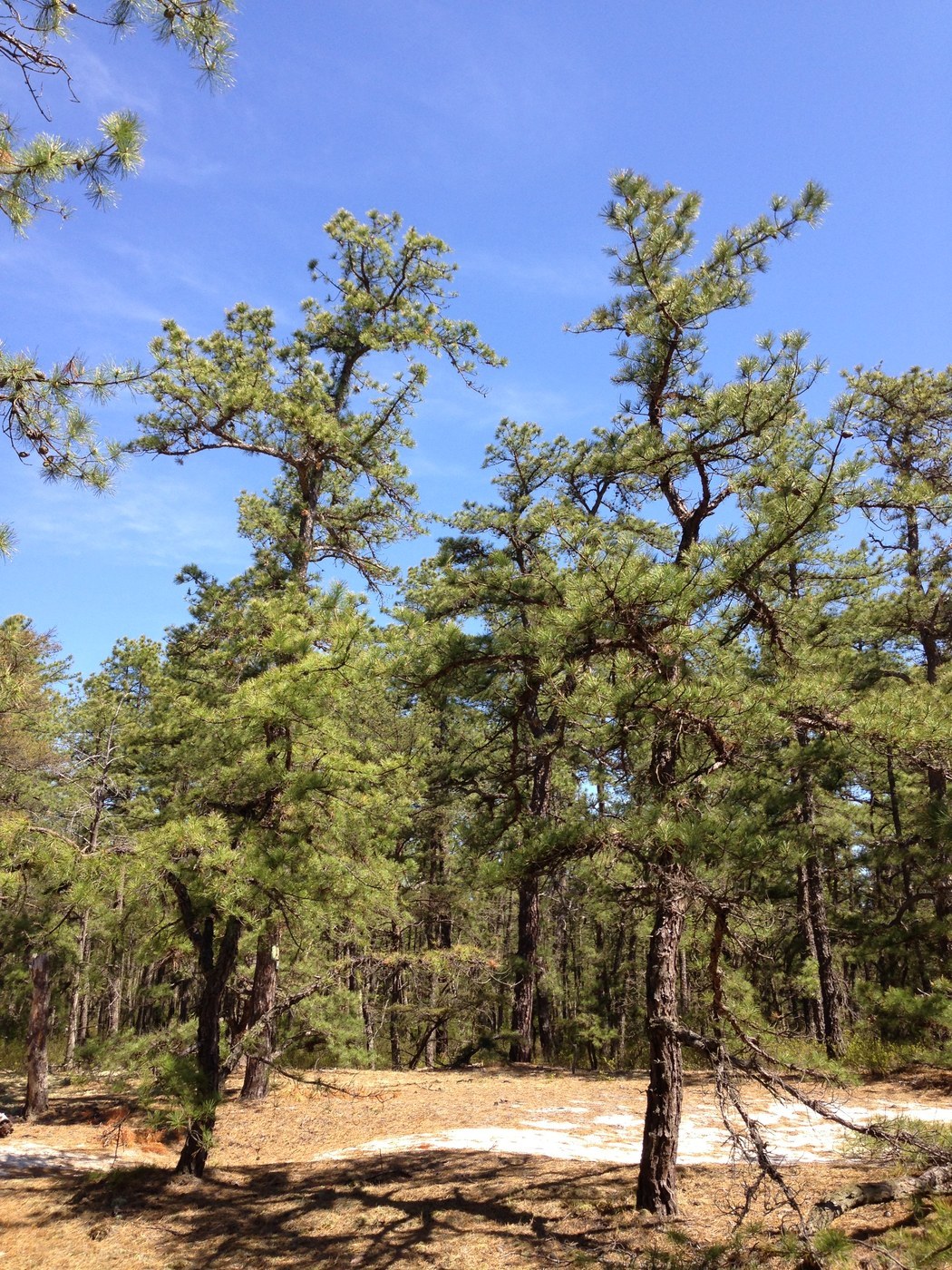
Key Identifying Features
Pitch Pine (Pinus rigida) is a rugged, often gnarled eastern pine of poor sandy soils. The most reliable signs are three stiff needles per bundle, prickly egg-shaped cones, and—uniquely—tufts of needles sprouting straight out of the trunk and large branches (epicormic sprouts). Its irregular, twisted, fire-scarred form sets it apart from neater plantation pines.
Leaves & Stems
- Needles in bundles of three (fascicles of 3), 3 to 5 inches long, stiff, often slightly twisted, and yellow-green to dark green.
- Sprout tufts (epicormic shoots) emerge directly from the bark of the trunk and limbs — a distinctive, almost diagnostic trait among eastern pines.
- Bark thick, deeply furrowed into irregular reddish-brown to gray plates; tolerant of fire.
- Form is usually crooked and irregular, with a ragged open crown rather than a straight central leader.
Flowers & Fruit
- Female cones ovoid, 1.5 to 3 inches long, often clustered, frequently persisting on the tree for years.
- Each cone scale bears a sharp, rigid prickle — the cone feels noticeably spiny in the hand.
- Many cones are serotinous, staying closed and opening after fire's heat to release seed.
- Cones may be nearly stalkless and angled along the branch.
How to Tell It Apart from Look-Alikes
- Pond pine (Pinus serotina) is very similar with three needles and even more abundant trunk sprouts, but its needles are longer (5 to 8 in) and it grows in southeastern wetlands.
- Loblolly pine has longer needles (6 to 9 in) and a tall straight trunk without the gnarled barrens look.
- Shortleaf pine has slender needles in bundles of two and three and smaller cones with weaker prickles.
- Red and Scotch pine have only two needles per bundle.
Where You'll Find It
A signature tree of the Pine Barrens of New Jersey, Long Island, and Cape Cod, plus dry ridgetops and sandy or rocky, acidic, nutrient-poor sites across the Appalachians and Northeast. Thrives where fire is frequent and few other pines tolerate the conditions.
Quick ID Checklist
- Needles in bundles of three, 3 to 5 inches, stiff
- Tufts of needles sprouting from the trunk and branches
- Cones 1.5 to 3 inches with sharp prickles, often persistent
- Thick fire-furrowed bark; crooked, irregular form
- Growing on dry sandy barrens or rocky acidic ridges
Frequently asked questions
What makes Pitch Pine easy to recognize?
The tufts of needles that sprout directly from the trunk and large branches are unusual among eastern pines and, combined with three stiff needles per bundle, strongly indicate Pitch Pine.
How many needles does Pitch Pine have per bundle?
Three. They are stiff, 3 to 5 inches long, and often slightly twisted.
Are Pitch Pine cones prickly?
Yes. Each cone scale has a sharp rigid prickle, and the cones often stay on the tree for years, sometimes opening only after fire.
Where does Pitch Pine typically grow?
On dry, sandy, acidic, nutrient-poor soils such as the New Jersey Pine Barrens, Cape Cod, and dry Appalachian ridgetops where fire is common.