
Pittosporum Identification Guide
Identify Pittosporum by its whorled, glossy, wavy-edged evergreen leaves, intensely orange-blossom-scented flowers, and sticky-seeded woody capsules.
Read the full Pittosporum encyclopedia entry →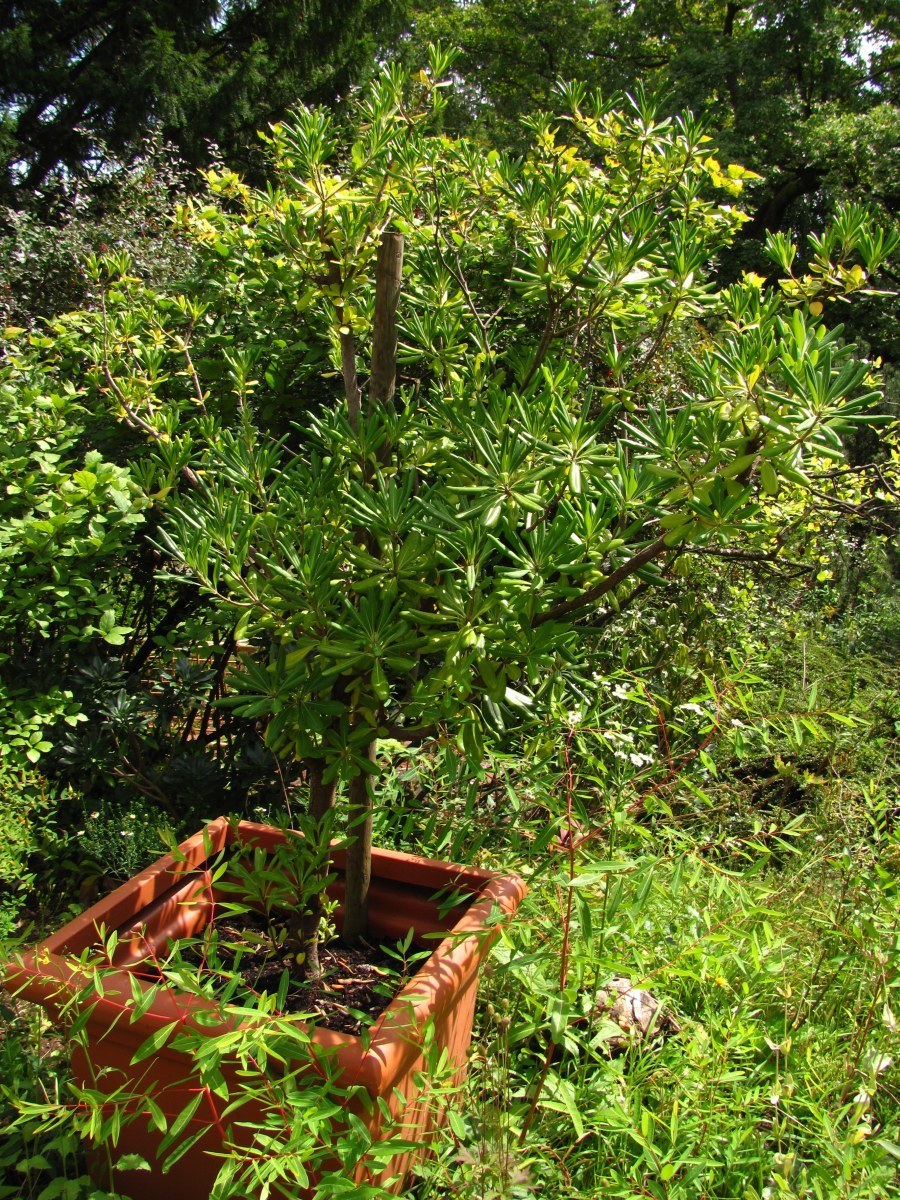
Key Identifying Features
Pittosporum is a genus of evergreen shrubs and small trees (family Pittosporaceae). Common garden types include Pittosporum tobira (mock orange / Japanese pittosporum) and Pittosporum tenuifolium (kohuhu). Identify it by leathery, glossy leaves often clustered in whorls at branch tips, small cream-to-yellow flowers with a strong orange-blossom fragrance, and woody seed capsules that split to reveal sticky, orange-red seeds.
- Evergreen shrub/small tree, from compact 2–3 ft cultivars to 10–15 ft+
- Leaves typically whorled at the ends of branches
- Flowers intensely fragrant (orange-blossom scent), especially P. tobira
- Woody capsules with sticky seeds (the name means 'pitch-seed')
Leaves & Stems
Leaves are simple, alternate but crowded into rosette-like whorls at branch tips, leathery, glossy, obovate to oblong, with smooth margins that are often slightly rolled or wavy, usually with a paler midrib. P. tobira leaves are broad (2–4 in) and rounded; P. tenuifolium has smaller leaves with wavy/crinkled edges on dark stems. Many cultivars are variegated with cream or silver margins ('Variegata', 'Silver Sheen'). Stems are often dark-colored (black/purple in P. tenuifolium).
Flowers & Fruit
Flowers are small, five-petaled, cream to pale yellow (or dark maroon in some species), borne in clusters at the branch tips, usually in spring. P. tobira blooms are famous for a powerful orange-blossom / jasmine fragrance. The fruit is a rounded woody capsule that ripens and splits into segments to expose sticky, resinous orange-red seeds — a defining genus trait.
How to Tell It Apart from Look-Alikes
- True mock orange (Philadelphus): Deciduous with larger white four-petaled flowers; Pittosporum is evergreen with smaller five-petaled flowers.
- Cherry laurel / Ligustrum: Similar glossy evergreen leaves, but lack the whorled leaf rosettes and sticky-seeded woody capsules.
- Camellia: Larger, toothed leaves and big showy flowers; very different fruit.
The whorled glossy smooth-edged leaves + orange-blossom-scented cream flowers + sticky-seeded woody capsules combination identifies Pittosporum.
Where You'll Find It
Native across Australasia, eastern Asia, and parts of Africa; widely planted in warm-temperate and Mediterranean climates (USDA zones 8–11) as hedges, screens, foundation shrubs, and container plants, and valued in the cut-foliage trade. It tolerates coastal salt, heat, and pruning into formal shapes.
Quick ID Checklist
- Evergreen shrub/small tree, often dense
- Leathery, glossy leaves in whorl-like rosettes at branch tips
- Smooth, often wavy or rolled leaf margins; many variegated
- Small cream/yellow flowers with strong orange-blossom scent
- Woody capsules splitting to sticky orange-red seeds
- Common as coastal and Mediterranean-climate hedging
Frequently asked questions
Why does my Pittosporum smell like orange blossom?
Pittosporum tobira's cream flowers produce a powerful sweet, orange-blossom or jasmine fragrance in spring, which is one of the easiest ways to recognize it.
What does the name Pittosporum mean?
It means 'pitch seed,' referring to the sticky, resin-coated seeds revealed when the woody capsules split open — a reliable identifying feature.
Is Pittosporum the same as mock orange?
Pittosporum tobira is sometimes called mock orange for its scent, but true mock orange is Philadelphus, a deciduous shrub with larger white four-petaled flowers.
Why are the leaves clustered at the branch tips?
Pittosporum characteristically arranges its leathery leaves in whorl-like rosettes near the ends of branches, giving it a distinctive tufted look.