
Plantain Identification Guide
Identify broadleaf and ribwort plantain (Plantago) by their basal leaf rosettes with parallel ribs and slender flower spikes on leafless stalks.
Read the full Plantain encyclopedia entry →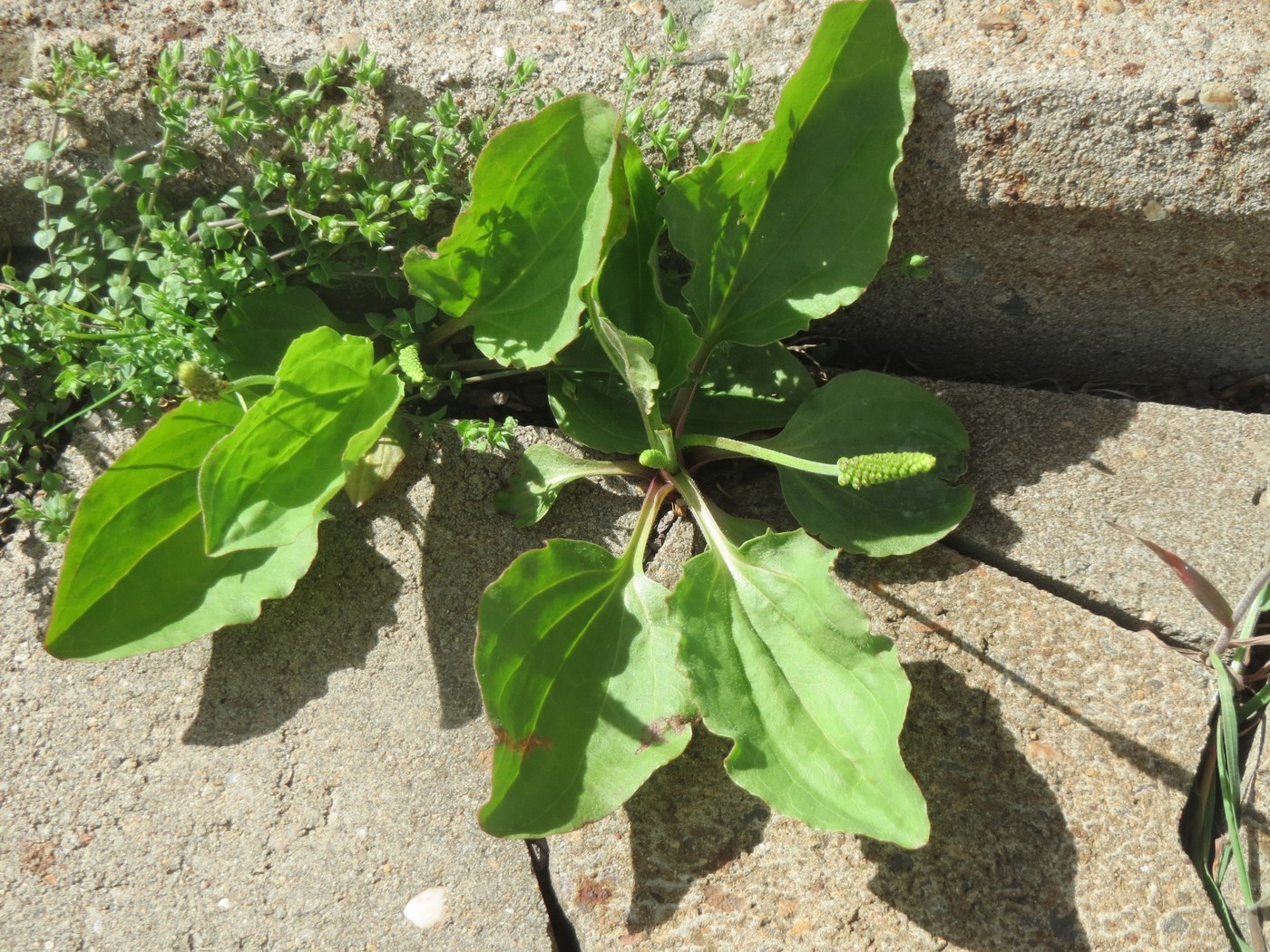
Key Identifying Features
Plantain here refers to the lawn and roadside weeds of the genus Plantago (not the banana-like cooking plantain). The two most common are broadleaf plantain (P. major) and ribwort/narrowleaf plantain (P. lanceolata). Universal marks:
- A basal rosette of leaves with prominent parallel veins (ribs) running lengthwise.
- A leafless flower stalk topped by a narrow spike of tiny flowers.
- A pull-test trick: tear a leaf slowly and the tough vein strings hang out like threads.
Leaves & Stems
In broadleaf plantain (P. major), leaves are broad, oval to egg-shaped, 5-20 cm long, with 3-7 strong parallel ribs and a broad stalk; they lie in a flat rosette pressed to the ground.
In ribwort plantain (P. lanceolata), leaves are long, narrow, and lance-shaped with 3-5 ribs, held more upright. Both have no true above-ground branching stem; only the wiry flower stalks rise from the rosette center. The leaf veins are stringy and tough.
Flowers & Fruit
Broadleaf plantain bears a long, narrow greenish spike of densely packed tiny flowers along much of the stalk's length. Ribwort plantain has a short, dense, blackish-green oval head at the tip of a tall, grooved stalk, ringed by a halo of protruding cream-white stamens when in bloom. Both produce small capsules containing several seeds. Flowering runs spring through autumn.
How to Tell It Apart from Look-Alikes
- Young dock or sorrel (Rumex) rosettes look similar but have a papery sheath (ocrea) at the leaf base and lack the parallel-ribbed leaf with stringy veins.
- Lamb's ear and mullein rosettes are softly woolly-grey, unlike the smoother green plantain leaves.
- Lily-of-the-valley has parallel-veined leaves too but grows from creeping rhizomes in shade and has bell flowers — easily separated by the plantain's weedy rosette and spike.
The ground-hugging ribbed rosette plus a leafless spike of tiny flowers identifies Plantago.
Where You'll Find It
Plantains are tough survivors of compacted, disturbed ground: lawns, paths, driveways, playing fields, roadsides, and waste places worldwide. Broadleaf plantain especially tolerates trampling and is a classic footpath weed.
Quick ID Checklist
- Basal rosette of leaves with parallel ribs
- Stringy veins that hang out when a leaf is torn
- Leafless flower stalk topped by a slim spike
- Broad oval leaves (P. major) or narrow lance leaves (P. lanceolata)
- Grows in compacted, trampled ground
Frequently asked questions
Is this the same as the banana-like cooking plantain?
No. This plantain is a small broadleaf weed in the genus Plantago, unrelated to the starchy banana-family cooking plantain. They share only a name.
How do I tell broadleaf from ribwort plantain?
Broadleaf plantain (P. major) has wide oval ground-hugging leaves and a long slender greenish flower spike. Ribwort plantain (P. lanceolata) has narrow upright lance-shaped leaves and a short, dense, dark oval flower head on a tall grooved stalk.
What is the quickest field test?
Slowly tear a leaf crosswise. The tough parallel veins pull free and dangle like little strings, a memorable confirming trait shared by plantains.
Where does plantain typically grow?
It thrives in compacted, disturbed ground such as lawns, footpaths, driveways, playing fields, and roadsides, tolerating heavy trampling better than most plants.