
Plumeria Tree Identification Guide
Recognize plumeria (frangipani) by its thick blunt branches, milky sap, clustered leathery leaves, and intensely fragrant five-petaled pinwheel flowers.
Read the full Plumeria Tree encyclopedia entry →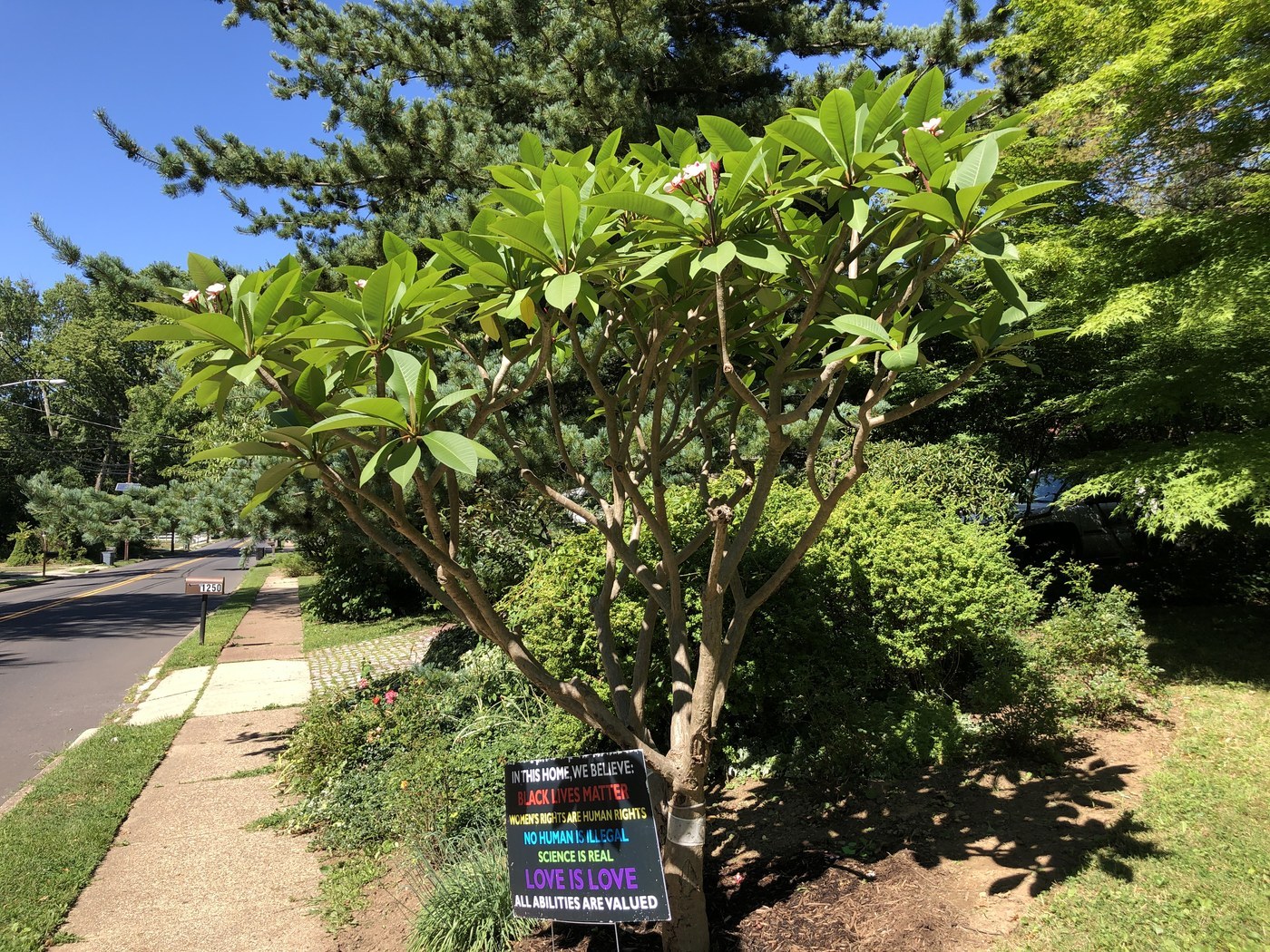
Key Identifying Features
Plumeria (Plumeria spp.), widely known as frangipani, is a small tropical tree or large shrub famous for its heavily scented flowers used in Hawaiian leis. Its overall look is distinctive: chunky, sparsely branched, almost sculptural form.
- Size & form: Usually 10–25 ft tall with a few thick, succulent, gray-green branches that fork at wide angles.
- Branches: Notably thick and blunt-tipped, leaving a candelabra silhouette when bare.
- Sap: Stems and leaves exude a milky white latex when broken—a key family trait (Apocynaceae) and a mild skin irritant.
Leaves & Stems
Leaves are large, leathery, and clustered toward the tips of the thick branches. They are typically lance-shaped to elliptical, 8–20 inches long, with a prominent midrib and a fine vein running parallel just inside the leaf margin (a helpful diagnostic). Leaves are dark green and glossy, deciduous in cooler/dry seasons, leaving prominent leaf scars on the blunt branches.
Flowers & Fruit
- Flowers: Borne in clusters at branch tips, each flower has five waxy, overlapping petals arranged in a pinwheel spiral. Colors include white, yellow, pink, red, and multicolor blends, usually with a yellow center. They are powerfully fragrant, especially at night.
- Fruit: Rarely seen on cultivated plants; when present they are paired, cigar-shaped follicles (pods) up to 7 inches that split to release winged seeds.
How to Tell It Apart from Look-Alikes
- Oleander (Nerium): Same family with milky sap, but oleander has narrow whorled leaves and smaller flowers on a shrub—not thick succulent branches.
- Desert rose (Adenium): Milky sap and similar flowers, but it has a swollen succulent caudex and is much smaller.
- Champaca / frangipani impostors: True Magnolia-relatives have single fragrant flowers but woody non-succulent branches and no milky latex.
- The combination of thick blunt branches + milky sap + pinwheel 5-petal fragrant flowers is essentially unique to plumeria.
Where You'll Find It
Native to Central America and the Caribbean, plumeria is now planted across the tropics and subtropics worldwide—Hawaii, Southeast Asia, India, the Pacific, and as a container plant in warm-temperate areas. It loves full sun, heat, and well-drained soil and is frost-tender (USDA zone 10+).
Quick ID Checklist
- Small tree with thick, blunt, succulent branches
- Milky white sap when cut
- Large leathery leaves clustered at branch tips
- Five-petaled pinwheel flowers, very fragrant, yellow-centered
- Tropical/subtropical, frost-tender
Frequently asked questions
Why does my plumeria ooze white liquid when cut?
Plumeria belongs to the dogbane family (Apocynaceae), whose members produce a milky latex sap. It can irritate skin and eyes, so wash hands after pruning. The milky sap is a useful identification clue.
Is plumeria the same as frangipani?
Yes. Plumeria and frangipani are two common names for the same genus of trees. The name frangipani is more common in Asia, the Pacific, and Australia.
How can I tell plumeria from oleander?
Both have milky sap and are in the same family, but plumeria has thick succulent branches and large leaves clustered at branch tips, while oleander is a multi-stemmed shrub with narrow leaves in whorls of three.
Why isn't my plumeria producing seed pods?
Cultivated plumeria rarely sets seed because the flowers need specific moth pollinators. Pods, when they form, are paired cigar-shaped follicles, but most home plants never fruit.