
Ponderosa Pine Identification Guide
Recognize ponderosa pine by its long needles in bundles of two or three, prickly cones, and the puzzle-piece orange bark of mature trees that smells of vanilla. Includes how to separate it from Jeffrey and lodgepole pine.
Read the full Ponderosa Pine encyclopedia entry →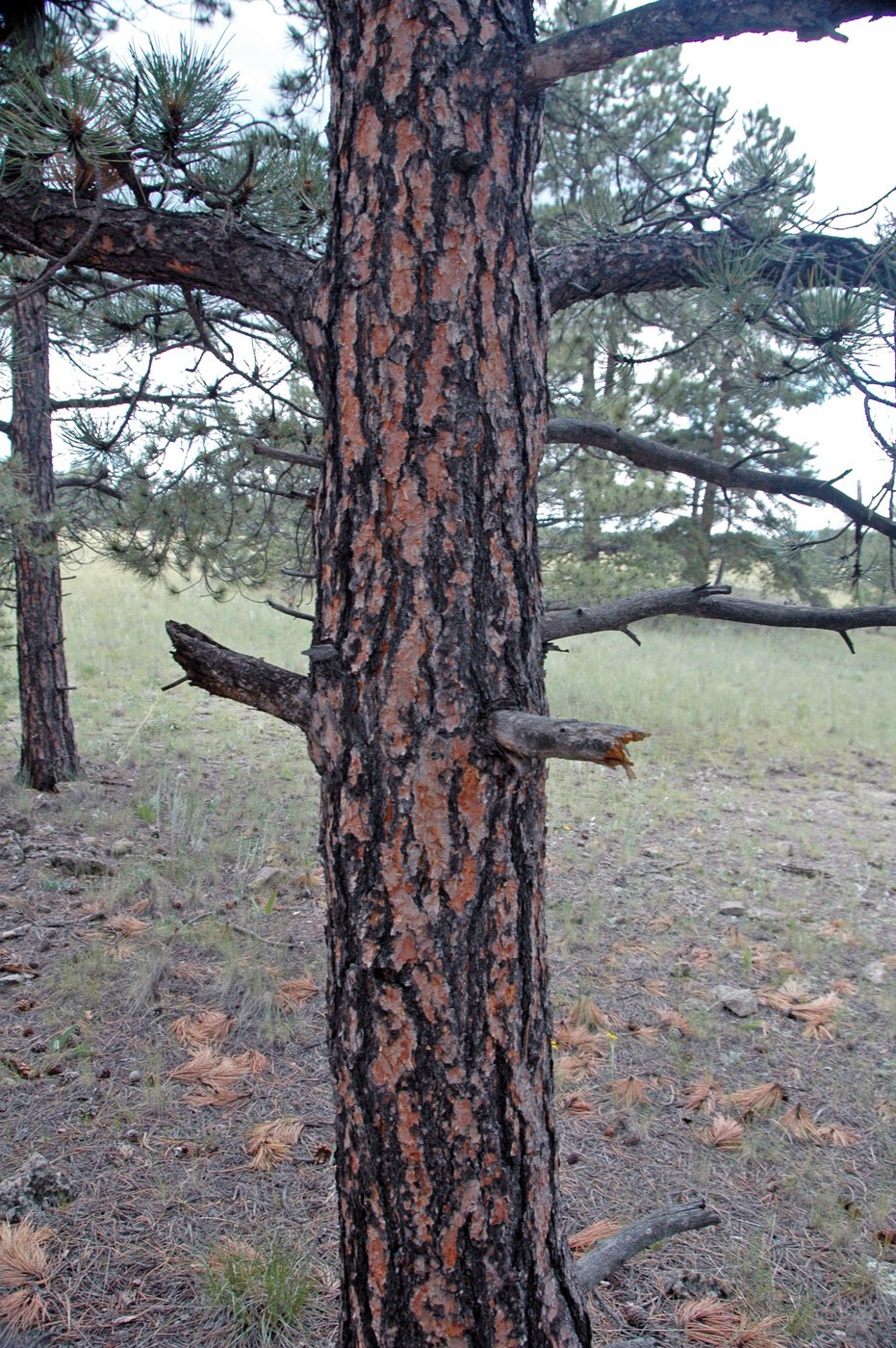
Key Identifying Features
Ponderosa pine (Pinus ponderosa) is a tall, iconic pine of the western United States. Mature trees are unmistakable thanks to their cinnamon-orange bark that breaks into jigsaw-puzzle plates and smells of vanilla or butterscotch in warm sun. The long needles (usually in bundles of three) and prickly cones confirm it.
- Long needles, 12 to 25 cm, in bundles of (two or) three
- Orange-brown plated bark in puzzle-piece shapes on old trees
- Bark scent of vanilla/butterscotch in the furrows
- Egg-shaped cones with an outward-pointing prickle on each scale
Leaves & Stems
Ponderosa needles are long (5 to 10 inches), stout, and usually grouped in threes (sometimes twos in some regions), forming dense tufts at branch ends. They are yellow-green to dark green and persist several years. Young trees ("blackjacks") have dark grey-brown to nearly black furrowed bark; with age this transforms into the famous broad, flat, orange-cinnamon plates separated by deep black fissures. Sniffing the bark crevices on a warm day reveals a sweet vanilla aroma. Trees commonly reach 30 to 50 m.
Flowers & Fruit
Male pollen cones cluster at branch tips in spring. Female cones mature into woody, ovoid cones 7 to 15 cm long, reddish-brown, with each scale tipped by a sharp, outward-curved prickle. A handy field test: a ponderosa cone pressed into the palm pricks you ("prickly ponderosa"), because the spines point outward. Cones fall whole, often leaving a few basal scales on the twig.
How to Tell It Apart from Look-Alikes
- Jeffrey pine (P. jeffreyi): extremely similar, but its cone prickles curve inward so the cone feels gentle in the hand ("gentle Jeffrey"), and the bark smells more strongly of vanilla; needles are bluer.
- Lodgepole pine (P. contorta): needles in bundles of two, much shorter, and thin scaly bark; far smaller cones.
- Sugar pine (P. lambertiana): needles in fives and enormous hanging cones.
The "prickly" outward cone spines plus puzzle-piece orange bark distinguish ponderosa, especially from its twin, the "gentle" Jeffrey pine.
Where You'll Find It
Ponderosa pine ranges widely across western North America, from British Columbia to Mexico, dominating dry montane forests, foothills, and plateaus. It thrives in full sun on well-drained soils and is adapted to periodic ground fire, which its thick bark resists. Look for open, park-like stands of large orange-barked trees.
Quick ID Checklist
- Long needles 12 to 25 cm, usually three per bundle
- Mature bark orange, in puzzle-piece plates
- Bark furrows smell of vanilla or butterscotch
- Cones with outward-pointing prickles (pricks the hand)
- Young trees with dark furrowed "blackjack" bark
- Dry western montane forests, full sun
Frequently asked questions
Why does ponderosa pine bark smell like vanilla?
Mature ponderosa bark contains aromatic compounds that release a sweet vanilla or butterscotch scent, especially when warmed by the sun. Sniffing a bark furrow is a classic identification trick.
How do I tell ponderosa from Jeffrey pine?
Feel the cone. Ponderosa cone prickles point outward and prick your palm ("prickly ponderosa"), while Jeffrey pine prickles curve inward so the cone feels gentle ("gentle Jeffrey"). Jeffrey needles are also bluer.
Why does young ponderosa bark look so different from old trees?
Young ponderosas, called blackjacks, have dark grey-black furrowed bark. As the tree matures over many decades, the bark turns the characteristic orange and forms puzzle-piece plates.
How many needles are in a ponderosa bundle?
Usually three, occasionally two depending on region, each needle 5 to 10 inches long. This separates it from two-needle lodgepole pine and five-needle sugar pine.