
Puncturevine Identification Guide
Identify puncturevine (Tribulus terrestris) by its flat trailing stems, ferny paired leaflets, small yellow flowers, and sharp two-horned spiny seed burs.
Read the full Puncturevine encyclopedia entry →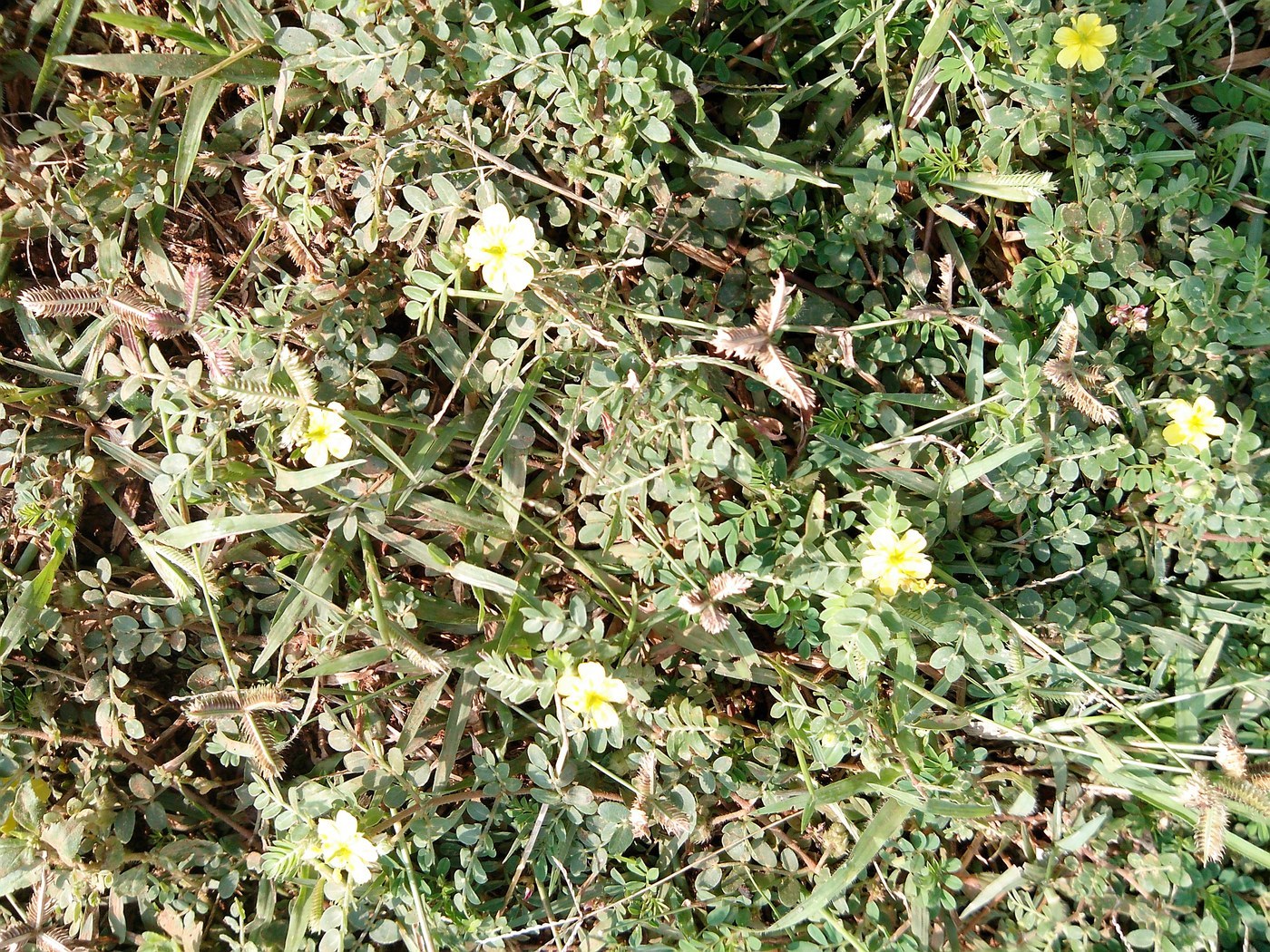
Key Identifying Features
Puncturevine (Tribulus terrestris), also called goathead, is a low, flat, ground-hugging annual broadleaf weed infamous for woody seed burs with sharp spines that can puncture bicycle tires and bare feet. Its mat of trailing stems with small yellow flowers and ferny leaves is distinctive.
- Prostrate stems radiating flat from a central root, forming circular mats
- Pinnately compound leaves with paired oval leaflets (fern-like)
- Small five-petaled yellow flowers
- Spiny, horned seed burs ("goatheads") that resemble a goat's skull
Leaves & Stems
Leaves are opposite, pinnately compound, each with 4-8 pairs of small oval leaflets about 1/4 inch long, giving a soft, ferny appearance. Leaflets and stems are often hairy.
Stems are trailing and branching, radiating outward flat along the ground from a stout central taproot, sometimes forming mats 2-5 feet across. They rarely climb; the "vine" name refers to the spreading habit, not climbing. Stems are reddish-green and slightly hairy.
Flowers & Fruit
Flowers are small (about 1/3 to 1/2 inch wide), bright yellow, with five petals, borne singly in the leaf axils, opening in sunny weather from spring through fall. The fruit is the dangerous part: a woody bur that splits into 4-5 segments, each armed with two sharp, stout spines resembling a goat's or bull's head. These burs lie on the ground and easily lodge in tires, shoes, and feet.
How to Tell It Apart from Look-Alikes
- Sandbur: a grass with round spiny burs; puncturevine is a broadleaf with ferny leaves and two-horned burs.
- Black medic (Medicago lupulina): has yellow flowers and trifoliate leaves, but no spiny burs and clover-like leaflets in threes, not many-paired pinnate leaves.
- Spurge (Euphorbia): also prostrate, but it has milky sap, simple leaves, and no spiny burs.
The two-horned woody goathead bur plus ferny paired leaflets and yellow flowers is conclusive.
Where You'll Find It
Puncturevine thrives in hot, dry, disturbed ground: roadsides, gravel lots, sidewalk cracks, fields, trails, driveways, and waste areas. It tolerates poor compacted soil and drought, and is widespread across warm temperate regions of North America and worldwide.
Quick ID Checklist
- Flat, ground-hugging mat radiating from a central taproot
- Ferny paired leaflets (pinnately compound, hairy)
- Small bright yellow 5-petaled flowers
- Woody burs with two sharp horns (goatheads)
- Stems reddish, hairy, trailing not climbing
- Dry, hot, disturbed habitat
Frequently asked questions
Why is it called puncturevine or goathead?
Its hard, spiny seed burs have two sharp horns resembling a goat's head, and the spines are tough enough to puncture bicycle tires and bare feet, hence both names.
Does puncturevine actually climb like a vine?
No. Despite the name, it trails flat along the ground, radiating from a central taproot into a circular mat. It does not climb.
How do I tell it from sandbur?
Puncturevine is a broadleaf plant with ferny paired leaflets, yellow flowers, and two-horned burs, while sandbur is a grass with narrow blades and round, many-spined burs.
When does puncturevine flower?
It produces small yellow five-petaled flowers from spring through fall, with each flower followed by the characteristic spiny bur.