
Purple Coneflower Identification Guide
Identify purple coneflower (Echinacea purpurea) by its drooping pinkish-purple ray petals, spiny raised orange-brown central cone, and coarse rough leaves.
Read the full Purple Coneflower encyclopedia entry →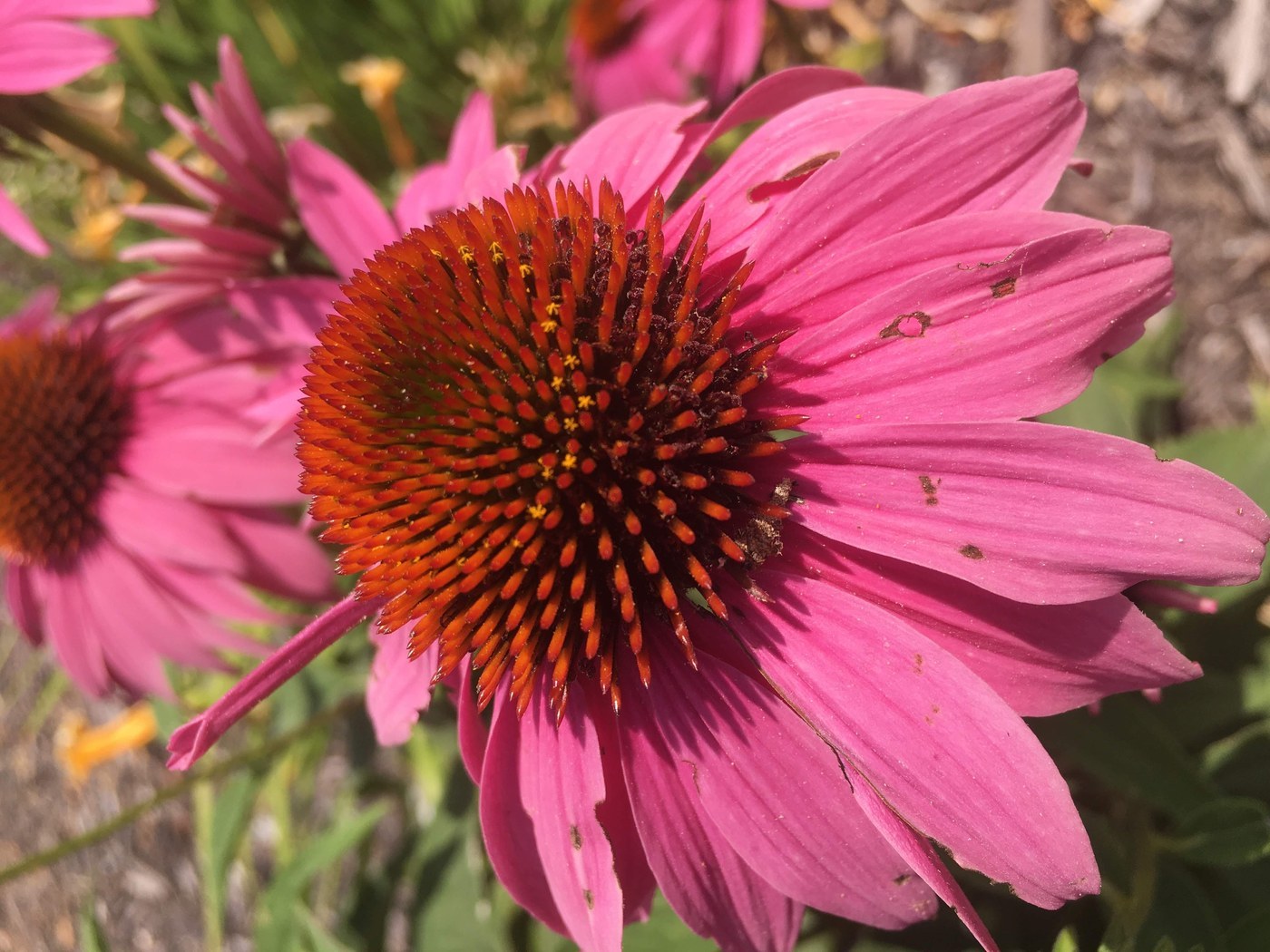
Key Identifying Features
Purple coneflower (Echinacea purpurea) is a North American prairie perennial in the daisy family (Asteraceae). It is unmistakable for its large daisy-like flower heads with backward-drooping pinkish-purple petals surrounding a tall, dome-shaped, spiny orange-brown central cone. The genus name comes from the Greek echinos (hedgehog), referring to that prickly cone.
- Pink-purple ray petals that sweep downward (reflexed)
- A raised, rounded, bristly copper-to-orange central cone
- Coarse, rough-textured, dark green leaves
- Stiff, upright, hairy stems often 2-4 feet tall
Leaves & Stems
Leaves are alternate, lance- to egg-shaped, with coarsely toothed or smooth margins and a noticeably rough, sandpapery texture from stiff hairs. Lower leaves have long stalks and can be 3-8 inches long; they get smaller and stalkless up the stem. Both leaves and stems show prominent veins and bristly hairs. Stems are stiff, erect, and usually unbranched or sparingly branched, rising from a clump and topped by one flower head each.
Flowers & Fruit
Each flower head is 3-5 inches across. The ray florets (petals) are pink to rosy-purple, narrow, and droop downward from the rim, while the center is a conspicuous, raised, spiny cone that ages from greenish to a rich orange-brown and feels prickly. The tiny disk florets opening across the cone are tipped orange. Flowering peaks in mid to late summer. As seeds ripen, the cone becomes dark and very stiff, holding hard, four-angled seeds prized by goldfinches.
How to Tell It Apart from Look-Alikes
- Black-eyed Susan (Rudbeckia): has yellow-gold petals and a dark brown-black dome, not pink petals.
- Pale purple coneflower (E. pallida): very narrow, drooping, paler petals and a slimmer cone.
- Aster / Michaelmas daisy: flatter flowers with small centers, not a tall spiny cone.
- Gloriosa daisy / gerbera: lack the bristly raised cone and rough prairie foliage.
The pairing of drooping pink-purple petals with a spiny raised orange cone confirms purple coneflower.
Where You'll Find It
Native to the central and eastern United States, it grows wild in prairies, open woodlands, and meadows and is one of the most popular garden perennials worldwide. Look for it in pollinator gardens, borders, and naturalized plantings in full sun. It is drought-tolerant and a magnet for bees and butterflies.
Quick ID Checklist
- Pink to rosy-purple petals that droop downward
- Raised, dome-shaped, spiny orange-brown central cone
- Coarse, rough, sandpapery toothed leaves
- Stiff, hairy, upright stems 2-4 feet tall
- Hard spiny seed cone that persists into fall
Frequently asked questions
How do I tell purple coneflower from black-eyed Susan?
Purple coneflower has pink-purple drooping petals and a spiny orange-brown raised cone, while black-eyed Susan has golden-yellow petals around a dark brown, more rounded center.
Why is the center of the flower prickly?
The cone is made of stiff, pointed bracts among the disk florets, which gives Echinacea its hedgehog-like center and protects the developing seeds.
Is the flower always purple?
Wild Echinacea purpurea is pink-purple, but garden cultivars now come in white, orange, red, and yellow; the drooping petals and spiny cone still identify them as coneflowers.
Should I cut back the seed heads in fall?
Many gardeners leave them standing because the hard cones feed goldfinches and other birds through winter and provide structure.