
Pyracantha Identification Guide
Identify Pyracantha (firethorn) by its sharp thorns, glossy evergreen leaves, flat clusters of white spring flowers, and masses of red, orange, or yellow berries.
Read the full Pyracantha encyclopedia entry →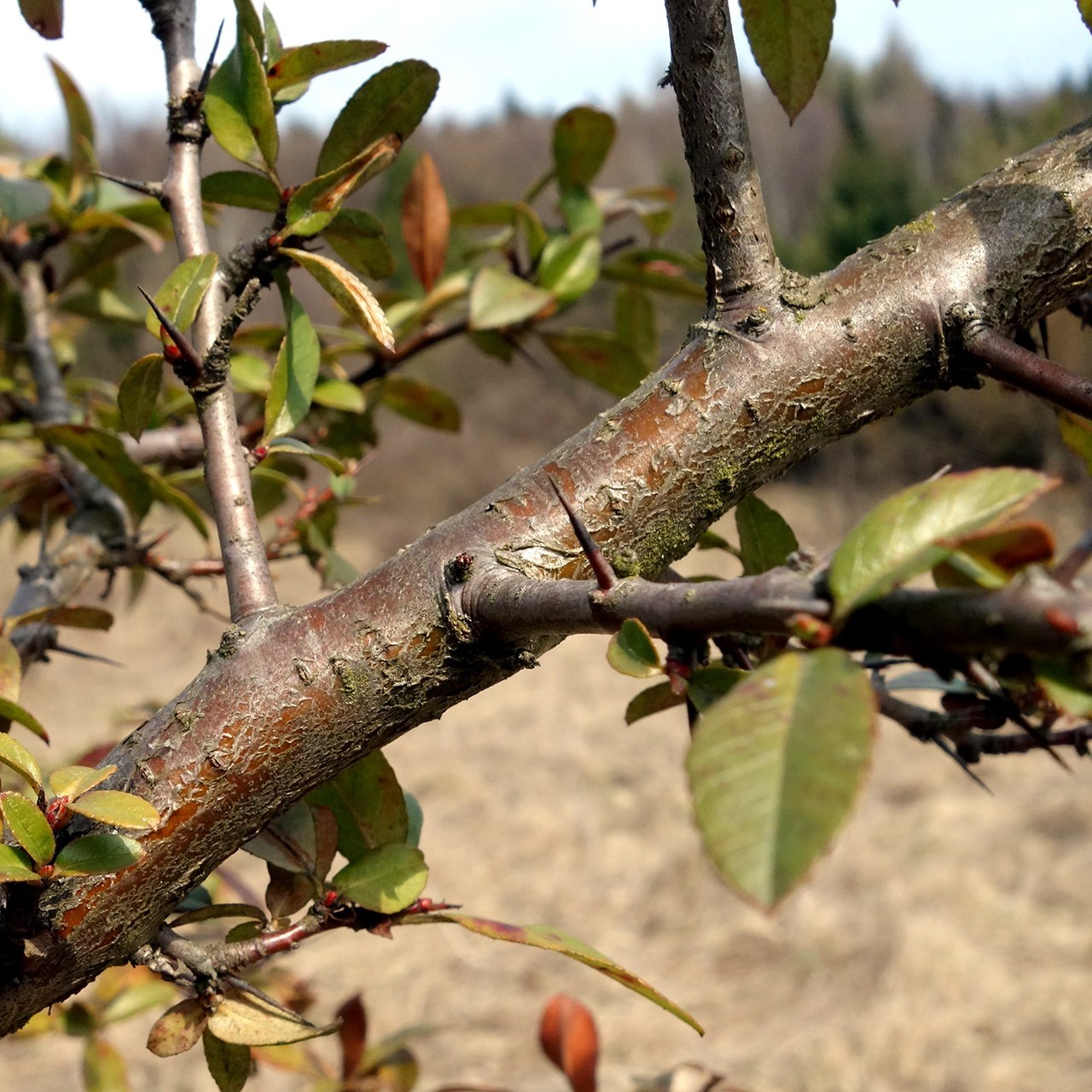
Key Identifying Features
Pyracantha, commonly called firethorn, is a thorny evergreen shrub in the rose family (Rosaceae). It is recognized by its stiff, sharp thorns, small glossy evergreen leaves, flat-topped clusters of white flowers in spring, and spectacular dense masses of red, orange, or yellow berries in fall and winter. It is frequently trained against walls and fences.
- Vigorous, thorny evergreen shrub, 6–15 ft, often espaliered
- Sharp woody thorns along the branches
- Flat clusters of small white flowers in spring
- Abundant red/orange/yellow berries (pomes) in fall–winter
Leaves & Stems
Leaves are alternate, small (1–1.5 in), oval to oblong (obovate), glossy dark-green above and paler beneath, with finely scalloped or smooth margins and a rounded or slightly notched tip. Stems are stiff and woody, armed with sharp spine-tipped short branches (true thorns). Young growth may be slightly hairy. The plant has a dense, sometimes sprawling or wall-hugging habit.
Flowers & Fruit
Flowers appear in flat-topped clusters (corymbs) in late spring, each a small, five-petaled white flower about ⅓ in across with a hawthorn-like look and a somewhat musky scent. These are followed by the signature dense clusters of small, round berries (pomes) about ¼ in across, in brilliant red, orange, or yellow depending on species/cultivar, ripening in fall and persisting well into winter — a major food source for birds.
How to Tell It Apart from Look-Alikes
- Cotoneaster: Closely related and similar berries, but cotoneaster is thornless with smooth-edged leaves; Pyracantha's thorns are the key difference.
- Hawthorn (Crataegus): Also thorny with white flowers and red fruit, but hawthorn is deciduous with lobed/toothed leaves and larger fruit.
- Holly (Ilex): Has spiny leaf margins rather than stem thorns, and different flowers.
The stiff stem thorns + glossy small evergreen leaves + flat white flower clusters + masses of red/orange/yellow berries combination is diagnostic.
Where You'll Find It
Native to southeastern Europe and Asia; widely planted across USDA zones 6–9 as a barrier hedge, espalier against walls, and for winter berry color and wildlife value. It tolerates a range of soils and full sun to part shade. The thorns make it a popular security/barrier plant.
Quick ID Checklist
- Evergreen shrub with sharp woody thorns
- Small, glossy, oval leaves with finely scalloped edges
- Flat-topped clusters of small white flowers in spring
- Dense masses of red, orange, or yellow berries in fall/winter
- Often trained flat against walls or fences
- Distinguished from thornless cotoneaster by its thorns
Frequently asked questions
How do I tell Pyracantha from cotoneaster?
Both have similar berries, but Pyracantha (firethorn) has sharp thorns and finely toothed leaves, while cotoneaster is thornless with smooth-edged leaves.
What color are Pyracantha berries?
Depending on the species and cultivar, the berries are bright red, orange, or yellow, borne in dense clusters that persist from fall into winter.
When does Pyracantha flower and fruit?
Small white flower clusters open in late spring, and the berries develop over summer to ripen in fall, then persist on the shrub well into winter, giving it a long season of interest.
Why is it called firethorn?
The name refers to its fiery red-orange berries combined with its sharp, woody thorns.