
Queen Victoria Agave Identification Guide
Identify the Queen Victoria Agave (Agave victoriae-reginae) by its tight, geometric dome of dark green leaves marked with crisp white lines and tipped with black spines.
Read the full Queen Victoria Agave encyclopedia entry →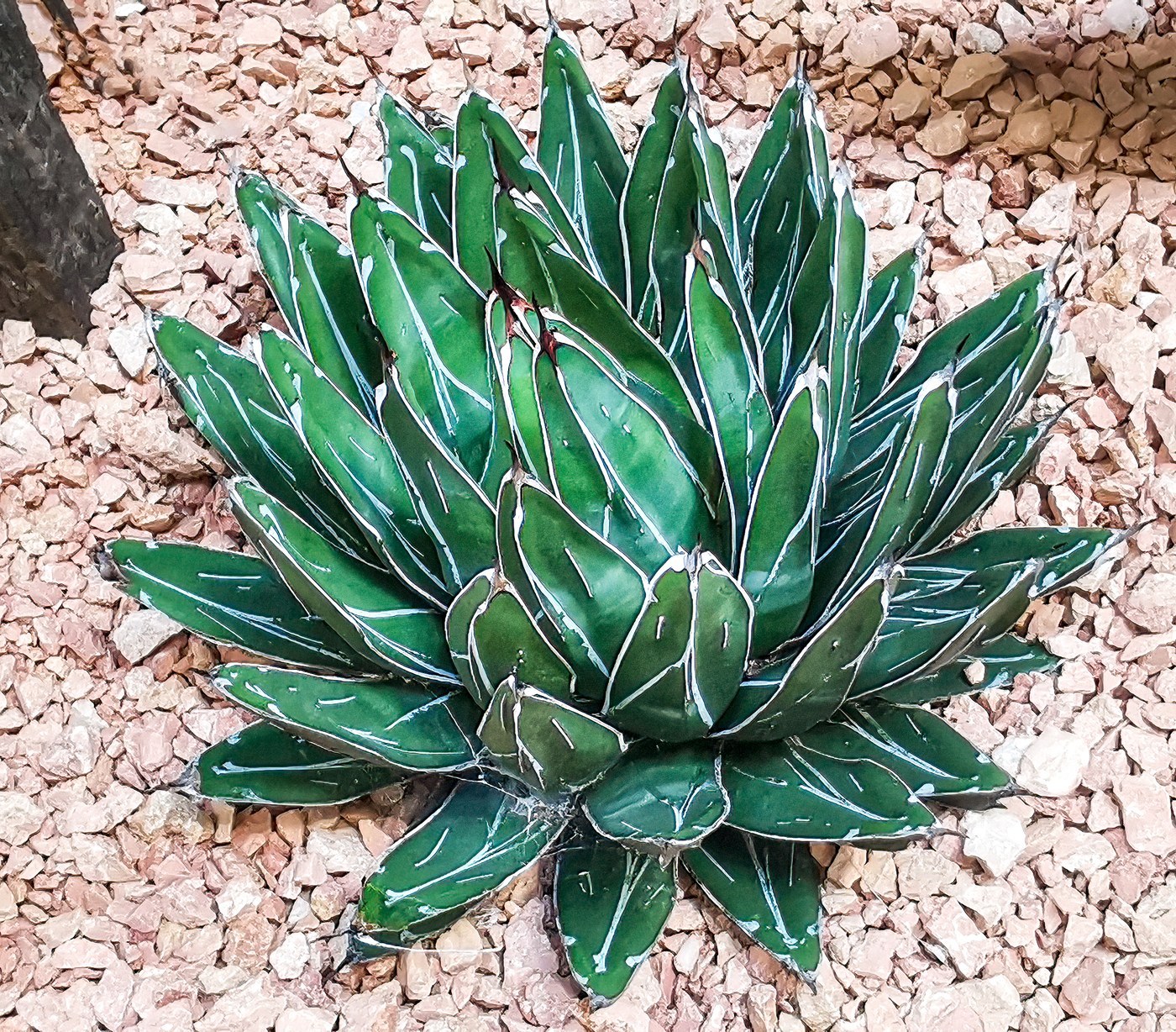
Key Identifying Features
The Queen Victoria Agave (Agave victoriae-reginae) is a small, slow-growing, exceptionally symmetrical agave that forms a tight, compact dome-shaped rosette. Its short, stiff, dark green leaves are striped with bold white markings and tipped with short black spines, making it one of the most ornamental and recognizable agaves.
- Compact, near-spherical rosette (usually under 1-2 feet wide)
- Stiff, keeled, triangular dark green leaves
- Striking white penciled lines along leaf edges and keels
- Short black terminal spine at each leaf tip
Leaves & Stems
The leaves are short, rigid, and thick with a flattened or keeled triangular cross-section, packed densely into a geometric ball. They are dark green and decorated with distinctive bright white lines that trace the leaf margins and the imprints left by neighboring leaves (the "bud printing"). Each leaf ends in one short, stout black terminal spine (and sometimes one or two small accessory spines), but the leaf margins are otherwise toothless. There is essentially no visible stem; the rosette sits low and tight. Growth is very slow, and the plant stays compact for years.
Flowers & Fruit
After many years (often 20-30), a mature rosette sends up a tall, unbranched flower spike 10-15 feet high, densely packed with creamy-white to pale flowers sometimes tinged purple/red. As with all agaves, it is monocarpic — the rosette dies after flowering. Because flowering is so rare, the leaf markings, not the flowers, are the practical identifier.
How to Tell It Apart from Look-Alikes
- Other white-marked agaves (e.g., A. parryi): A. parryi is larger, bluer, and lacks the crisp white penciling; Queen Victoria is smaller, darker green, and far more geometric.
- Agave ferdinandi-regis (King Ferdinand): very closely related and similar, but typically has fewer, broader leaves and more pronounced white margins; the two are sometimes treated as forms of one species.
- Haworthia/Aloe: smaller succulents that lack the rigid keeled leaves and bold white-lined dome of this agave.
Where You'll Find It
Native to the Chihuahuan Desert of northeastern Mexico (Coahuila, Nuevo León, Durango), it grows wild on limestone slopes. In cultivation it is a prized specimen and container plant for rock gardens and collectors in warm, dry climates (USDA zones 7b-11, with good drainage), valued for its tidy size and architectural form.
Quick ID Checklist
- Compact, dome-shaped, very symmetrical rosette
- Stiff, keeled triangular dark green leaves
- Crisp white penciled lines on edges and faces
- Short black terminal spine, toothless margins
- Small size and very slow growth
- Flowers only once after decades, then dies
Tip: The combination of a tight dark-green geometric dome with sharp white pinstripes is unique among agaves and the fastest confirmation.
Frequently asked questions
What are the white lines on the leaves?
The white markings are natural pigmentation along the leaf margins and keels, plus 'bud printing' impressions left where leaves pressed against each other in the bud. They are a key identifying feature of this species.
How big does Queen Victoria Agave get?
It stays small and compact, usually under 1-2 feet wide, and grows very slowly, which makes it ideal for containers and rock gardens.
Does it have dangerous spines?
Its leaf margins are toothless, but each leaf tip has a short, hard black spine that can prick. It's far less hazardous than large toothed agaves but should still be handled with some care.
How is it different from Agave ferdinandi-regis?
They are closely related and very similar. King Ferdinand Agave (A. ferdinandi-regis) generally has fewer, broader leaves with heavier white margins, and some botanists treat the two as forms of the same species.