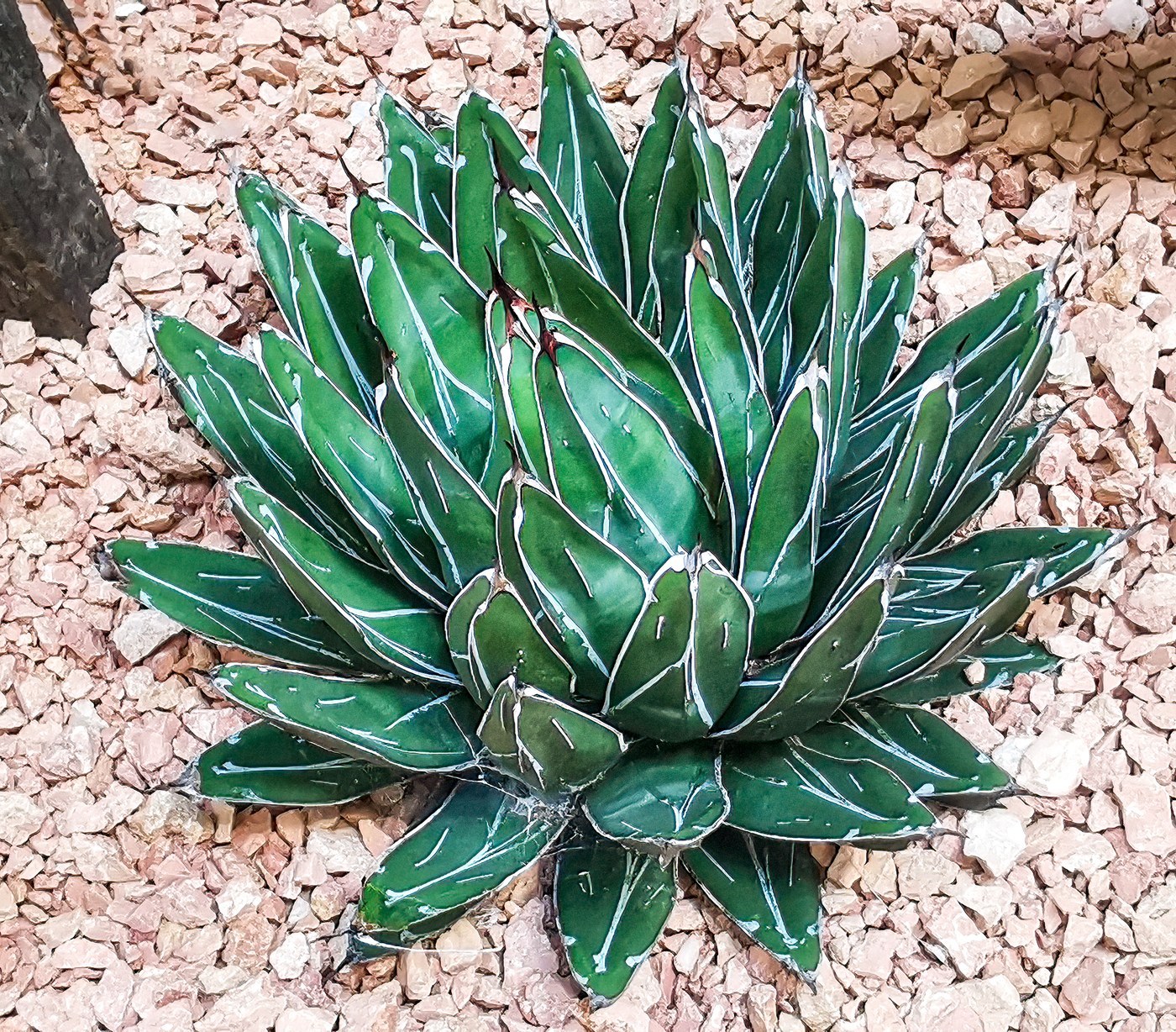
Queen Victoria Agave
Agave victoriae-reginae
A compact, slow-growing agave forming a near-perfect dome of dark green leaves painted with striking white markings. A prized, geometric collector's succulent.
- Light
- Bright light, direct sun
- Water
- Sparingly; very drought tolerant
- Difficulty
- Easy
Got a plant like this?
Identify any plant from a photo, free.
Overview
Queen Victoria Agave is among the most admired of all agaves, forming a dense, symmetrical, near-spherical rosette of stiff, short, dark green leaves boldly marked with contrasting white lines along the margins and keels.
Each leaf is tipped with a small terminal spine, and the white markings are imprints left by neighboring leaves in the tightly packed bud. It is slow-growing and stays compact, rarely exceeding a foot or two across, which makes it ideal for pots and small spaces.
A classic collector's and architectural plant, it eventually sends up a tall flower spike after many years, after which the rosette dies.
How to identify it
- Leaves: Short, stiff, triangular, dark green with striking white penciled lines on margins and surfaces; small terminal spine
- Rosette: Very dense, symmetrical, dome-shaped to nearly spherical
- Size: Compact, typically 10-18 in across; slow growing
- Flower spike: Tall, unbranched spike of creamy flowers after many years, then the rosette dies
- Habit: Mostly solitary, though some forms offset
Care & growing
Light: Bright light with direct sun for tight, well-marked growth.
Water: Water sparingly, letting soil dry completely; extremely drought tolerant and rot-prone if overwatered.
Soil: Very gritty, fast-draining mineral soil.
Temperature: Tolerates heat and some frost when dry; protect from prolonged hard freezes.
Feeding: Minimal.
Propagation: From seed; offsetting forms can be divided, though many plants are solitary.
Habitat & origin
Native to the Chihuahuan Desert of northeastern Mexico (Coahuila, Nuevo Leon, Durango), where it grows on rocky limestone slopes and cliffs in arid, exposed conditions.
Because of habitat collection it is protected in the wild, but it is widely propagated and grown as a prized ornamental and collector's plant worldwide.
Frequently asked questions
Why does it have white lines on the leaves?
The white markings are 'bud imprints' left where tightly packed leaves pressed against each other before unfurling.
How big does it get?
It stays compact, usually under 18 inches across, and grows slowly, which makes it ideal for containers.
Does it die after flowering?
Yes, like most agaves it is monocarpic; the rosette flowers once after many years and then dies, sometimes leaving offsets.
Is it cold hardy?
It tolerates some frost when kept dry but should be protected from prolonged hard freezes.
Queen Victoria Agave guides
In-depth guides for identifying, growing, and caring for Queen Victoria Agave.
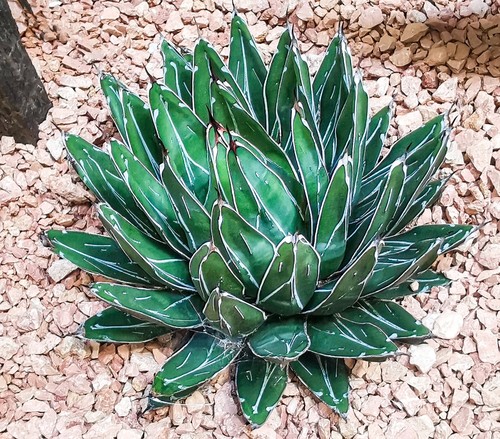
How to Care for Queen Victoria Agave
A slow, sculptural succulent, Queen Victoria Agave thrives on bright sun, gritty soil and very sparing water.
Queen Victoria Agave Identification Guide
Identify the Queen Victoria Agave (Agave victoriae-reginae) by its tight, geometric dome of dark green leaves marked with crisp white lines and tipped with black spines.