
Rainbow Eucalyptus Identification Guide
Identify the rainbow eucalyptus (Eucalyptus deglupta) by its multicolored peeling bark streaked green, blue, orange, and purple, plus its aromatic leaves and woody capsules.
Read the full Rainbow Eucalyptus encyclopedia entry →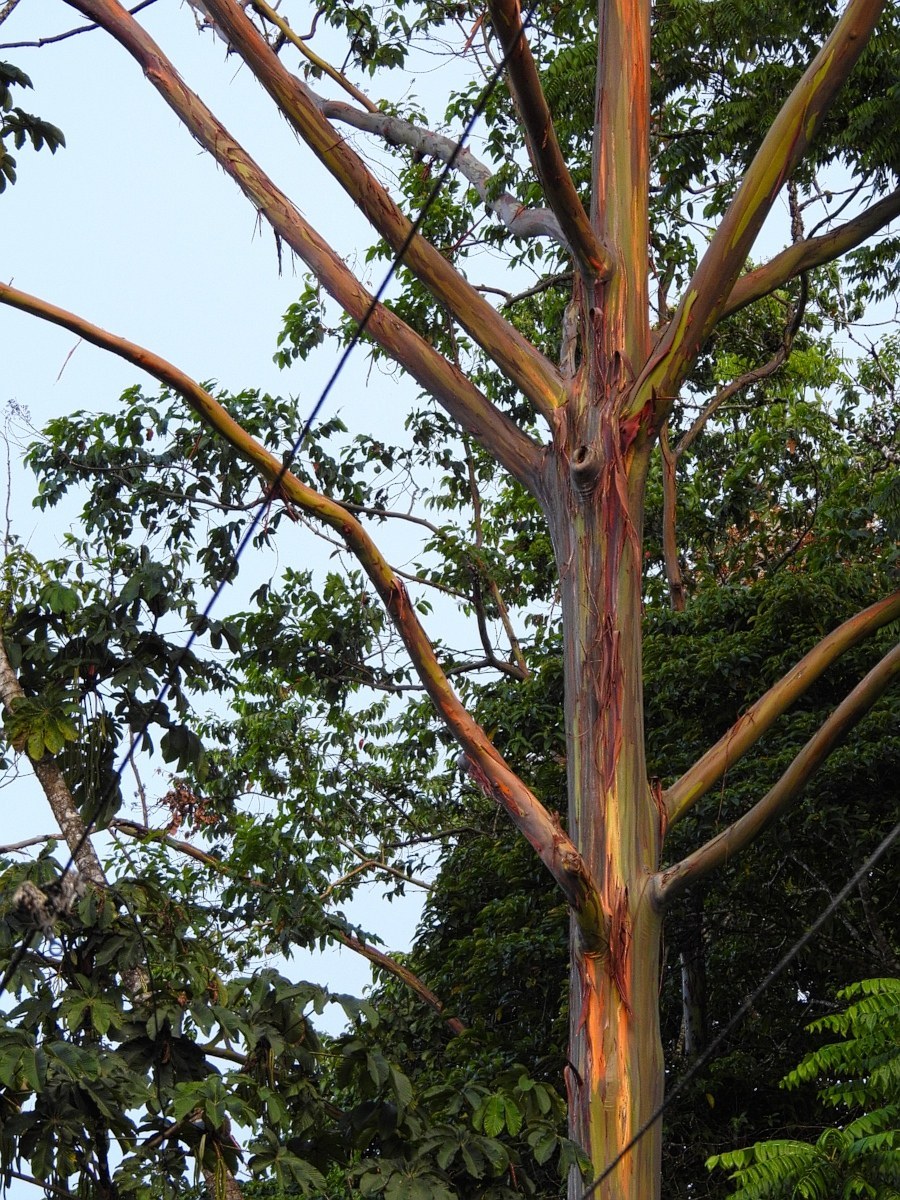
Key Identifying Features
The rainbow eucalyptus (Eucalyptus deglupta), also called Mindanao gum, is a tall tropical tree famous for the most colorful bark of any tree on Earth. Its trunk looks streaked and painted with green, blue, orange, maroon, and purple—an instantly recognizable, almost unmistakable feature.
- Size & form: Very large—up to 100–200 ft in the tropics (smaller in cultivation)—with a tall, straight trunk and a high, rounded canopy.
- The bark show: It continuously sheds thin strips of outer bark, exposing bright green inner bark that ages through blue, purple, orange, and maroon as it matures, creating the rainbow patchwork.
Leaves & Stems
Leaves are simple, lance-shaped to ovate, 4–6 inches long, glossy green, and—unusually for eucalyptus—arranged oppositely on young growth (often becoming alternate later). Like all eucalypts, the crushed leaves are aromatic with a fresh, resinous eucalyptus scent, and hold leaves to the light to see oil-gland dots. New growth and twigs are often reddish.
Flowers & Fruit
- Flowers: Small, fluffy white-to-cream flowers typical of eucalyptus, made of many stamens (no showy petals), borne in clusters. The bud has a little cap (operculum) that pops off as the stamens emerge.
- Fruit: Small, woody, cup- or capsule-shaped fruits about ¼ inch, splitting open to release tiny seeds—the classic eucalyptus "gumnut."
How to Tell It Apart from Look-Alikes
- Other eucalyptus species: Share aromatic leaves, fluffy flowers, and capsules, but none has the multicolored green-blue-orange-purple bark—that's diagnostic for E. deglupta.
- Paperbark (Melaleuca): Spongy white peeling bark and bottlebrush flowers, not rainbow streaks.
- Sycamore/plane tree: Patchy peeling bark too, but in muted cream-gray-brown, not vivid colors, plus broad lobed leaves.
- Crepe myrtle: Smooth peeling cinnamon bark, but small and with showy flowers.
- The vivid multicolored peeling trunk alone identifies rainbow eucalyptus.
Where You'll Find It
Native to the Philippines, Indonesia, and New Guinea, it's the only eucalyptus native to the Northern Hemisphere and to rainforest. It needs a frost-free, humid tropical/subtropical climate (USDA 10–11) and is planted ornamentally in Hawaii, South Florida, Southeast Asia, and similar regions, as well as commercially for pulpwood.
Quick ID Checklist
- Very tall tropical tree, straight trunk
- Multicolored peeling bark—green, blue, orange, purple, maroon (the giveaway)
- Aromatic lance-shaped leaves with oil-gland dots
- Fluffy white stamen flowers; small woody capsules
- Frost-free tropical/subtropical climate only
Frequently asked questions
Why does rainbow eucalyptus bark have so many colors?
The tree sheds thin strips of outer bark at different times, exposing fresh bright-green inner bark. As each patch ages and oxidizes, it turns blue, purple, orange, and maroon, so the trunk shows many colors at once.
Is the bark naturally colorful or is it painted?
It's completely natural. The colors come from the aging of freshly exposed inner bark, not paint. This makes the rainbow eucalyptus one of the most striking trees in the world.
Can I grow rainbow eucalyptus where it freezes?
No. It's a tropical rainforest species that cannot tolerate frost and only thrives in warm, humid, frost-free climates such as Hawaii, South Florida, and Southeast Asia (USDA zones 10-11).
How can I be sure it's a eucalyptus and not another peeling-bark tree?
Crush a leaf for the distinctive eucalyptus aroma, check for translucent oil-gland dots, and look for fluffy stamen flowers and small woody seed capsules, combined with the unmistakable multicolored bark.