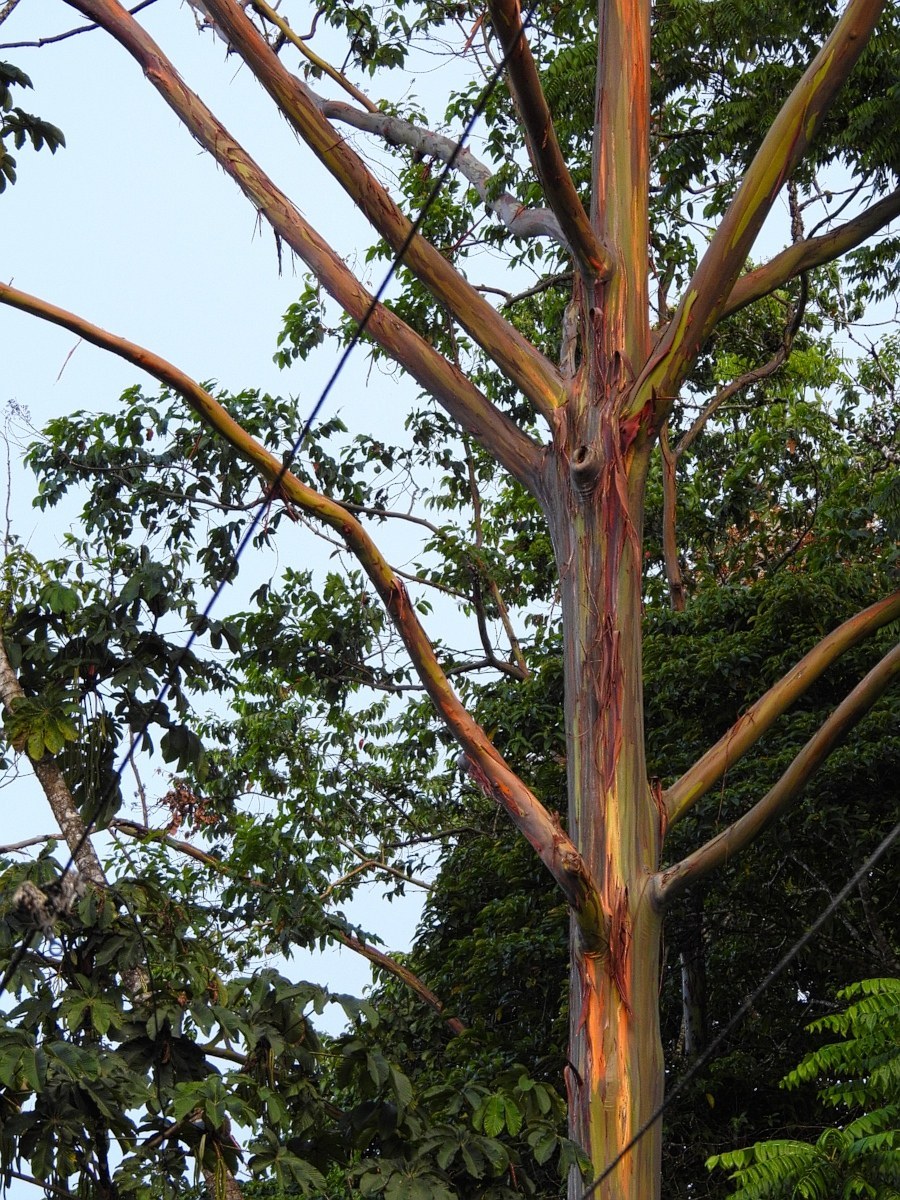
Rainbow Eucalyptus
Eucalyptus deglupta
A towering tropical tree whose smooth bark sheds in patches to reveal streaks of green, blue, orange, purple, and maroon, like a living rainbow. It is the only eucalyptus native to the Northern Hemisphere.
- Light
- Full sun
- Water
- Plentiful; prefers moist soil
- Difficulty
- Moderate
Got a plant like this?
Identify any plant from a photo, free.
Overview
The rainbow eucalyptus, Eucalyptus deglupta, is a fast-growing tropical tree famous for its astonishing multicolored bark. As the smooth outer bark peels away in strips at different times, it exposes bright green inner bark that ages through blue, purple, orange, and maroon, painting the trunk in vivid streaks.
It is a very large tree, reaching 100-200 ft (30-60 m) in its native range, with a straight trunk and broad crown. Unlike most eucalypts, it thrives in wet, humid tropical conditions rather than dry ones.
It is the only Eucalyptus species naturally occurring in the Northern Hemisphere and is widely planted as both an ornamental curiosity and a pulpwood tree.
How to identify it
- Bark: Smooth, shedding in strips to reveal a constantly changing patchwork of green, blue, purple, orange, and maroon
- Leaves: Lance-shaped, aromatic evergreen leaves; bronze-tinged when young
- Habit: Very tall tree, often 100-200 ft in the tropics, with a straight bole and spreading crown
- Flowers: Small white to cream flowers with fluffy stamens, typical of eucalypts
- Fruit: Small woody capsules releasing tiny seeds
Care & growing
Light: Full sun.
Water: Unlike most eucalypts it likes abundant moisture; keep soil moist and never let it dry out for long.
Soil: Prefers deep, fertile, moist but reasonably draining soil.
Temperature: Strictly tropical to subtropical; hardy only in USDA zones 10-11 and damaged below about 40 F (4 C).
Feeding: Benefits from regular feeding to support its rapid growth.
Propagation: Grown from its tiny seeds; grows extremely fast. In cooler climates it can be kept as a container or greenhouse plant but rarely shows full bark color indoors.
Habitat & origin
Eucalyptus deglupta is native to the humid tropics of the Philippines, Indonesia (especially Mindanao and Sulawesi), Papua New Guinea, and New Britain, where it grows in rainforests, often along rivers and in areas of high rainfall.
It is the only eucalyptus species whose natural range extends into the Northern Hemisphere. It is now grown ornamentally and commercially in tropical regions worldwide, including Hawaii, Florida, and parts of Southeast Asia and Latin America.
Frequently asked questions
Why does the bark have rainbow colors?
The smooth bark sheds in strips at different times, exposing fresh green inner bark that gradually darkens through blue, purple, orange, and maroon, so the trunk shows many colors at once.
Can I grow rainbow eucalyptus where it freezes?
No. It is a tropical tree hardy only to about USDA zone 10. In cooler areas it can survive only as a protected container or greenhouse plant and rarely develops full bark color.
How fast and how big does it grow?
It is extremely fast-growing and can reach 100-200 ft in its tropical native range, though cultivated specimens elsewhere are usually smaller.
Is rainbow eucalyptus related to the Australian eucalyptus species?
It is in the same genus but is a distinct, tropical species native to Southeast Asia and the Pacific, rather than to Australia.
Rainbow Eucalyptus guides
In-depth guides for identifying, growing, and caring for Rainbow Eucalyptus.
How to Care for Rainbow Eucalyptus
Grow Eucalyptus deglupta for its famous multicolored bark, in full sun with plentiful water and warm, frost-free conditions.
Rainbow Eucalyptus Identification Guide
Identify the rainbow eucalyptus (Eucalyptus deglupta) by its multicolored peeling bark streaked green, blue, orange, and purple, plus its aromatic leaves and woody capsules.