
Rattlesnake Master Identification Guide
Identify Rattlesnake Master by its yucca-like spiny-edged leaves and globe-shaped greenish-white flower heads, an unusual prairie member of the carrot family.
Read the full Rattlesnake Master encyclopedia entry →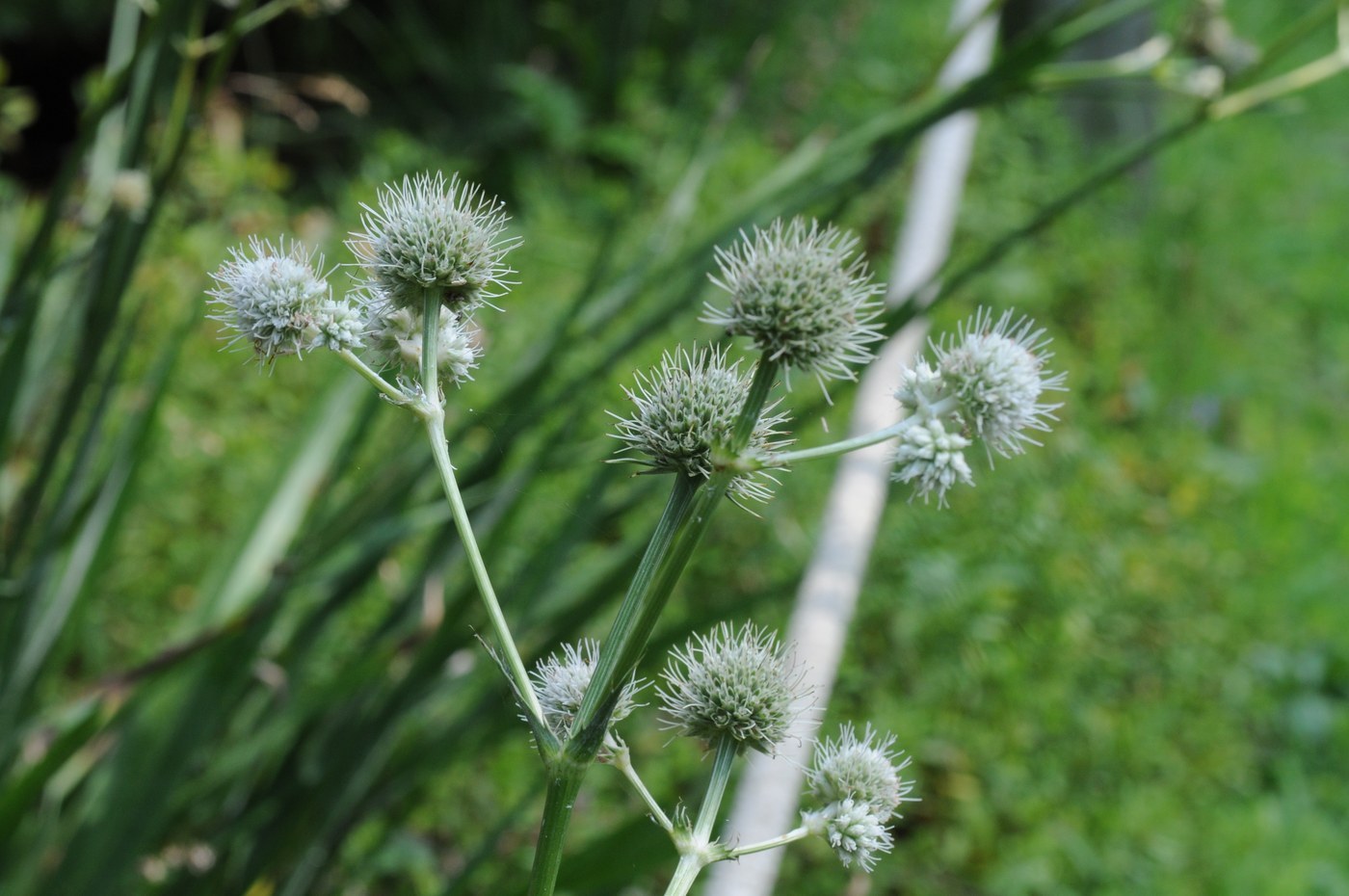
Key Identifying Features
Rattlesnake Master (Eryngium yuccifolium) is a distinctive tallgrass-prairie perennial that looks more like a yucca than its true relatives in the carrot family. Identify it by:
- Stiff, sword-like, blue-green leaves with soft spiny (bristly) edges, resembling a yucca
- Round, golf-ball-sized greenish-white flower heads clustered at the top
- A smooth, stout, often branching upper stem 2-5 feet tall
- A spiky, architectural, almost prehistoric appearance
Leaves & Stems
The leaves are the giveaway and the source of the species name yuccifolium: long, narrow, parallel-veined, rigid, and gray-green, with widely spaced soft spines or bristles along the margins. Lower leaves can be 1-3 feet long, clustered at the base, becoming smaller and clasping up the stem. The stem is smooth, stiff, and pale green, branching near the top to hold the flower heads. Despite the yucca look, crushing the foliage and the overall structure place it in the Apiaceae (carrot/parsley family).
Flowers & Fruit
Instead of the flat-topped umbels typical of carrots, Rattlesnake Master packs its tiny flowers into dense, globular heads about 1/2 to 1 inch across, greenish-white to pale silvery, each head studded with small pointed bracts giving a slightly prickly, thistle-like feel (though not sharp). Many heads top the branched stem. Bloom time is summer (June-September), drawing a wide range of bees, wasps, beetles, and butterflies to the accessible nectar. The fruit is a small, scaly, dry schizocarp typical of the carrot family.
How to Tell It Apart from Look-Alikes
- Yucca (Yucca spp.): superficially similar spiny leaves, but Yucca leaves are stiffer with sharp tips and marginal threads, and it produces a tall stalk of large bell-shaped white flowers, not round greenish heads.
- Thistles / Eryngo (Eryngium leavenworthii): related Eryngos have purple/blue thistle-like heads and deeply lobed spiny leaves; Rattlesnake Master's leaves are strap-shaped and parallel-veined.
- Sea hollies (other Eryngium): often blue-tinged and more sharply spiny.
The strap-like soft-spined leaves + round greenish-white heads combination is unique on the prairie.
Where You'll Find It
Rattlesnake Master grows in tallgrass prairies, savannas, open woods, glades, and prairie restorations across the central and eastern U.S., in full sun and well-drained soils. It was historically (and mistakenly) thought to treat snakebite, hence the name, and is now a popular native-garden and pollinator plant.
Quick ID Checklist
- Stiff, yucca-like blue-green leaves with soft spiny margins
- Round, golf-ball greenish-white flower heads
- Stout, smooth, branching stem 2-5 ft tall
- Parallel-veined strap leaves (member of carrot family)
- Prairie/savanna habitat, full sun
- Blooms in summer; major pollinator plant
Frequently asked questions
Is Rattlesnake Master related to yucca?
No. Despite its yucca-like spiny strap leaves, Rattlesnake Master is a member of the carrot and parsley family (Apiaceae). The leaf resemblance is the reason for its species name yuccifolium, but the two are unrelated.
Does it actually treat snakebite?
No. The name comes from a historical folk belief that the root could cure or protect against rattlesnake bites, but this has no proven medical basis. The name persists for historical reasons only.
What do the flowers look like up close?
Each round head is packed with many tiny greenish-white flowers and small pointed bracts, giving a slightly prickly, thistle-like ball about half an inch to an inch across that attracts diverse pollinators.
Where does Rattlesnake Master grow?
In tallgrass prairies, savannas, glades, and open woods across the central and eastern United States, in full sun and well-drained soil, and increasingly in native and pollinator gardens.