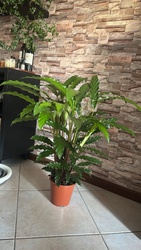
Rattlesnake Plant Identification Guide
Identify the Rattlesnake Plant (Goeppertia / Calathea lancifolia) by its long wavy leaves with dark spots and purple undersides. Includes look-alike comparisons.
Read the full Rattlesnake Plant encyclopedia entry →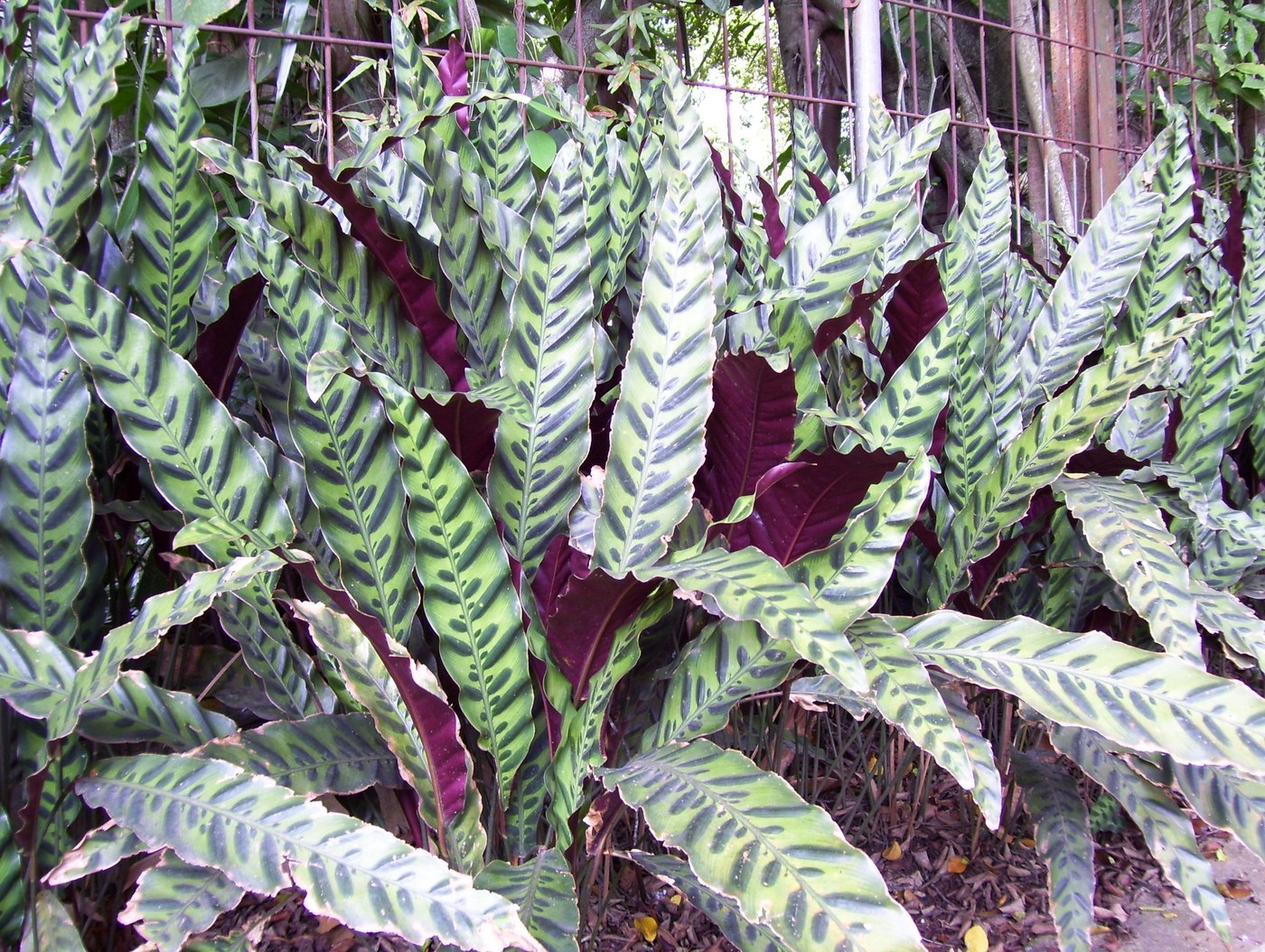
Key Identifying Features
The Rattlesnake Plant (Goeppertia insignis, syn. Calathea lancifolia) is a prayer plant named for the snakeskin-like pattern of dark green spots along its long, wavy leaves, paired with deep purple-red undersides. The bold markings resemble a rattlesnake's tail.
- Long, narrow, lance-shaped leaves with wavy edges
- Alternating large and small dark green spots down the midrib
- Purple-maroon leaf undersides
- Upright clumping habit with prayer-plant movement
Leaves & Stems
Leaves are slender and elongated (up to 18 inches) with a strongly undulating, ruffled margin. The light green surface is marked with darker green ovals that alternate large and small along the central vein, mimicking reptile scales. The undersides are rich purple to burgundy, visible as leaves curl upward at night. Plants form upright clumps to about 2-3 feet, with leaves on slim stalks that rise in the evening and lower by day, a classic Marantaceae trait.
Flowers & Fruit
Outdoors in the tropics it can produce small yellow-orange flower spikes, but indoors it rarely blooms. It is grown for foliage; ornamental fruit is not produced as a houseplant.
How to Tell It Apart from Look-Alikes
- Velvet Calathea (G. rufibarba) has similar wavy narrow leaves but is plain green and fuzzy, lacking the dark spots.
- Calathea 'Medallion' or 'Orbifolia' have broad, rounded patterned leaves, not narrow spotted ones.
- Maranta (prayer plant) is low/trailing with red veins, not upright with spotted lance leaves.
The long wavy leaf with alternating dark spots and a purple underside is uniquely diagnostic.
Where You'll Find It
Native to the rainforests of Brazil, it is grown as a humidity-loving houseplant in bright indirect light. It needs steady moisture, warmth, and protection from drafts, and is favored for its striking foliage and nightly leaf movement.
Quick ID Checklist
- Long, narrow leaves with wavy/ruffled edges
- Dark green spots alternating large and small along the midrib
- Purple-maroon undersides
- Upright clumping growth
- Leaves fold up at night (prayer plant)
Spotted, wavy-edged leaves with purple backs confirm the Rattlesnake Plant.
Frequently asked questions
Why is it called Rattlesnake Plant?
The alternating dark green spots along its wavy leaves resemble the pattern on a rattlesnake's skin and tail.
Why are the undersides purple?
Purple-maroon undersides are a natural feature, most visible when the leaves fold upward at night. It is a normal identifying trait.
Do the leaves move?
Yes. As a prayer plant, its leaves rise and fold at night and lower during the day, sometimes with an audible rustle.
How is it different from Velvet Calathea?
Velvet Calathea has plain green, fuzzy leaves. Rattlesnake Plant has smooth leaves marked with distinctive dark spots.
Rattlesnake Plant identified by the community
Recent Rattlesnake Plant specimens identified with Plant Identifier.