
Red Hot Poker Identification Guide
How to identify Red Hot Poker (Kniphofia) by its torch-like spikes of densely packed tubular flowers that grade from red-orange to yellow, above grassy clumps of foliage.
Read the full Red Hot Poker encyclopedia entry →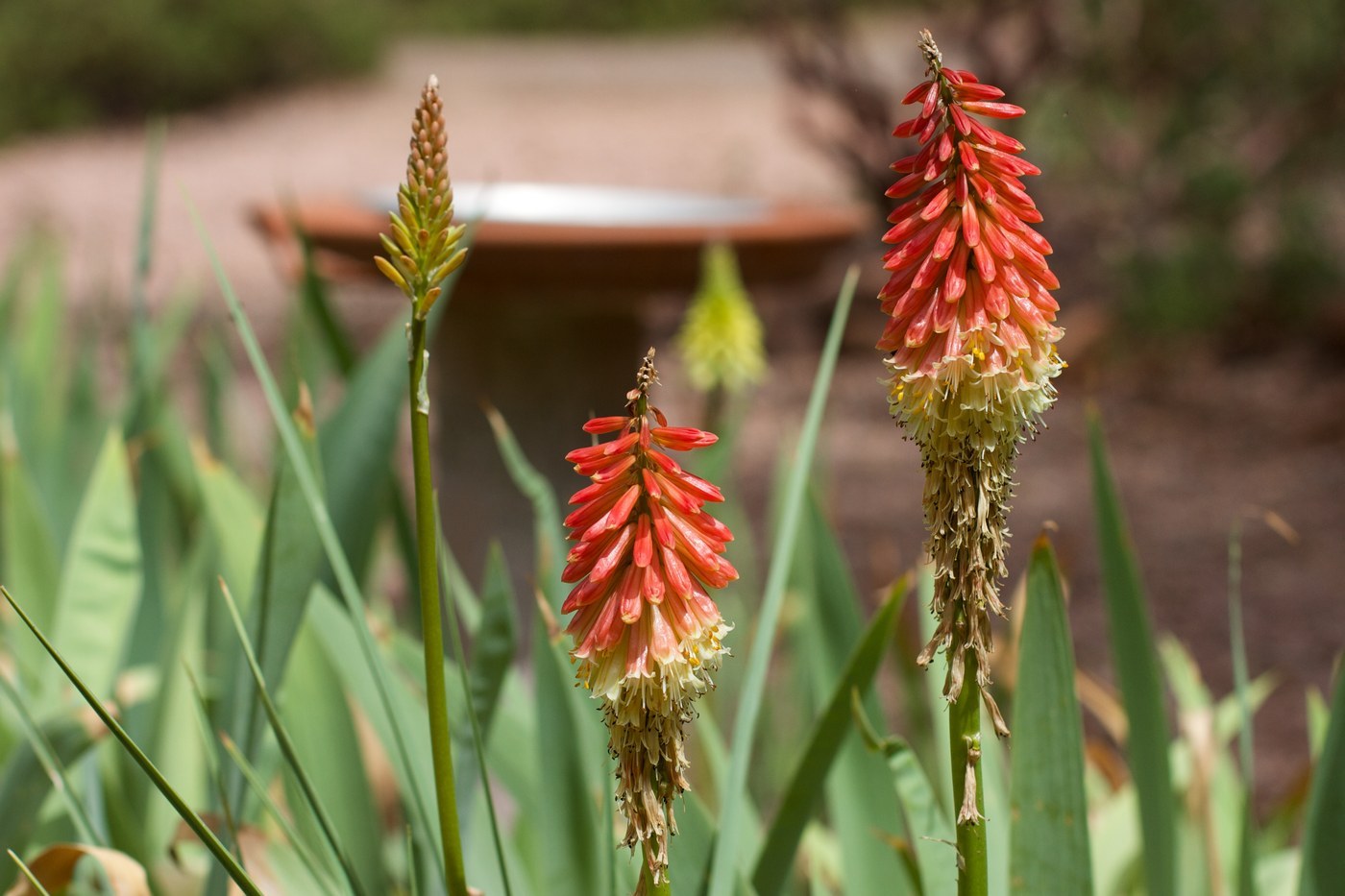
Key Identifying Features
Red Hot Poker (Kniphofia, also called Torch Lily or Poker Plant) is unmistakable when in bloom: tall bare stalks topped by a dense, cone-shaped spike of flowers that often shades from red or orange at the top to yellow below, exactly like a glowing poker.
- Torch-shaped flower spikes in fiery red-orange-to-yellow gradients
- Tall leafless flower stalks (scapes) 2-5 feet above the leaves
- Foliage is a clump of arching, grass-like to sword-shaped leaves
- Attracts hummingbirds, bees, and sunbirds
Leaves & Stems
The leaves form a dense basal clump, are long, narrow, and strap- or grass-like, often V-shaped or keeled in cross-section, and arch outward. They can be 1-3 feet long and are usually blue-green to gray-green. The flower stalk is a smooth, leafless scape rising straight up from the clump, bearing only the flower head at its tip.
Flowers & Fruit
The flower head is a dense, elongated cluster (raceme) of many slim, drooping tubular flowers packed tightly around the stalk. Flowers open from the bottom up, so the top buds are often a hotter red-orange while the lower, open flowers fade to yellow or cream, creating the classic two-tone torch. Each tube is about 1-2 inches long. Some cultivars are solid yellow, coral, or greenish. After flowering, small three-parted seed capsules form.
How to Tell It Apart from Look-Alikes
- Aloe: aloes also have tubular orange-red flower spikes, but their leaves are thick, fleshy, succulent, and often spiny-edged, whereas Kniphofia leaves are thin, grassy, and unarmed.
- Yucca: sword leaves are similar, but yucca produces white bell-shaped flowers, not tubular red-orange torches.
- Eremurus (foxtail lily): tall spikes too, but flowers are star-shaped and spread loosely up a much taller stalk, not packed into a dense drooping-tube torch.
The two-tone, densely packed, drooping-tube torch over grassy (not succulent) foliage is diagnostic.
Where You'll Find It
Native to Africa, Red Hot Poker is widely planted in sunny borders, gravel gardens, and pollinator gardens. It thrives in full sun with well-drained soil and is drought-tolerant once established. Look for its torches blooming from early summer into fall depending on the variety, standing tall above the leaf clumps.
Quick ID Checklist
- Torch/poker-shaped dense flower spike
- Colors often graded red-orange at top to yellow below
- Many slim, drooping tubular flowers packed around the stalk
- Tall leafless scape above a clump
- Leaves grassy/strap-like, not succulent (vs. aloe)
A fiery, two-tone torch of tubular flowers on a bare stalk over grassy foliage is Red Hot Poker.
Frequently asked questions
Why do red hot poker flowers have two colors?
Flowers open from the bottom of the spike upward. The unopened upper buds are usually a hotter red-orange while the older, open lower flowers fade to yellow or cream, producing the two-tone torch effect.
How is red hot poker different from aloe?
Both have tubular orange-red flower spikes, but aloe has thick fleshy succulent leaves, often with spiny edges, while red hot poker has thin, grassy, strap-like, unarmed foliage.
What pollinates red hot poker?
In its native Africa, sunbirds visit it; in gardens worldwide it attracts hummingbirds and bees, which are drawn to the abundant nectar in the tubular flowers.
When does it bloom?
Depending on the species and cultivar, red hot poker blooms from early summer into autumn, with some varieties offering repeat or extended flowering.