Red Hot Poker
Kniphofia uvaria
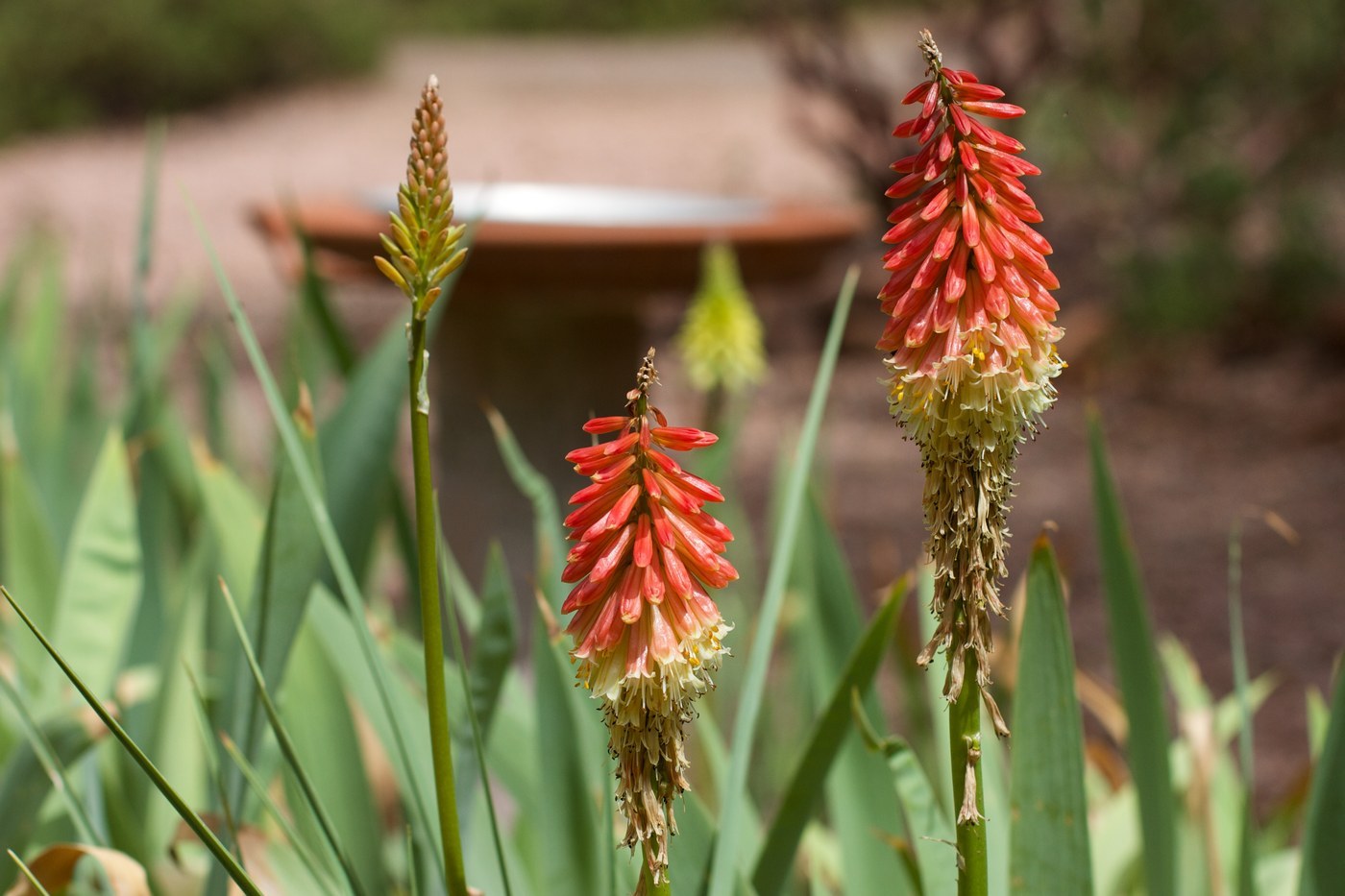
Red hot poker is a bold perennial sending up torch-like spikes of tubular flowers that grade from fiery red at the top to yellow below. Its grassy clumps and dramatic blooms attract hummingbirds and bees.
- Light
- Full sun
- Water
- Low to moderate; well-drained
- Difficulty
- Easy
Got a plant like this?
Identify any plant from a photo, free.
Overview
Red hot poker (Kniphofia uvaria) earns its name from flower spikes that look like glowing pokers, with buds opening from the bottom up so each spike often shows red, orange, and yellow at once.
Native to South Africa, it forms arching clumps of strappy, grass-like foliage from which the tall flower stalks rise in summer. It is tough, drought-tolerant once established, and very showy.
Modern Kniphofia hybrids come in many colors and sizes, but the classic red-and-yellow torch remains a cottage and prairie garden favorite.
How to identify it
- Flowers: Dense, cylindrical spikes of downward-pointing tubular flowers; typically red/orange at top fading to yellow below, on bare stalks 2-4 ft tall
- Foliage: Arching, narrow, grass- or aloe-like leaves forming a dense basal clump
- Bloom time: Summer, with some rebloom if deadheaded
- Habit: Clumping evergreen to semi-evergreen perennial
Care & growing
- Light: Full sun for strong, upright flowering
- Water: Moderate during growth, low once established; tolerates drought but dislikes soggy soil, especially in winter
- Soil: Sharp drainage is essential; sandy or gritty soils are ideal, and wet winter soil causes crown rot
- Temperature: Hardy about USDA zones 5-9 depending on species; mulch crowns in cold zones
- Feeding: Light; a spring feed supports bloom
- Propagation: By division of clumps in spring (it resents frequent disturbance) or from seed
Habitat & origin
Red hot poker is native to South Africa, where various Kniphofia species grow in grasslands, moist mountain slopes, and along streams.
It is widely grown as an ornamental in temperate and Mediterranean climates and has naturalized in parts of California, Australia, and Europe.
Frequently asked questions
Why won't my red hot poker bloom?
The most common causes are too much shade, overcrowded clumps, or overly rich soil. Give it full sun, divide congested clumps, and avoid heavy feeding.
How do I overwinter red hot poker in cold climates?
Ensure excellent drainage, tie up the foliage to protect the crown from wet, and mulch the base. Winter wet, not cold alone, is the main killer.
Should I cut back red hot poker?
Remove spent flower spikes to encourage rebloom and tidy old or damaged foliage in spring. Avoid cutting all leaves in fall, as they help protect the crown.
Is red hot poker invasive?
It can naturalize and spread in mild climates like coastal California, but in most gardens it stays a well-behaved clump.
Red Hot Poker guides
In-depth guides for identifying, growing, and caring for Red Hot Poker.
How to Care for Red Hot Poker
Red hot poker is a bold, easy perennial with fiery flower spikes that loves full sun and sharp drainage.
Red Hot Poker Identification Guide
How to identify Red Hot Poker (Kniphofia) by its torch-like spikes of densely packed tubular flowers that grade from red-orange to yellow, above grassy clumps of foliage.