
Rex Begonia Identification Guide
Recognize Begonia rex-cultorum by its large, asymmetrical, swirled leaves in metallic silver, purple, pink, and green, with hairy red-backed undersides.
Read the full Rex Begonia encyclopedia entry →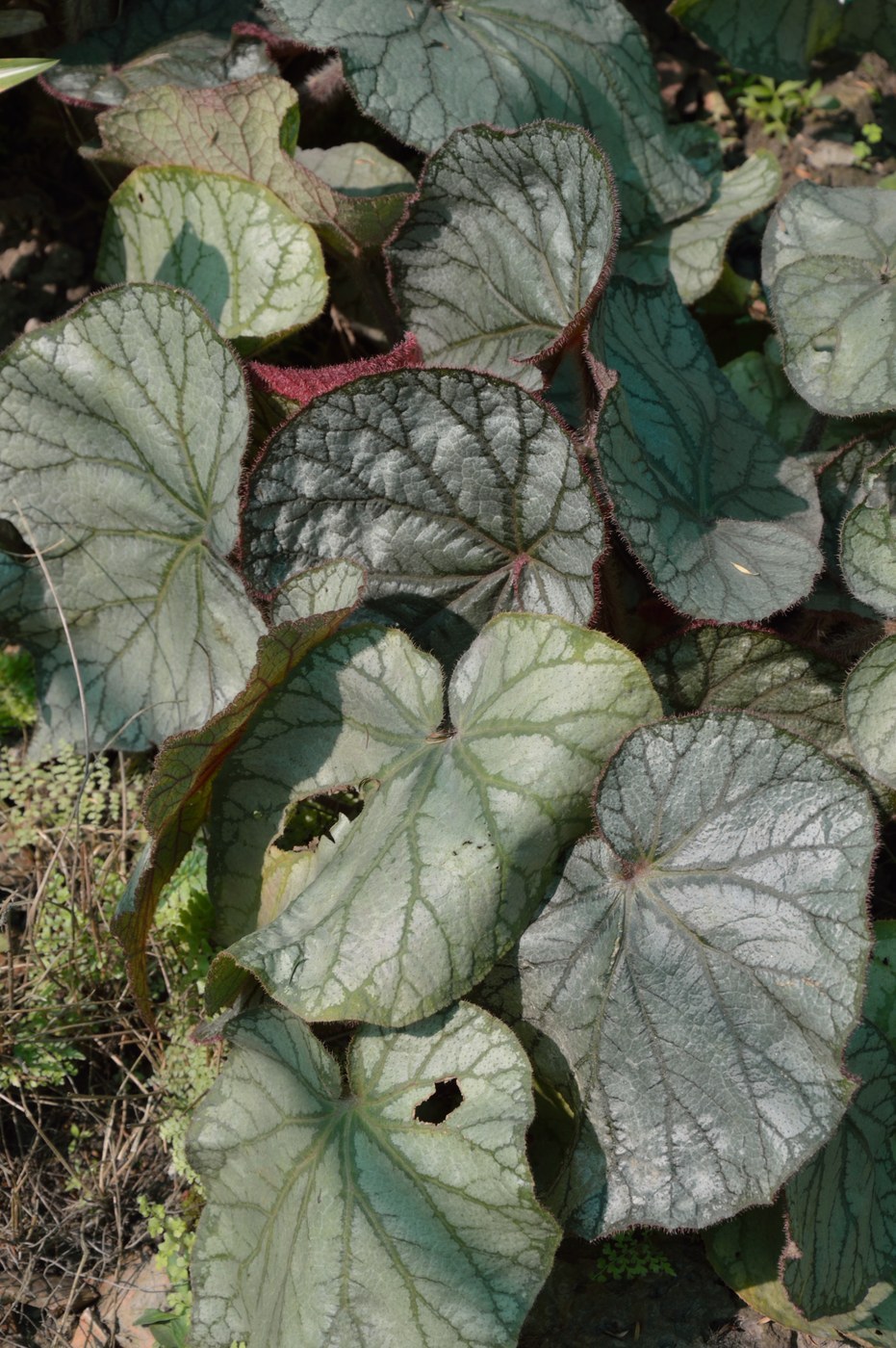
Key Identifying Features
Rex Begonia (Begonia rex-cultorum hybrids) is a foliage begonia grown for its large, lopsided leaves splashed in metallic silver, purple, burgundy, pink, and green, often arranged in spirals or bold concentric bands.
- Asymmetrical (lopsided) leaf base, the classic begonia trait
- Leaves large, often heart- to spiral-shaped, vividly multicolored with metallic sheen
- Undersides typically red to maroon, often hairy
- Grows from a rhizome that creeps along the soil surface
Leaves & Stems
The leaves are the whole point: 6-23 cm long, with a strongly uneven (oblique) base where one side of the leaf attaches lower than the other on the stalk. Surfaces show swirled, banded, or spotted patterns in silver, pewter, plum, rose, emerald, and near-black, frequently with a metallic or iridescent shimmer. Many have a spiraled "escargot" snail-shell base in some cultivars. The leaf back is usually reddish and covered in fine hairs.
Growth arises from a thick, creeping rhizome rather than tall woody canes (distinguishing it from cane/angel-wing begonias). Petioles are often hairy and reddish.
Flowers & Fruit
Rex begonias do flower, sending up small pink or pale-white flowers on wiry stalks, but the blooms are modest and often removed so the plant invests in foliage. Like all begonias, flowers are unisexual (separate male and female on the same plant) and the female flowers have a small winged ovary. Foliage, not flowers, drives identification.
How to Tell It Apart from Look-Alikes
- Cane/angel-wing begonias have tall bamboo-like stems and wing-shaped, spotted leaves, not creeping rhizomes and metallic swirls.
- Painted-leaf or other rhizomatous begonias can look similar, but rex hybrids are the most boldly metallic and multicolored.
- Caladium has arrowhead leaves with a symmetrical, centered stalk attachment (peltate), whereas rex begonia leaves are lopsided at the base.
- The asymmetrical leaf base + metallic multicolor + red hairy underside + rhizome combination confirms a rex begonia.
Where You'll Find It
Derived from species native to northeastern India and parts of Asia, rex begonias are grown worldwide as humidity-loving houseplants, terrarium specimens, and shade container plants. They want warmth, high humidity, and bright indirect light.
Quick ID Checklist
- Large, lopsided (asymmetrical) leaves
- Metallic silver/purple/pink/green coloring
- Reddish, often hairy leaf undersides
- Creeping rhizome at soil surface
- Small pink flowers, foliage far showier
Frequently asked questions
What makes a begonia leaf look lopsided?
All begonias have an asymmetrical (oblique) leaf base, where one side attaches lower than the other. In rex begonias this uneven base, plus metallic coloring, is a key identification trait.
How is a rex begonia different from a caladium?
Caladium leaves are arrowhead-shaped with the stalk attached centrally (peltate) and are symmetrical, while rex begonia leaves are lopsided at the base and often have a metallic, swirled sheen and red hairy backs.
Why are the leaf undersides red and fuzzy?
Red pigmentation and fine hairs on the underside are normal for rex begonias and help with identification. The red helps the shade plant capture and reflect light.
Do rex begonias flower?
Yes, they produce small pink or white flowers, but the blooms are unremarkable and many growers remove them so the plant focuses energy on its spectacular foliage.