
Rhubarb Identification Guide
How to identify rhubarb by its huge crinkled heart-shaped leaves, thick red-to-green stalks rising from a ground-level crown, and tall plumed flowering stalks.
Read the full Rhubarb encyclopedia entry →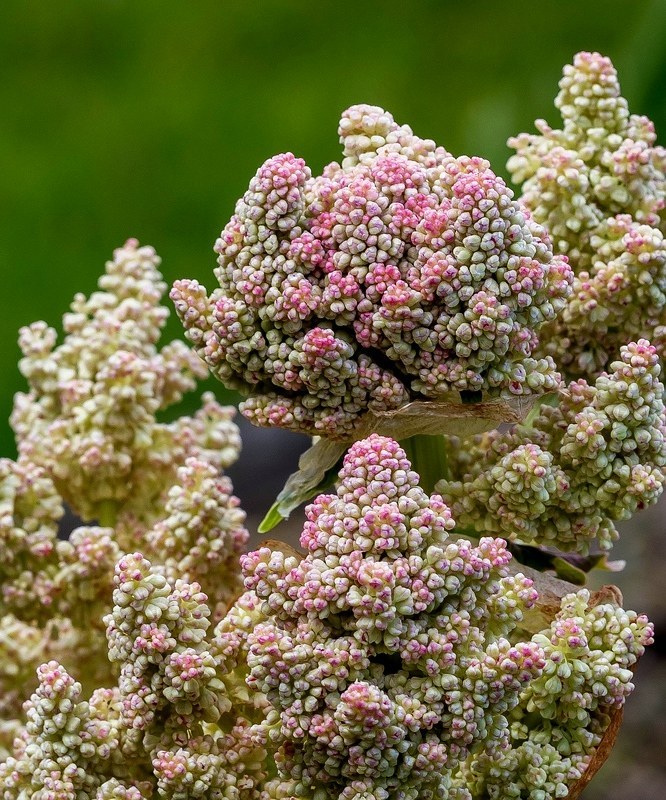
Key Identifying Features
Rhubarb (Rheum rhabarbarum / Rheum × hybridum) is a hardy herbaceous perennial in the knotweed family (Polygonaceae). It is unmistakable as a clump of very large, heart-shaped to triangular leaves rising on thick, fleshy stalks (petioles) directly from a crown at ground level.
- Growth habit: mounded clump 2–4 ft tall and wide, emerging from a stout underground crown/rhizome
- Stalks: thick, juicy, often celery-like in shape but much stouter, frequently red-tinged
Leaves & Stems
The leaves are enormous — blades commonly 1–2 ft across, broadly heart-shaped (cordate) to triangular, with wavy, crinkled (rugose) surfaces and undulating margins. Veins are prominent and often reddish on the underside. Each leaf sits at the top of a thick, grooved petiole 1–2 ft long, colored anywhere from deep cherry-red to pink-speckled to mostly green depending on variety. A papery sheath (ocrea) wraps the stalk base where it meets the crown — a classic knotweed-family trait.
Flowers & Fruit
Mature plants may "bolt," sending up a tall, hollow flowering stalk 3–6 ft high topped with a large branched plume of tiny creamy-white to greenish flowers. The flowers give way to small, dry, winged (3-angled) reddish-brown seeds (achenes), typical of the buckwheat/knotweed family. Gardeners usually remove flower stalks to keep stalk production going.
How to Tell It Apart from Look-Alikes
- Burdock (Arctium): also has huge leaves, but they are dull green with woolly undersides and the plant produces hooked burrs; petioles are not red or crisp.
- Swiss chard: has colorful red/yellow stalks too, but they are thin, flat-ribbed, and the leaves are smaller and glossy, not giant and crinkled.
- Ornamental rhubarbs (Rheum palmatum): have deeply lobed, jagged leaves rather than smooth heart-shaped blades.
- Skunk cabbage / large hostas: lack the thick red petiole and the papery ocrea sheath.
The combo of giant crinkled heart-shaped leaf + thick fleshy (often red) petiole + ground-level crown is diagnostic.
Where You'll Find It
A cool-climate garden classic, rhubarb thrives in temperate zones with cold winters that it needs for dormancy. Look for it in vegetable and perennial gardens, old homesteads, and abandoned farm plots where established crowns persist for decades.
Quick ID Checklist
- Clump form rising from a ground-level crown, 2–4 ft
- Huge crinkled heart-shaped leaves, 1–2 ft across
- Thick fleshy petioles, often red to pink, with a papery sheath at the base
- Tall plume of tiny cream-green flowers when bolting
- Winged 3-angled reddish-brown seeds after flowering
Frequently asked questions
Does rhubarb have to be red?
No. Stalk color is variety-dependent — some cultivars stay mostly green even when fully mature. Color alone is not a reliable identification guide; rely on the giant crinkled leaves and thick fleshy stalks instead.
How do I tell rhubarb from burdock?
Both have big leaves, but rhubarb has smooth, crinkled heart-shaped blades on crisp, often red, fleshy stalks rising from a crown, while burdock has woolly-backed leaves, no red stalks, and produces hooked burrs.
What is the tall stalk with flowers on my rhubarb?
That's a bolting flower stalk topped with a plume of tiny creamy-green flowers. It's normal in mature plants, but most growers cut it off so the plant keeps putting energy into its stalks and leaves.
How big do rhubarb leaves get?
Very large. The broadly heart-shaped, crinkled blades commonly reach 1 to 2 feet across, sitting atop thick grooved petioles of similar length, which makes a mature clump one of the boldest-textured plants in the garden.