Rose of Sharon Identification Guide
Identify Rose of Sharon (Hibiscus syriacus) by its upright shrubby form, three-lobed toothed leaves, and large late-summer hibiscus flowers with a prominent staminal column.
Read the full Rose of Sharon encyclopedia entry →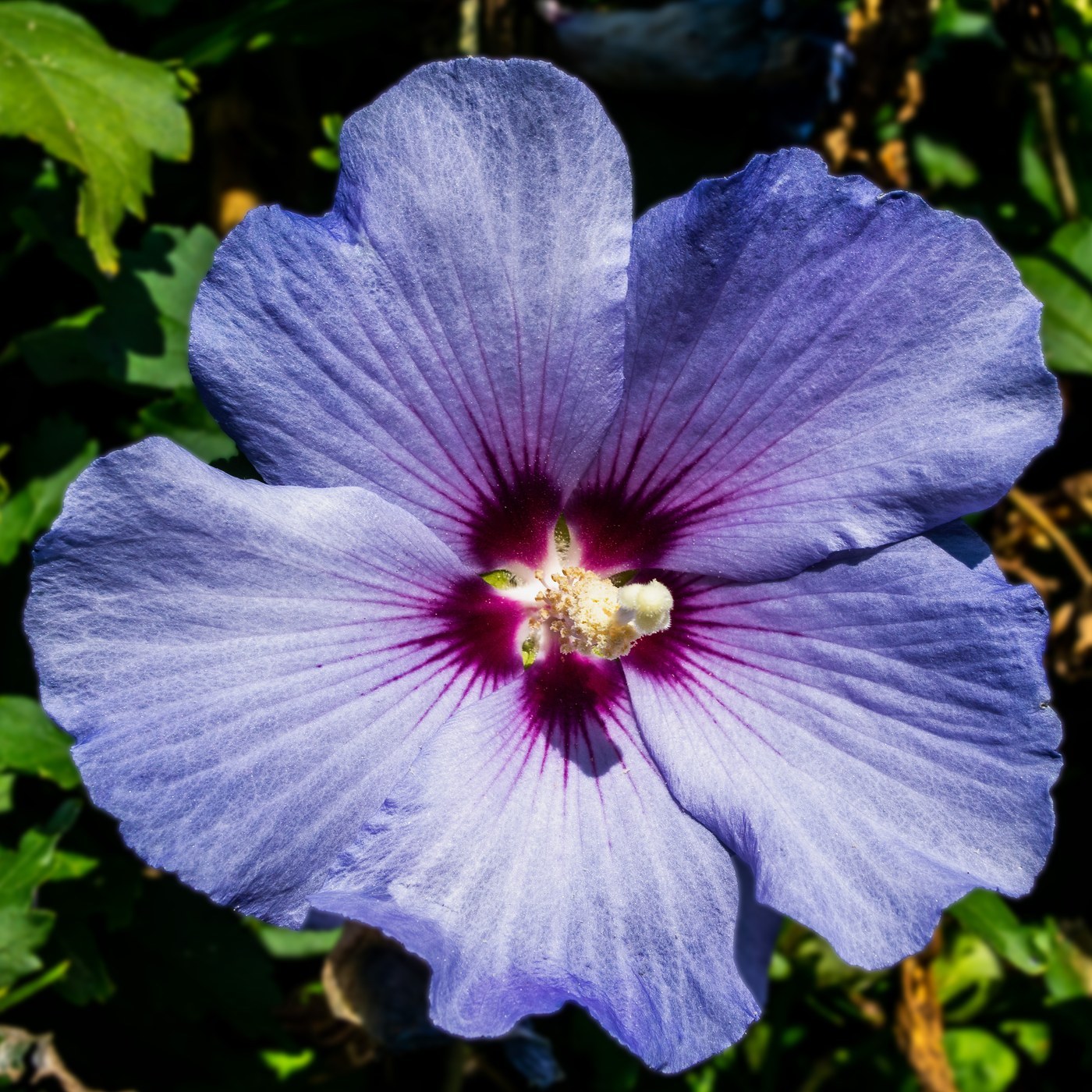
Key Identifying Features
Rose of Sharon (Hibiscus syriacus) is a hardy, deciduous shrub or small tree grown for its big, showy hibiscus-style flowers in late summer. It is recognized by its upright vase-shaped form, three-lobed coarsely toothed leaves, and flowers with a central column of fused stamens.
- Large flowers (2–4 in) with five petals and a prominent staminal column
- Blooms mid-to-late summer into fall, when many shrubs are done
- Three-lobed, coarsely toothed, diamond-shaped leaves
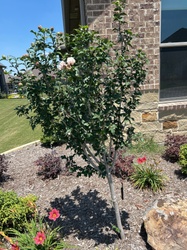
- Upright, multi-stemmed, vase-shaped growth
Leaves & Stems
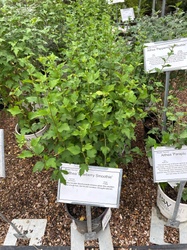
Leaves are alternate, roughly 2–4 inches, broadly diamond-shaped (rhombic) and usually three-lobed toward the tip, with coarse, irregular teeth along the margins. They are medium green and emerge late in spring — the late leaf-out is itself a clue. Stems are upright and gray-brown, forming a dense, twiggy, vase-shaped shrub typically 6–12 ft tall.
Flowers & Fruit
Flowers are the highlight: broadly funnel-shaped, 2–4 inches across, with five overlapping petals in white, pink, lavender, blue, or purple, often with a darker red or maroon throat. A slender column of fused stamens topped with a protruding pistil projects from the center — the classic mallow-family signature. After bloom, brown five-parted woody seed capsules form and persist into winter, releasing seeds that self-sow readily.
How to Tell It Apart from Look-Alikes
- Hardy hibiscus (Hibiscus moscheutos) is herbaceous (dies to the ground) with dinner-plate flowers and unlobed leaves; Rose of Sharon is woody with smaller lobed leaves.
- Tropical hibiscus is not winter-hardy and has glossier leaves.
- Hollyhock is a tall herbaceous biennial, not a shrub.
- The combination of woody upright shrub + 3-lobed toothed leaves + late-summer hibiscus flowers with a staminal column confirms Rose of Sharon.
Where You'll Find It
Rose of Sharon is widely planted in temperate gardens across North America, Europe, and Asia as a hedge, screen, or specimen, valued for late-season color and toughness. Native to east Asia, it naturalizes and self-seeds freely in disturbed ground, fencerows, and old gardens.
Quick ID Checklist
- Upright woody shrub, vase-shaped
- 3-lobed, coarsely toothed alternate leaves
- Late-summer hibiscus flowers with central staminal column
- Often dark throat; many color forms
- Persistent brown seed capsules; self-sows
Frequently asked questions
How is Rose of Sharon different from hardy hibiscus?
Rose of Sharon is a woody shrub with smaller, three-lobed leaves, while hardy hibiscus is herbaceous, dies back each winter, and has huge dinner-plate flowers on unlobed leaves.
When does Rose of Sharon bloom?
It flowers from mid-to-late summer into early fall, providing color when most other shrubs have finished blooming.
What is the column sticking out of the flower?
That is the staminal column — fused stamens surrounding the style — a hallmark of the mallow family that helps confirm the identification.
Why does Rose of Sharon leaf out so late?
It is naturally one of the last shrubs to break dormancy in spring, so bare branches in late spring are normal and not a sign of dieback.
Rose of Sharon identified by the community
Recent Rose of Sharon specimens identified with Plant Identifier.