
Rowan Identification Guide
How to identify Rowan (Sorbus aucuparia, mountain ash) by its feathery pinnate leaves, flat white flower clusters, and bunches of orange-red berries.
Read the full Rowan encyclopedia entry →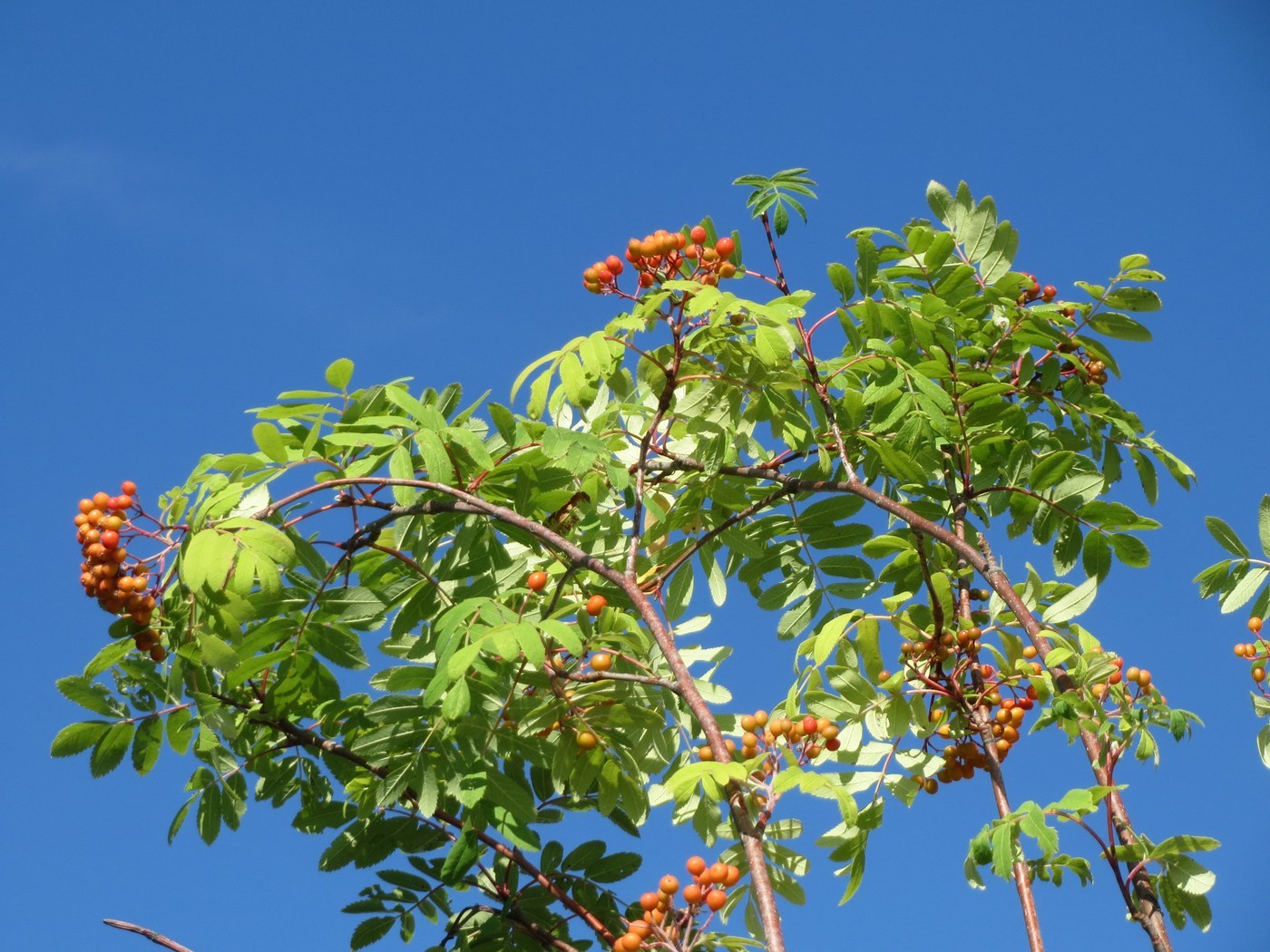
Key Identifying Features
Rowan (Sorbus aucuparia), also called mountain ash, is a graceful small tree recognized by its ash-like feathery leaves, flat sprays of white flowers, and dense bunches of bright orange-red berries in autumn.
- Pinnate (feather-like) leaves with many toothed leaflets
- Flat-topped clusters of creamy-white flowers in spring
- Hanging bunches of orange-red berries in late summer/autumn
- Smooth silvery-gray bark; slender, upright form, 8-15 m tall
Leaves & Stems
Leaves are alternate and pinnately compound, 10-25 cm long, with 9-19 (usually 11-15) leaflets arranged in pairs along a central stalk plus one at the tip. Each leaflet is narrow, oblong, 3-6 cm long, with sharply toothed (serrated) margins, dark green above and paler/slightly hairy below. The foliage often turns yellow to red in autumn.
Despite the name 'mountain ash', it is unrelated to true ash trees — the feathery leaf shape is similar, but rowan leaflets are toothed and the buds and flowers are completely different. Bark is smooth, shiny, silvery-gray, marked with horizontal lenticels; young twigs are purplish with hairy buds.
Flowers & Fruit
- Flowers appear in late spring (May-June) in dense, flat-topped clusters (corymbs) 8-15 cm across, each a small creamy-white five-petaled bloom with a strong, somewhat heavy scent. The clusters attract many insects.
- Fruit is the signature feature: rounded berries (pomes) 6-9 mm wide in large drooping bunches, ripening from green to vivid scarlet-orange in late summer. They persist into autumn until stripped by birds, and are a key food for thrushes and waxwings.
How to Tell It Apart from Look-Alikes
- True Ash (Fraxinus) has pinnate leaves too but with smooth-margined (or only faintly toothed) leaflets, distinctive black buds, and winged 'key' fruits — never berry bunches.
- Elder (Sambucus) has pinnate leaves and white flower clusters but bears purple-black berries and has soft pithy stems.
- Whitebeam and other Sorbus have simple (undivided) leaves; rowan's fully pinnate toothed leaves plus orange-red berries identify it.
Where You'll Find It
Native across Europe and western Asia, rowan thrives from lowland woods to high mountain slopes (hence mountain ash), often on poor, acidic, or rocky soils where few other trees grow. It is widely planted as an ornamental and street tree for its flowers, berries, and autumn color, and tolerates cold and exposure well.
Quick ID Checklist
- Pinnate leaves with 11-15 sharply toothed leaflets
- Flat creamy-white flower clusters in late spring
- Drooping bunches of bright orange-red berries in autumn
- Smooth silvery-gray bark with horizontal lenticels
- Slender upright tree, often in uplands or planted in gardens
Frequently asked questions
Is rowan the same as ash?
No. Rowan is called 'mountain ash' only because its feather-like leaves resemble those of true ash, but it belongs to a different family (rose family). True ash has smooth-margined leaflets, black buds, and winged keys, never berry clusters.
How do I tell rowan from elder?
Both have pinnate leaves and white flower clusters, but rowan bears bright orange-red berries and has firm woody stems and smooth gray bark, while elder produces purple-black berries on soft, pithy stems.
When do rowan berries appear?
The rounded berries ripen from green to vivid scarlet-orange in late summer, hanging in large drooping bunches that persist into autumn until birds strip them.
Why does rowan grow so high on mountains?
It is exceptionally hardy and tolerant of poor, acidic, rocky soils and exposure, allowing it to colonize high slopes and crags where most other trees cannot survive, which is the origin of the name mountain ash.