
Royal Poinciana Identification Guide
Identify the flamboyant Royal Poinciana (Delonix regia) by its fern-like leaves, umbrella canopy, brilliant red-orange flowers, and large woody seed pods.
Read the full Royal Poinciana encyclopedia entry →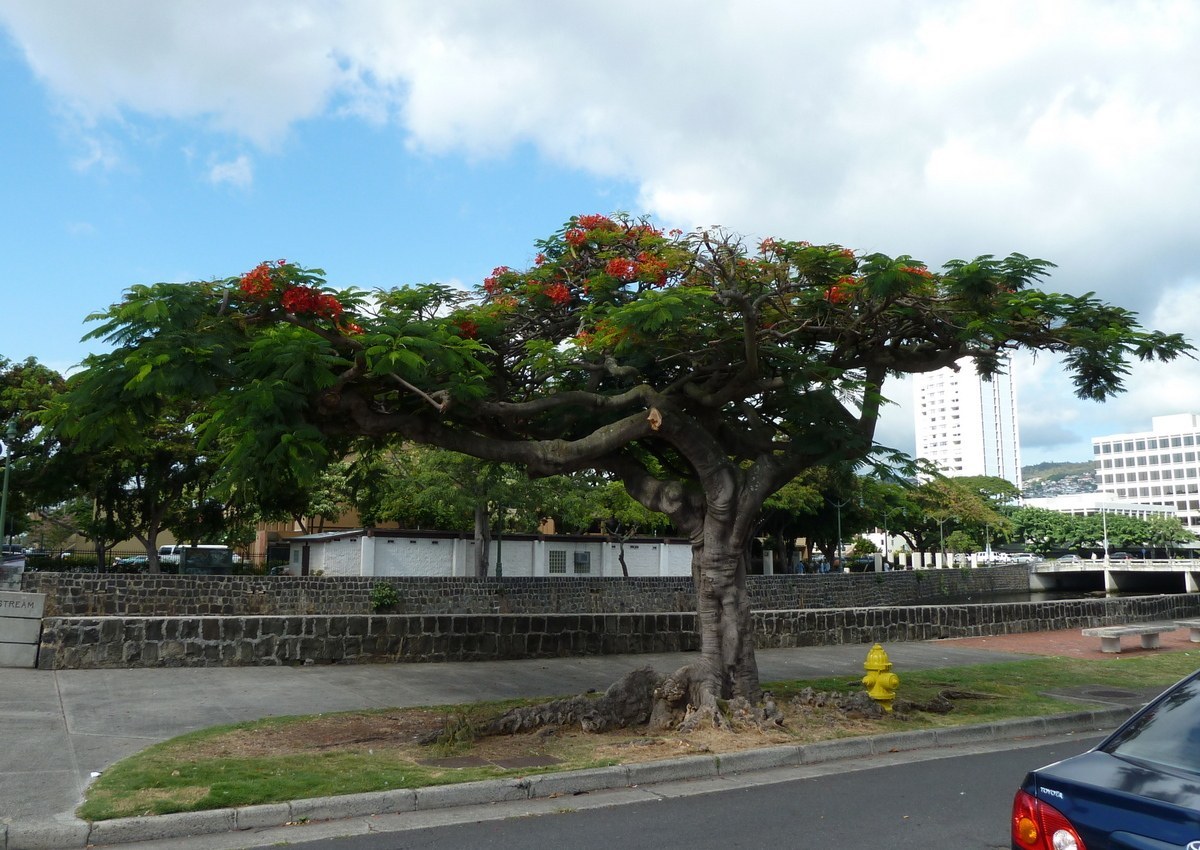
Key Identifying Features
The Royal Poinciana (Delonix regia), also called flamboyant or flame tree, is a tropical legume famous for one of the most spectacular flowering displays of any tree. When in bloom it can appear almost entirely scarlet-orange, with a broad, flat-topped canopy.
- Size & form: Typically 30–40 ft tall but often wider than tall, with a distinctive umbrella-shaped, spreading canopy.
- Trunk: Stout, smooth, gray-brown, often with buttressed surface roots in older trees.
- Habit: Deciduous or semi-deciduous in dry/cool periods, leafing out and flowering in late spring/summer.
Leaves & Stems
The foliage is delicate and fern-like. Leaves are large (up to 20 inches) and bipinnately compound, meaning each leaf is divided into 20–40 pairs of small pinnae, and each pinna carries dozens of tiny oblong leaflets. The overall feathery texture casts light, dappled shade and is a strong clue even when the tree isn't flowering. Leaflets fold closed at night and in heat.
Flowers & Fruit
- Flowers (late spring–summer): Large, showy blooms 4–5 inches across in clusters, each with five petals. Four petals are scarlet to orange-red; the fifth (the standard) is larger, upright, and marked with white and yellow streaks—a key diagnostic. Prominent long red stamens project outward.
- Fruit: Large, flat, woody seed pods 12–24 inches long, dark brown to black when mature. They hang on the tree for months and rattle in the wind, splitting to release hard seeds. The persistent oversized pods are diagnostic outside of flowering season.
How to Tell It Apart from Look-Alikes
- Jacaranda (Jacaranda mimosifolia): Also fern-leaved and umbrella-shaped, but flowers are blue-purple and tubular, not red.
- African tulip tree (Spathodea): Red-orange flowers too, but leaves are pinnate (not bipinnate) and flowers are cup-shaped.
- Pride of Barbados (Caesalpinia): Similar red-orange legume flowers but it's a shrub with much smaller stature.
- Flame of the forest / Butea: Has trifoliate leaves, not feathery bipinnate foliage.
Where You'll Find It
Native to Madagascar, the Royal Poinciana is now planted throughout the frost-free tropics and subtropics—South Florida, the Caribbean, Hawaii, Southeast Asia, India, and northern Australia. It's a common street, park, and avenue tree where temperatures stay above freezing (USDA zone 10+).
Quick ID Checklist
- Broad umbrella canopy, often wider than tall
- Feathery bipinnately compound fern-like leaves
- Mass display of scarlet-orange 5-petaled flowers in summer
- One upper petal streaked white/yellow
- Long flat woody seed pods (1–2 ft) persisting on the tree
- Tropical/subtropical, frost-free climate
Frequently asked questions
When does the Royal Poinciana bloom?
It typically flowers in late spring through summer, often coinciding with the start of the rainy season in tropical regions. The bloom can be so dense it nearly hides the foliage.
How do I distinguish it from a jacaranda?
Both have fern-like foliage and umbrella crowns, but jacaranda produces blue-purple trumpet flowers while Royal Poinciana produces brilliant red-orange flowers. Out of bloom, look for the long woody pods of the poinciana.
Can Royal Poinciana grow outside the tropics?
No. It is very frost-sensitive and only thrives in frost-free climates (USDA zone 10 and warmer), such as South Florida, Hawaii, and the Caribbean.