Royal Poinciana
Delonix regia
A spectacular tropical tree famous for its fiery red-orange canopy of blooms and broad, fern-like foliage. It is one of the most flamboyant flowering trees in the world.
- Light
- Full sun
- Water
- Drought-tolerant once established
- Difficulty
- Moderate
Got a plant like this?
Identify any plant from a photo, free.
Overview
The royal poinciana, Delonix regia, is a fast-growing tropical tree celebrated for its brilliant early-summer flowering, when the entire canopy turns scarlet to orange-red. It belongs to the legume family (Fabaceae).
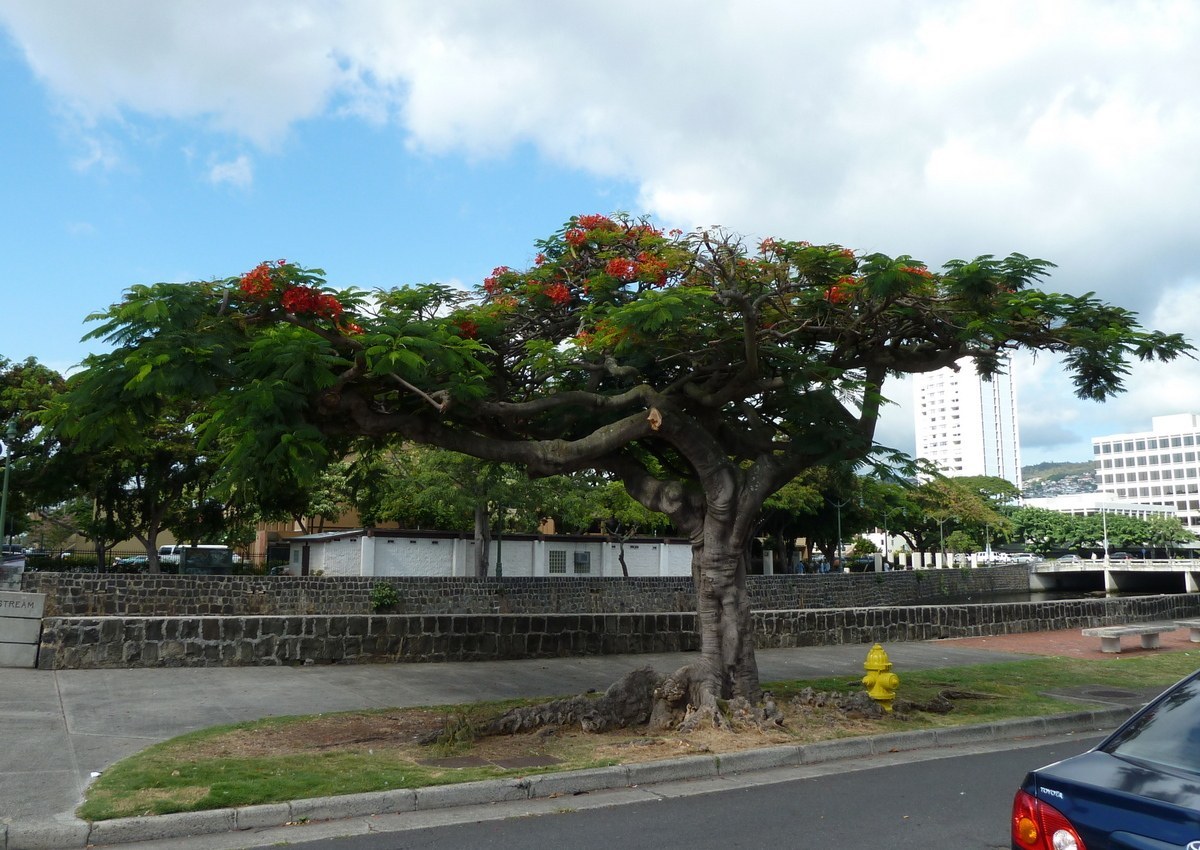
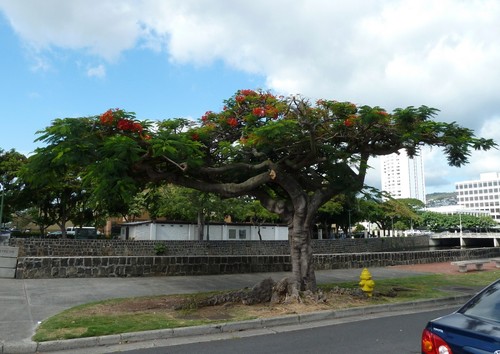
The tree forms a wide, umbrella-like crown that often spreads wider than the tree is tall, casting dense shade. Mature trees reach 30-40 ft (9-12 m) in height with a canopy that can exceed 60 ft (18 m) across.
Native to Madagascar but now planted throughout the tropics, it is also called the flamboyant tree for good reason.
How to identify it
- Flowers: Large, showy blooms 4-5 in (10-13 cm) across with five spoon-shaped petals, typically flame red to orange; one petal is streaked white or yellow
- Leaves: Large, bipinnate (twice-compound), fern-like and feathery, with many tiny leaflets; bright green
- Form: Broad, flat-topped, umbrella-shaped crown wider than the tree is tall
- Pods: Long, woody, flattened seed pods up to 24 in (60 cm) that turn dark brown and persist
- Trunk: Smooth gray bark, often with buttressed roots at the base
Care & growing
Light: Requires full sun; it will not flower well in shade.
Water: Water young trees regularly; mature trees are notably drought-tolerant.
Soil: Tolerant of many soils including sandy and slightly alkaline types, provided drainage is good.
Temperature: Strictly tropical to subtropical; hardy only in USDA zones 10-12 and damaged by frost.
Feeding: As a legume it fixes some nitrogen; minimal fertilizer is needed.
Propagation: Grown from seed, which germinates faster after scarification or soaking. Trees may take several years to begin blooming.
Habitat & origin
Delonix regia is endemic to the dry deciduous forests of Madagascar, where it is now rare in the wild and considered threatened in its native habitat.
It has been widely introduced and is now a signature tree of tropical and subtropical regions worldwide, including the Caribbean, Florida, Hawaii, India, Southeast Asia, and Australia, where it lines avenues and shades parks and gardens.
Frequently asked questions
Where can I grow a royal poinciana?
Only in frost-free tropical and subtropical climates (USDA zones 10-12). It cannot tolerate freezing temperatures.
When does it bloom?
It flowers in late spring and summer, often after dropping its leaves, producing a dramatic blanket of red-orange blossoms.
How long until it flowers from seed?
Seed-grown trees typically take 4-10 years to begin flowering, depending on conditions.
What do the seed pods look like?
They are long, woody, flattened pods up to 24 in (60 cm) long that turn dark brown and often persist on the tree.
Royal Poinciana guides
In-depth guides for identifying, growing, and caring for Royal Poinciana.
How to Care for Royal Poinciana
Grow the flamboyant flame tree: a fast, broad-canopied tropical that erupts in scarlet-orange bloom and needs full sun and frost-free warmth.
Royal Poinciana Identification Guide
Identify the flamboyant Royal Poinciana (Delonix regia) by its fern-like leaves, umbrella canopy, brilliant red-orange flowers, and large woody seed pods.