Russian Sage Identification Guide
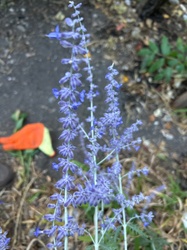
Identify Russian sage by its silvery, square, aromatic stems, finely cut gray-green leaves, and airy spires of small lavender-blue flowers.
Read the full Russian Sage encyclopedia entry →
Key Identifying Features
Russian sage (Salvia yangii, formerly Perovskia atriplicifolia) is a woody-based perennial known for its hazy cloud of tiny lavender-blue flowers on silvery-white, square stems. The whole plant has a gray, airy, almost smoky appearance.
- Stems: square (four-sided), whitish-silver, woody at the base
- Leaves: gray-green, finely cut/lobed, strongly aromatic
- Flowers: small two-lipped lavender-blue blooms in long, branched spikes
- Habit: loose, upright, 2-4 ft and as wide
Leaves & Stems
The square stems immediately mark it as a mint-family (Lamiaceae) plant. Stems are coated in fine hairs that make them look silvery-white, and they become woody at the base. Leaves are opposite, gray-green, and deeply cut into lobes or toothed segments (the species name atriplicifolia means saltbush-leaved). Crushing the foliage releases a strong sage-like, slightly peppery scent — a key confirmation.
Flowers & Fruit
From mid to late summer, the plant produces long, branching panicles studded with whorls of tiny tubular, two-lipped flowers in lavender to violet-blue. The flowers are held in fuzzy purplish calyces, so even before and after bloom the flower spikes have a hazy blue-purple tint. Fruits are tiny nutlets typical of the mint family.
How to Tell It Apart from Look-Alikes
- Lavender (Lavandula): also gray and aromatic, but lavender has narrow, untoothed (entire) leaves and dense flower spikes; Russian sage has deeply cut/lobed leaves and an airier, taller, branched habit.
- Catmint (Nepeta): smaller, with toothed but not deeply dissected leaves and a mounded form; Russian sage is taller with whiter stems.
- Salvias (true sages): related, but most garden salvias have broader, simpler leaves and denser flower spikes.
- Caryopteris (bluebeard): blue flowers too, but clustered in tight tufts along greener stems.
The winning combination is square silvery stems + finely dissected aromatic gray leaves + airy lavender-blue flower haze.
Where You'll Find It
Native to dry, rocky slopes of Central Asia, Russian sage is planted widely in hot, sunny, well-drained gardens, xeriscapes, and roadside medians. It is extremely drought- and heat-tolerant. Look for it where it stands as a tall, silvery-blue haze in full sun.
Quick ID Checklist
- Square, silvery-white, woody-based stems
- Gray-green, finely cut/lobed leaves
- Aromatic sage-like scent when crushed
- Airy spikes of small two-lipped lavender-blue flowers
- Loose, upright 2-4 ft mound in full sun
- Thrives in hot, dry, well-drained sites
Frequently asked questions
Is Russian sage the same as lavender?
No. Both are gray and aromatic, but lavender has narrow, smooth-edged leaves and dense flower wands, while Russian sage has deeply cut, lobed leaves, square silvery stems, and a taller, airier flower display.
Why are the stems square?
Russian sage is in the mint family (Lamiaceae), and square stems are a hallmark of that family. Feeling the four-sided stem is a quick way to confirm the ID.
Does Russian sage smell like sage?
Yes. Crushing the gray-green foliage releases a strong, sage-like, slightly peppery aroma, which helps separate it from look-alikes like caryopteris.
Is Russian sage a true sage?
It was reclassified as Salvia yangii, placing it in the same genus as true sages, though it was long known as Perovskia atriplicifolia. Its finely dissected leaves still set it apart from typical garden salvias.
Russian Sage identified by the community
Recent Russian Sage specimens identified with Plant Identifier.