Russian Sage
Salvia yangii
An airy, silver-stemmed subshrub topped with hazy clouds of tiny lavender-blue flowers all summer. Aromatic, heat- and drought-proof, and a favorite of bees in hot, sunny gardens.
- Light
- Full sun
- Water
- Sparingly; very drought-tolerant
- Difficulty
- Easy
Got a plant like this?
Identify any plant from a photo, free.
Overview
Russian sage delivers a long-lasting, soft haze of violet-blue bloom from midsummer into fall, carried on whitish, branching stems that give the whole plant a silvery, see-through quality. Despite the name it is neither Russian nor a true culinary sage, though it shares the aromatic, gray-green foliage of the mint family.
Formerly classified as Perovskia atriplicifolia, it is now placed in Salvia yangii. It behaves as a woody-based subshrub, dying back partway each winter.
Exceptionally tough, it shrugs off heat, drought, poor soil, and salt, making it a staple of low-water and pollinator gardens.
How to identify it
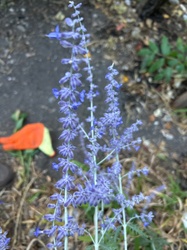
- Flowers: Clouds of tiny tubular lavender-blue flowers in branched, spire-like panicles
- Stems: Square, whitish-silver, woody at the base, upright and branching
- Leaves: Finely cut, gray-green, aromatic when crushed (sage-like scent)
- Habit: Loose, airy subshrub 3-5 ft tall and wide
- Bloom time: Mid-summer to fall, very long-lasting
Care & growing
Light: Full sun is essential; it flops and sparses in shade.
Water: Highly drought-tolerant once established; water sparingly and avoid wet feet.
Soil: Lean, well-drained soil; tolerates poor, rocky, sandy, and alkaline ground. Wet, heavy soil is its main killer.
Temperature: Hardy in USDA zones 4-9; tolerates heat and humidity.
Feeding: None needed; rich soil produces weak, floppy growth.
Propagation: Softwood cuttings in summer. Cut stems back hard to about 6-12 in. in early spring to encourage strong, upright new growth.
Habitat & origin
Russian sage is native to the rocky slopes, steppes, and dry grasslands of Central Asia, including Afghanistan, Pakistan, and the Himalayan foothills.
This arid origin explains its love of sun, heat, and lean soil. It is now widely planted in xeriscapes, gravel gardens, and hot borders across temperate climates worldwide.
Frequently asked questions
Why is my Russian sage flopping over?
Flopping is caused by too much shade, overly rich soil, or skipping the spring cutback. Give it full sun, lean soil, and prune hard in early spring.
When should I cut back Russian sage?
Cut stems back to 6-12 inches in early spring as new growth begins. This keeps the plant compact and encourages vigorous, upright stems.
Is Russian sage actually a sage?
It was long classified separately as Perovskia but is now placed in the genus Salvia. It is aromatic and sage-scented but is not the culinary garden sage.
Does Russian sage need a lot of water?
No, it is very drought-tolerant once established and prefers dry, well-drained soil. Overwatering and heavy soil are the most common ways to kill it.
Russian Sage guides
In-depth guides for identifying, growing, and caring for Russian Sage.

How to Care for Russian Sage
Grow Russian sage for airy silver foliage and long-blooming lavender-blue spires. An easy, drought-tolerant sun lover for hot, dry gardens.
Russian Sage Identification Guide
Identify Russian sage by its silvery, square, aromatic stems, finely cut gray-green leaves, and airy spires of small lavender-blue flowers.
Russian Sage identified by the community
Real specimens identified with Plant Identifier.