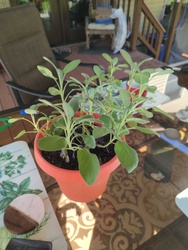
Sage Identification Guide
Identify common sage by its soft gray-green pebbled leaves, square woody stems, and tubular two-lipped purple-blue flowers. Covers its mint-family traits and how to separate it from lavender and lamb's ear.
Read the full Sage encyclopedia entry →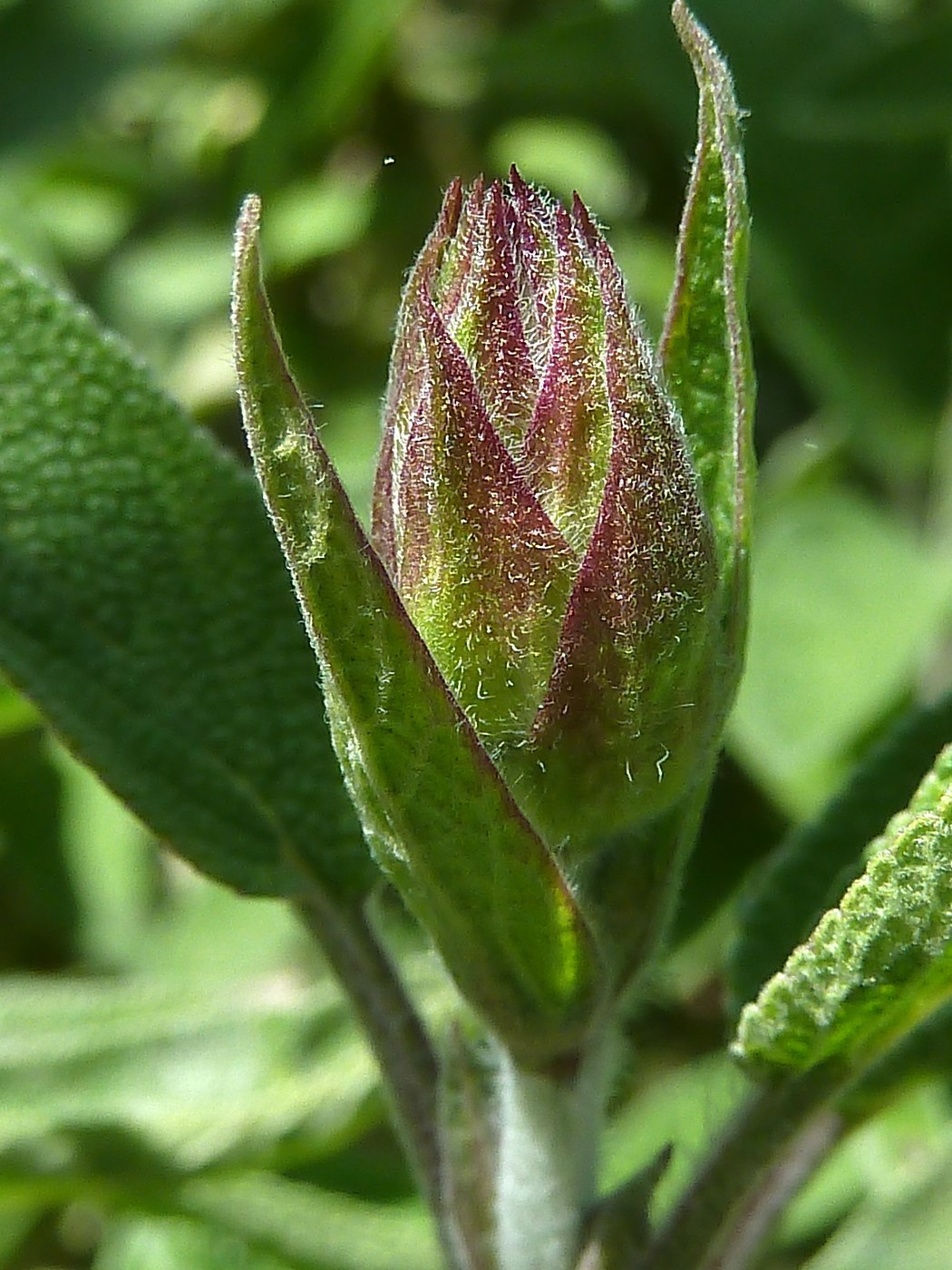
Key Identifying Features
Common sage (Salvia officinalis) is an evergreen subshrub in the mint family (Lamiaceae). Its hallmarks are soft, gray-green, finely pebbled (rugose) oblong leaves, square stems that grow woody at the base, and a strong warm, camphor-savory aroma. In summer it bears whorls of tubular, two-lipped violet-blue flowers.
Leaves & Stems
- Leaves are oblong to elliptic, 5-8 cm long, opposite, with a velvety, finely wrinkled surface and fine hairs giving a gray-green felted look.
- Leaf margins are smooth or very finely scalloped; the tip is rounded.
- Stems are square in cross-section (a mint-family trait), green and hairy when young, woody and gray at the base.
- Crushing a leaf releases a strong savory, slightly peppery, camphor-like scent.
Flowers & Fruit
- Flowers appear in whorls (verticillasters) along upright spikes.
- Each flower is tubular and two-lipped (bilabiate), typically violet-blue to purple, sometimes pink or white.
- Flowers are roughly 2 cm long and attract bees.
- Fruit consists of four small smooth nutlets held in the persistent calyx.
How to Tell It Apart from Look-Alikes
- Lavender (Lavandula) has narrow needle-like leaves and a sweeter floral scent, not pebbled oval leaves.
- Lamb's ear (Stachys byzantina) has similarly soft gray leaves but they are densely silvery-woolly and odorless or faintly fruity, not savory.
- Russian sage (Salvia yangii) has finely cut silvery leaves and airy flower panicles.
- Ornamental salvias share square stems and lipped flowers but differ in leaf texture; common sage's pebbled gray oval leaves with savory scent are diagnostic.
Where You'll Find It
Native to the Mediterranean, sage is grown worldwide in herb gardens, borders, and containers. It thrives in full sun and dry, well-drained, even poor soil, and tolerates drought. It can become a sprawling woody shrub up to 60-70 cm.
Quick ID Checklist
- Gray-green, finely pebbled velvety leaves
- Square stems, woody at the base
- Warm savory, camphor-like scent
- Whorls of tubular two-lipped purple-blue flowers
- Evergreen subshrub habit
Frequently asked questions
How do I tell sage from lavender?
Sage has soft, pebbled, gray-green oval leaves and a savory camphor scent, while lavender has narrow needle-like leaves and a sweet floral fragrance. Both have square stems but the leaves differ clearly.
Why are sage stems square?
Sage is in the mint family (Lamiaceae), whose members characteristically have square-sectioned stems. Rolling the stem between your fingers reveals the four flat sides.
Is the fuzzy gray plant in my garden sage or lamb's ear?
Lamb's ear leaves are densely silvery-woolly and nearly odorless, while sage leaves are pebbled gray-green with a strong savory smell when crushed.
What do sage flowers look like?
They are tubular, two-lipped, usually violet-blue, and arranged in whorls along upright spikes in early summer, attracting many bees.
Sage identified by the community
Recent Sage specimens identified with Plant Identifier.