
Saguaro Cactus Identification Guide
How to identify the giant Saguaro cactus by its towering ribbed column, upturned arms, and white night-blooming flowers of the Sonoran Desert.
Read the full Saguaro Cactus encyclopedia entry →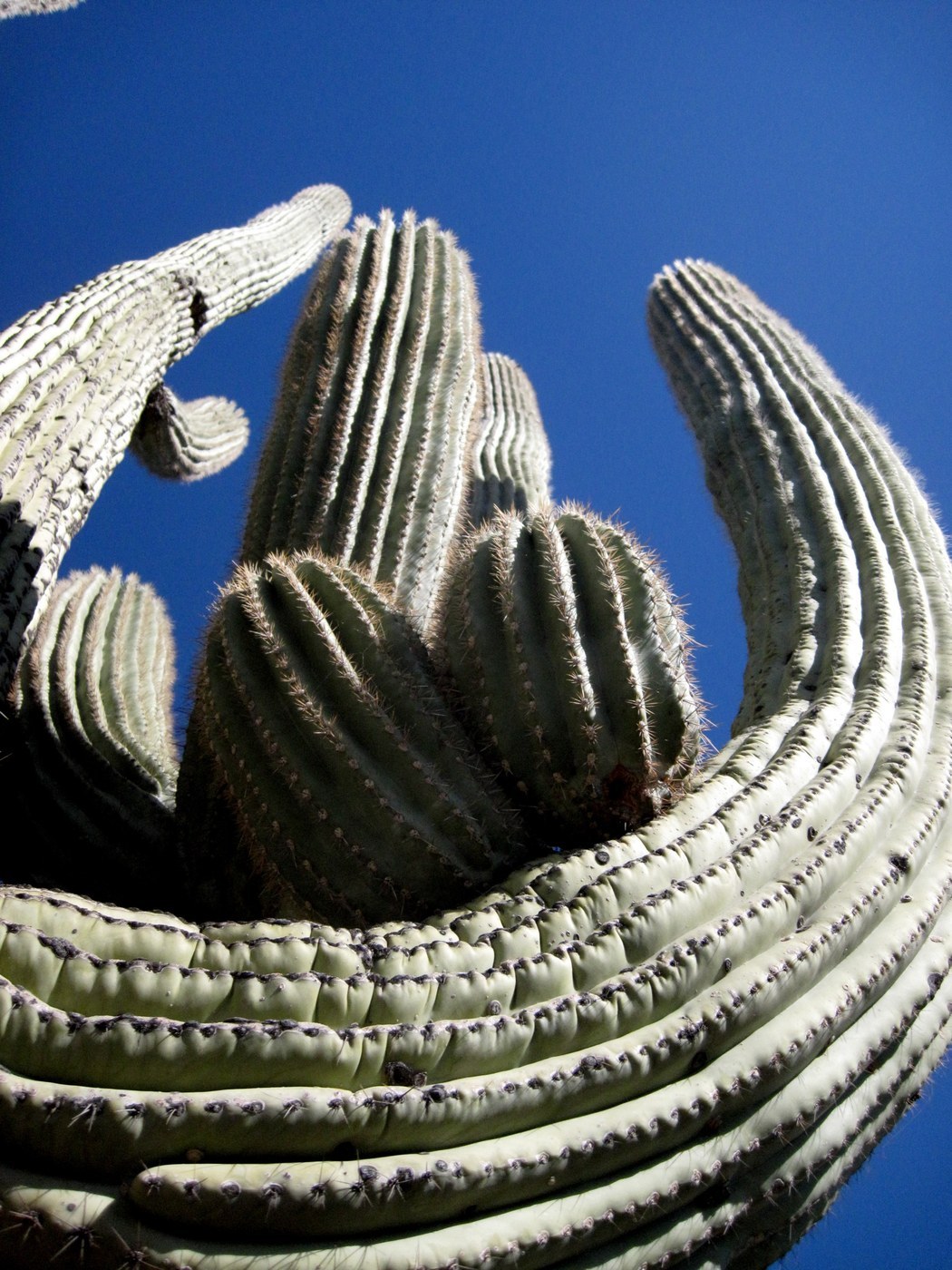
Key Identifying Features
The Saguaro (Carnegiea gigantea) is the iconic tree-sized cactus of the Sonoran Desert and the largest cactus in the United States.
- Massive, single columnar trunk reaching 15–50+ ft (5–15+ m) tall
- Distinctive upraised arms that curve upward (on mature plants)
- Body covered in vertical ribs and spine clusters
- Extremely slow-growing and long-lived (150–200 years)
Stems & Spines
The trunk is a fluted, accordion-pleated column with roughly 12–24 vertical ribs that expand and contract as the plant stores water. Along each rib, evenly spaced areoles bear clusters of stiff gray spines — up to 2 in (5 cm) long on young growth, becoming sparser and harder to see near the top. The skin is waxy green for photosynthesis. Arms typically don't appear until the plant is 50–75 years old, and a large saguaro may have several to dozens of arms, though some never branch.
Flowers & Fruit
In late spring (April–June), waxy white flowers with yellow centers open at the tips of the trunk and arms. Each is about 3 in (8 cm) wide, opens at night, and closes by the next afternoon — pollinated by bats, doves, and bees. The Saguaro is the state flower of Arizona. Flowers give way to egg-shaped red fruit that splits open to reveal juicy red pulp and thousands of tiny black seeds, a key food for desert wildlife and Indigenous peoples.
How to Tell It Apart from Look-Alikes
- Organ Pipe Cactus: branches into many stems from the base (no single trunk) and stays shorter.
- Cardón (Pachycereus pringlei): a similar giant in Mexico, but branches lower on the trunk and has more ribs; not found in the U.S.
- Mexican Fencepost / other columnar cacti: lack the thick single trunk and upturned arms.
The single thick trunk with upward-curving arms is unmistakable within its range.
Where You'll Find It
The Saguaro grows only in the Sonoran Desert — southern Arizona, a sliver of southeastern California, and Sonora, Mexico. It favors rocky bajadas and desert slopes below about 4,000 ft, often sheltering under "nurse" palo verde or mesquite trees as seedlings. It is legally protected in Arizona.
Quick ID Checklist
- Huge single columnar trunk, often 15–40+ ft tall
- Upward-curving arms (on older plants)
- 12–24 vertical accordion ribs lined with spine clusters
- Waxy white, yellow-centered flowers at stem tips in spring
- Red splitting fruit
- Found only in the Sonoran Desert
Frequently asked questions
How old is a saguaro before it grows arms?
Arms usually don't appear until the plant is 50 to 75 years old. A saguaro can be over 100 years old and still have no arms if conditions are dry.
How do I tell a saguaro from an organ pipe cactus?
A saguaro has one thick central trunk with arms that branch high up, while organ pipe cactus sends up many slender stems straight from the ground.
Is it legal to touch or move a saguaro?
Saguaros are protected by Arizona law. It is illegal to harm, remove, or transplant them without permits, even on private land.
When do saguaros bloom?
They flower from late April through June, with white night-opening blooms at the tips of the trunk and arms.