
Salmonberry Identification Guide
Identifying salmonberry by its three-part raspberry-like leaves, bright pink flowers, and golden-to-red raspberry-shaped fruit.
Read the full Salmonberry encyclopedia entry →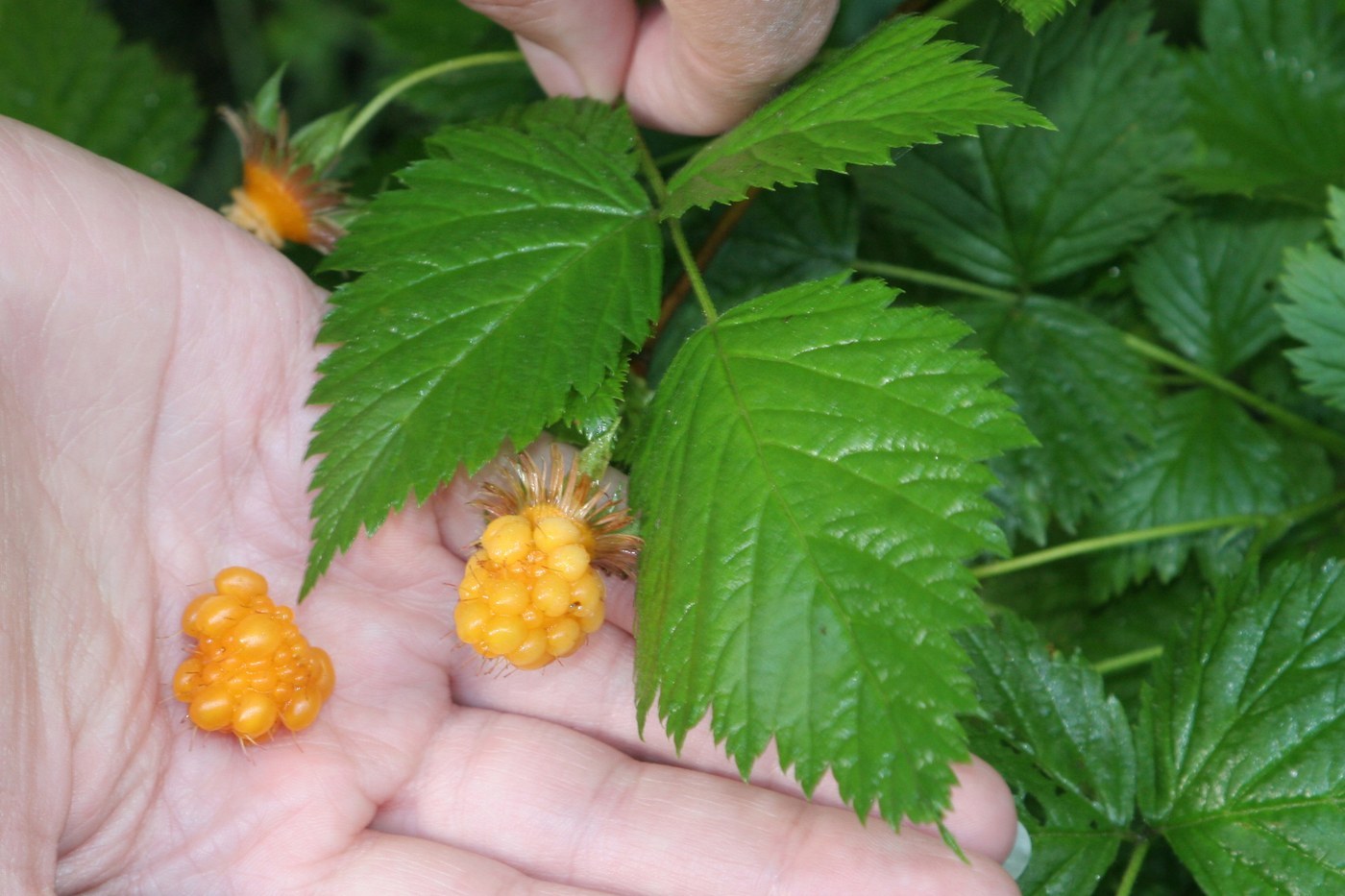
Key Identifying Features
Salmonberry (Rubus spectabilis) is a tall, thicket-forming bramble of the Pacific Northwest in the rose family. Identify it by compound leaves divided into three leaflets (like a raspberry), showy magenta-pink flowers that bloom very early, and raspberry-shaped fruit that ripens from yellow-orange to salmon-pink or red.
- Erect deciduous shrub, 1–4 m tall, forming dense colonies
- Stems with fine, weak prickles, golden-brown shredding bark on older canes
- Bright pink flowers in late winter to spring — unusually early
Leaves & Stems
Leaves are alternate, divided into three sharply toothed leaflets (occasionally pinnate on vigorous canes), the terminal leaflet largest, resembling a raspberry leaf but greener and less white beneath. Canes are erect and biennial, armed with small, soft prickles rather than stout thorns, and the older bark becomes golden-brown and papery, shredding in strips.
Flowers & Fruit
Flowers are conspicuous and a great ID feature: deep pink to magenta, five petals, 2–4 cm across, borne singly or in small clusters, often appearing before most other shrubs leaf out (late winter to early spring). The fruit is an aggregate of drupelets like a raspberry, 1–2 cm, that ripens through yellow and orange to salmon, pink, or deep red; the color is variable even on one plant. Ripe fruit pulls cleanly off a white core, leaving a hollow cap like a raspberry.
How to Tell It Apart from Look-Alikes
- Thimbleberry (Rubus parviflorus): has large, soft, maple-shaped single leaves (not divided) and white flowers; very different foliage.
- Red raspberry (Rubus idaeus): leaves white-woolly beneath, flowers white, fruit red; salmonberry has pink flowers and often orange/salmon fruit.
- Trailing blackberry / other brambles: sprawl along the ground with stouter thorns; salmonberry stands erect with weak prickles.
- The pink flowers + three-leaflet leaves + salmon-to-red raspberry-form fruit combination is distinctive.
Where You'll Find It
Native to the moist coastal forests of western North America, from Alaska to California. Look for it along streambanks, wet woodland edges, ditches, and shady ravines, where it often forms large impenetrable thickets. It favors damp, rich soils and partial shade.
Quick ID Checklist
- Erect bramble, 1–4 m, in moist coastal woods
- Three sharply toothed leaflets per leaf
- Canes with weak prickles; old bark golden, shredding
- Bright magenta-pink five-petaled flowers, very early
- Raspberry-form fruit ripening yellow → orange → salmon → red
- Pacific Northwest streamsides and wet forest
Frequently asked questions
What color are salmonberry fruits when ripe?
The fruit color varies widely — from golden yellow and orange to salmon-pink and deep red — sometimes within the same patch. Ripeness shows in the softening of the fruit and how easily it detaches, not in color alone.
How is salmonberry different from thimbleberry?
Salmonberry has compound leaves with three leaflets and pink flowers, while thimbleberry has large undivided maple-shaped leaves and white flowers.
Why does it flower so early?
Salmonberry is one of the first shrubs to bloom in the Pacific Northwest, often in late winter, with its bright pink flowers appearing before most surrounding plants leaf out.
What does the salmonberry shrub look like overall?
Salmonberry forms erect, thicket-forming canes 1–4 m tall with fine, weak prickles and golden-brown shredding bark, often spreading into dense colonies along moist coastal woods.