
Sandbur Identification Guide
Identify sandbur (Cenchrus species) by its spiny, sharp-barbed seed burs, low spreading grass habit, and preference for sandy, dry, disturbed soils.
Read the full Sandbur encyclopedia entry →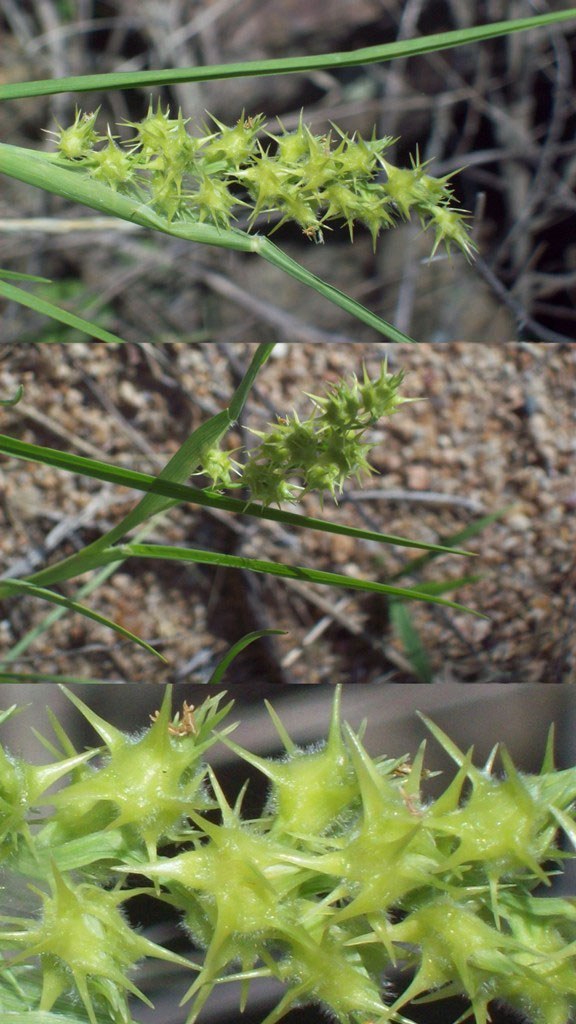
Key Identifying Features
Sandbur (Cenchrus spp., including C. spinifex and C. longispinus) is a low, spreading warm-season annual (sometimes short-lived perennial) grass best known for its painful spiny seed burs. If you have stepped on sharp, clinging burs in a sandy lot or beach path, you have met sandbur. The plant itself is unremarkable until it sets seed.
- Hard, spiny burs along the seed stalk that cling to skin, socks, and fur
- Low, sprawling, mat-like grass habit
- Flattened stems, often reddish at the base
- Strong preference for sandy, dry, disturbed soils
Leaves & Stems
Leaf blades are flat, narrow, and pale to medium green, sometimes slightly twisted, with a sparse fringe of hairs near the base. Blades are typically 2-5 inches long. The ligule is a small ring of hairs.
Stems are flattened and bent at the base (decumbent), branching and rooting at the lower nodes to form loose mats. The base is often tinged pinkish or reddish. Plants are usually under 2 feet and tend to flop outward across open ground.
Flowers & Fruit
The defining feature appears in summer to fall: a spike-like seed head bearing a row of round, spiny burs. Each bur is a hard cluster of sharp, barbed spines surrounding one or more seeds, about 1/4 to 1/2 inch across. Burs are green when young, hardening to straw-brown. Their barbed tips make them cling and are the unmistakable diagnostic feature.
How to Tell It Apart from Look-Alikes
- Cocklebur: a broadleaf plant with much larger (1 inch+) oval, hooked burs and large triangular leaves; sandbur is a grass with small round spiny burs.
- Burclover / burdock: broadleaf weeds with very different leaves; the grass habit of sandbur rules them out.
- Crabgrass and other lawn grasses: look similar before flowering, but none produce the hard spiny burs.
When burs are present, identification is certain; before then, look for the sandy habitat plus low flattened reddish-based stems.
Where You'll Find It
Sandbur thrives in sandy, well-drained, disturbed ground: beaches, dunes, sandy fields, roadsides, pastures, vacant lots, and poor lawns. It is widespread across warm regions of North America and beyond. It tolerates drought and poor fertility, so it dominates where better turf cannot establish.
Quick ID Checklist
- Low, sprawling annual grass on sandy soil
- Hard, spiny burs along the seed stalk
- Burs cling painfully to skin, socks, and animal fur
- Flattened stems, often reddish at the base, rooting at nodes
- Flat narrow blades with a hairy ligule
- Seed heads from summer to fall
Frequently asked questions
What makes sandbur easy to identify?
Its seed head produces hard, round, sharply spined burs that cling to skin, clothing, and animal fur. No other common lawn or field grass produces these painful barbed burs.
Is sandbur a grass or a broadleaf weed?
It is a grass. This separates it from cocklebur and burdock, which are broadleaf plants with larger leaves and different bur shapes.
Where does sandbur typically grow?
It favors sandy, dry, disturbed soils such as beaches, dunes, sandy fields, roadsides, and thin lawns, where it can outcompete weaker turf grasses.
Are the burs dangerous?
The barbed spines can puncture skin and are painful underfoot, and they can injure the mouths of grazing animals, but they are not poisonous.