
Satin Pothos Identification Guide
Identify Satin Pothos (Scindapsus pictus) by its matte, silver-spotted heart-shaped leaves and trailing vines. Covers how it differs from true pothos and philodendron.
Read the full Satin Pothos encyclopedia entry →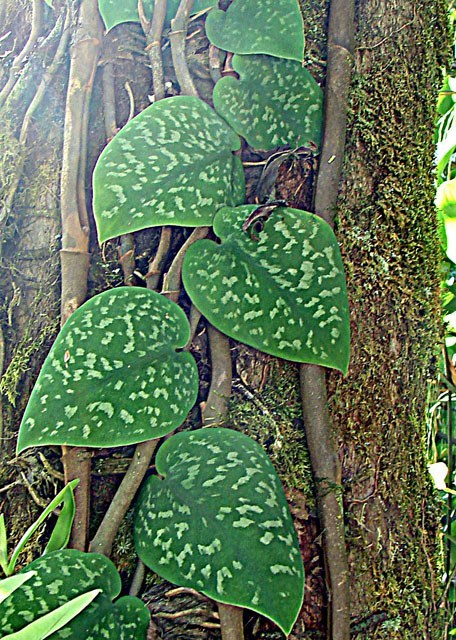
Key Identifying Features
Satin Pothos (Scindapsus pictus) is a trailing aroid vine prized for its matte, satiny dark-green leaves splashed with silvery-gray markings. Although called a pothos, it belongs to the genus Scindapsus, not Epipremnum. The combination of velvety texture and metallic silver variegation is its standout feature.
- Heart-shaped (cordate), slightly asymmetrical leaves
- Matte/satin surface dusted with silver-gray blotches
- Trailing or climbing vine with aerial roots
- Leaves held flat and somewhat thick
Leaves & Stems
Leaves are ovate to heart-shaped with a pointed tip, 2-4 inches long, and noticeably asymmetrical at the base (one side fuller than the other). The leaf surface is non-glossy/matte with a soft sheen, scattered with silvery patches and a silver margin in popular forms like 'Exotica' and 'Argyraeus' (the latter being smaller-leaved with neat silver dots). Stems are slender, trailing, and produce aerial roots at the nodes for climbing.
Flowers & Fruit
As a houseplant, Satin Pothos rarely flowers. In the wild it can produce a typical aroid spathe-and-spadix inflorescence, but indoor plants are grown solely for foliage. Do not expect blooms.
How to Tell It Apart from Look-Alikes
- Golden/Marble Queen Pothos (Epipremnum aureum) has glossy leaves with yellow or white variegation, not the matte silver dusting of Scindapsus.
- Philodendron species have glossy leaves and different leaf-base/sheath structure; they lack the metallic silver speckling.
- Scindapsus 'Silver Lady' / 'Treubii Moonlight' are relatives but have nearly solid silver or different leaf shapes.
The matte texture plus silvery spotting on heart-shaped leaves is the clearest diagnostic for Satin Pothos.
Where You'll Find It
Native to Southeast Asia (India to Indonesia), it grows as a forest-floor and tree-climbing vine. As a houseplant it thrives in medium to bright indirect light and is grown in hanging baskets or trained up moss poles. It tolerates lower light but shows less silver in dim conditions.
Quick ID Checklist
- Heart-shaped, asymmetrical leaves
- Matte/satin surface (not glossy)
- Silver-gray blotches and often a silver edge
- Trailing/climbing vine with aerial roots
- Leaves thicker and more rigid than common pothos
Matte leaf + silver speckles + heart shape = Satin Pothos, Scindapsus pictus.
Frequently asked questions
Is Satin Pothos a real pothos?
Not botanically. It is Scindapsus pictus, while true pothos is Epipremnum aureum. They are related aroids but different genera.
How do I distinguish it from Golden Pothos?
Golden Pothos has glossy leaves with yellow variegation. Satin Pothos has matte leaves with silvery-gray markings and a silver margin.
Why are my plant's leaves losing their silver?
Insufficient light reduces the silver variegation. Move it to brighter indirect light to restore the metallic markings.
Will it ever flower indoors?
Almost never. It is grown for foliage; mature wild plants produce an aroid spathe-and-spadix, but indoor specimens rarely bloom.