
Schisandra Identification Guide
Identify schisandra (Schisandra chinensis) by its twining woody vine, oval glossy leaves, fragrant cream flowers, and hanging spikes of red berries.
Read the full Schisandra encyclopedia entry →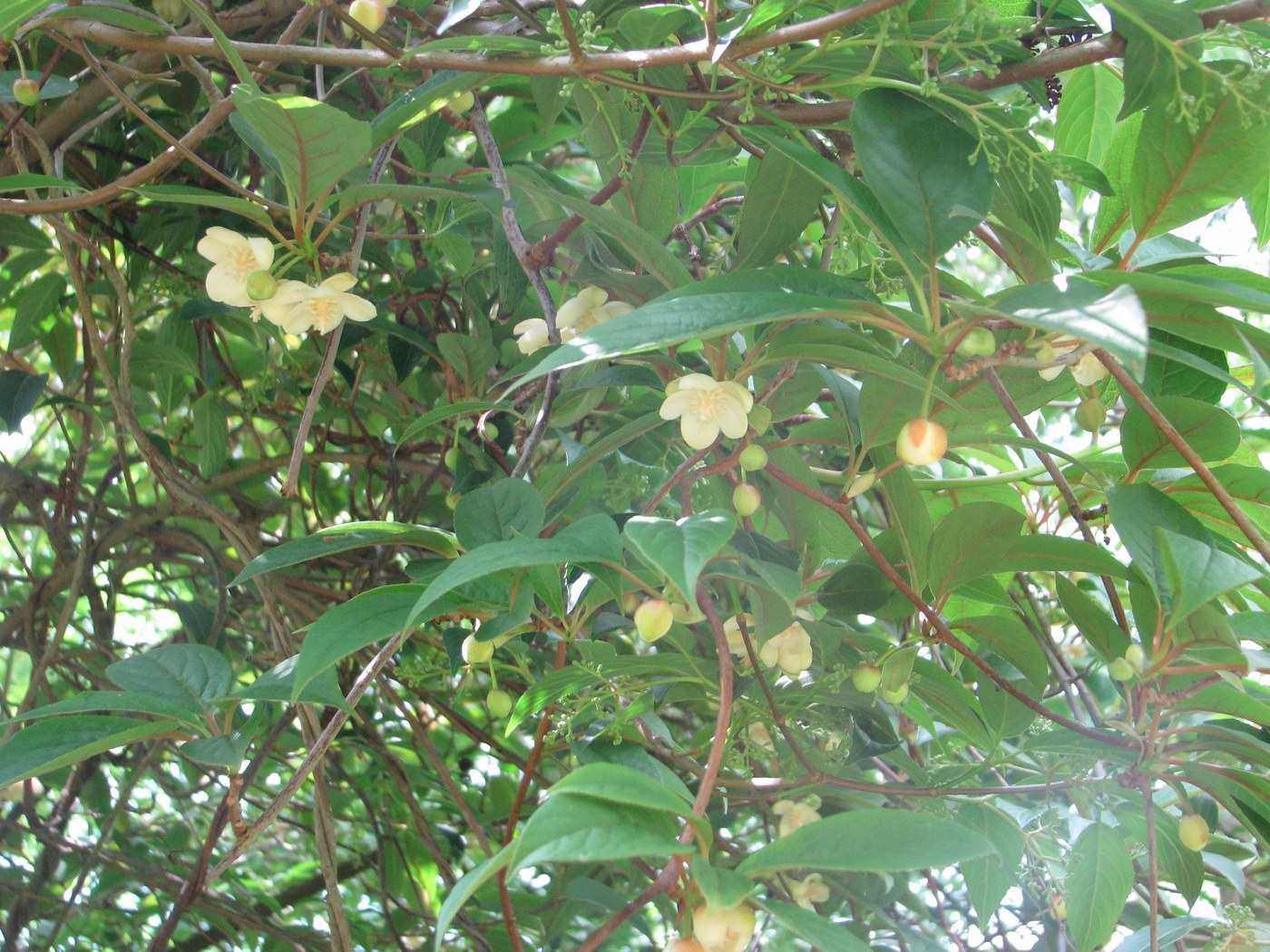
Key Identifying Features
Schisandra, or magnolia-vine (Schisandra chinensis), is a deciduous woody climber native to East Asia. Key marks:
- A twining woody vine that climbs by spiralling around supports (no tendrils).
- Oval, glossy, alternate leaves with finely toothed margins on slender reddish stalks.
- Hanging clusters (spikes) of bright red berries in late summer, the standout feature.
Leaves & Stems
Leaves are alternate, elliptic to oval (5-10 cm long), with a pointed tip, a tapering base, and fine, shallow teeth along the margin. They are bright to dark green, slightly glossy above, and often carried on pinkish-red petioles. The stems are slender, woody, and twine clockwise around shrubs, fences, or trellises, reaching several meters; older bark is greyish-brown and somewhat flaky.
Flowers & Fruit
Flowers appear in late spring to early summer, drooping on slender stalks from the leaf axils. Each is about 1.5 cm across, with 6-9 waxy, creamy-white to pale pink petals (tepals), and is pleasantly fragrant. The plant is usually dioecious (separate male and female plants). After pollination, the flower's receptacle elongates into a hanging spike bearing many small, round, scarlet-red berries, each containing one or two kidney-shaped seeds. The ripe fruit is the classic identifier.
How to Tell It Apart from Look-Alikes
- Honeysuckle vines (Lonicera) also twine and have opposite leaves (vs schisandra's alternate leaves) and tubular flowers with paired berries.
- Akebia (chocolate vine) has compound palmate leaves of 3-5 leaflets, quite unlike schisandra's simple oval leaves.
- Wild grape climbs by tendrils (schisandra has none) and bears clustered round purple-black grapes, not red spike berries.
The twining habit without tendrils, simple alternate toothed oval leaves, and hanging spikes of red berries identify schisandra.
Where You'll Find It
Native to forests of northeastern China, Korea, Japan, and the Russian Far East, schisandra grows along forest edges, in moist woodland, and over shrubs and rocks. Elsewhere it is cultivated as an ornamental vine on trellises and arbors in temperate gardens.
Quick ID Checklist
- Twining woody vine (no tendrils)
- Alternate, oval, glossy, finely toothed leaves
- Drooping fragrant cream-to-pink flowers (6-9 tepals)
- Hanging spikes of scarlet-red berries in late summer
- Berries each holding one or two kidney-shaped seeds
Frequently asked questions
How does schisandra climb?
It is a twining woody vine that spirals around its support rather than using tendrils or aerial roots. The absence of tendrils helps separate it from grapes and many other climbers.
Why do some schisandra plants never fruit?
Schisandra is usually dioecious, with separate male and female plants. Only female plants (when pollinated by a nearby male) develop the hanging spikes of red berries, so a lone male vine will flower but never fruit.
What do the berries look like?
They are small, round, bright scarlet-red berries borne in drooping spikes that form as the flower's receptacle elongates, each holding one or two kidney-shaped seeds.
How do I tell schisandra from honeysuckle?
Schisandra has alternate, simple, finely toothed oval leaves and red berries in hanging spikes, while honeysuckle has opposite leaves, tubular flowers, and berries borne in pairs.