
Sea Buckthorn Identification Guide
Recognizing sea buckthorn by its narrow silvery leaves, fierce thorns, and dense clusters of bright orange berries clinging to the stems.
Read the full Sea Buckthorn encyclopedia entry →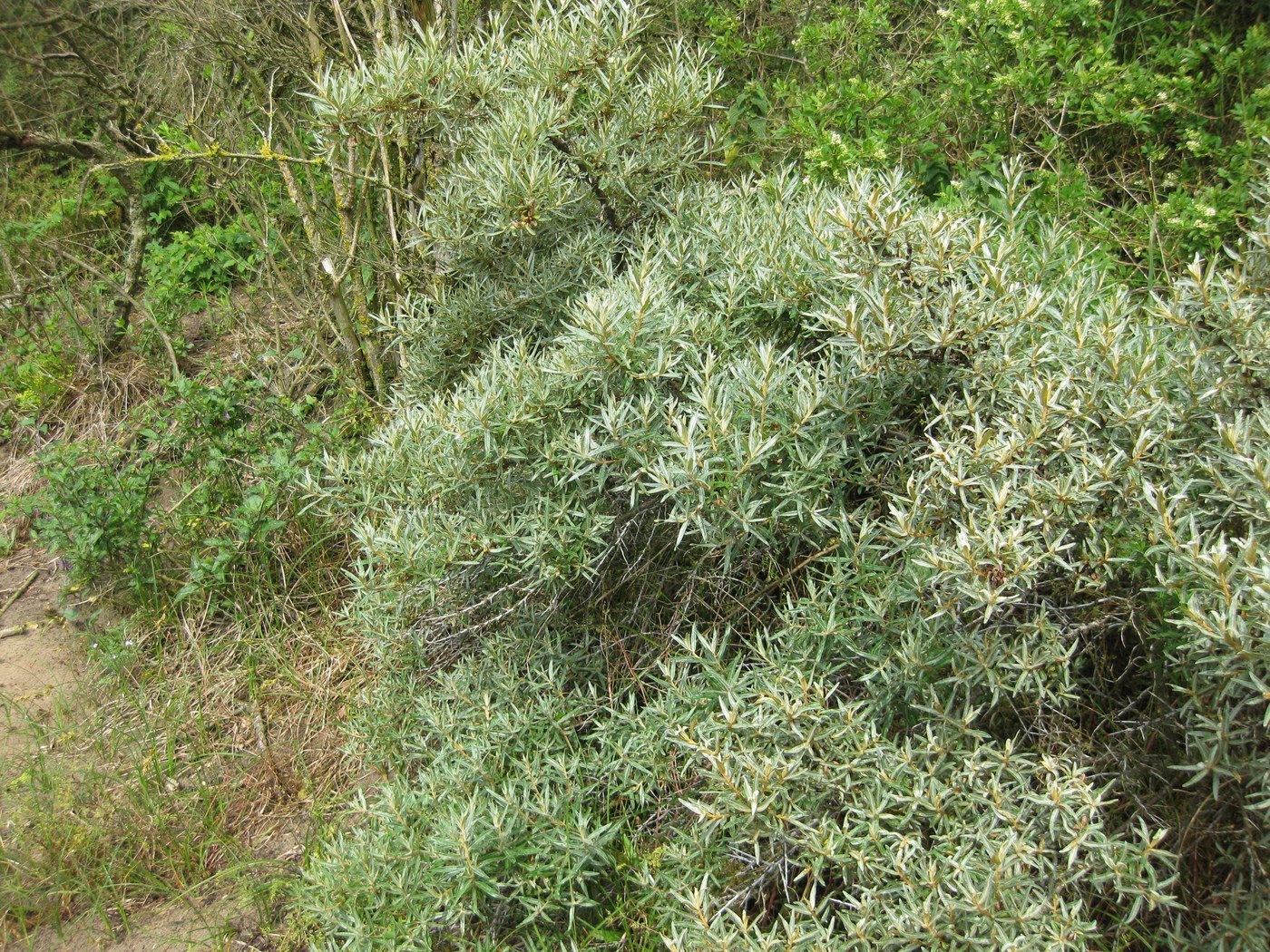
Key Identifying Features
Sea buckthorn (Hippophae rhamnoides) is a thorny, deciduous, nitrogen-fixing shrub of coasts and riverbanks, famous for its vivid orange berries packed tightly along the branches. Identify it by the narrow, silvery-gray willow-like leaves, sharp woody thorns, and the dense clusters of small orange fruit that cling so closely they seem to coat the twigs.
- Spreading thorny shrub or small tree, 2–6 m tall, suckering into thickets
- Silvery, narrow, linear leaves
- Bright orange berries packed densely along the stems (on female plants)
Leaves & Stems
Leaves are alternate, narrow and lance-shaped to linear, 3–8 cm long, dull green-gray above and conspicuously silvery-scaly beneath, covered in tiny star-shaped scales that also coat young twigs, giving the whole plant a frosted, gray-green look. The stems bear stiff, sharp thorns, and the bark is dark brown and rough. The plant suckers aggressively, forming dense thorny stands.
Flowers & Fruit
Sea buckthorn is dioecious (separate male and female plants). Flowers are tiny, greenish-yellow, and inconspicuous, appearing before or with the leaves in early spring. Only female plants bear fruit. The fruit is a small, round to oval, bright orange berry-like drupe about 6–10 mm, borne in dense clusters wrapped tightly around the previous year's wood — so abundant the stems look encrusted in orange. The fruit tends to persist into winter.
How to Tell It Apart from Look-Alikes
- Willows (Salix): also narrow-leaved but lack thorns and silvery scales, and bear catkins, not orange berries.
- Russian olive / oleaster (Elaeagnus): a relative with similar silvery scaly leaves, but its fruit is silvery-yellow and it lacks the dense bright-orange berry clusters.
- Buckthorns (Rhamnus): have broader, veined leaves and black fruit.
- The silver narrow leaves + sharp thorns + densely packed bright orange berries combination is unmistakable.
Where You'll Find It
Native across Europe and Asia, especially coastal dunes, sea cliffs, and gravelly riverbanks; widely planted for dune stabilization, hedging, and ornament. As a nitrogen fixer it colonizes poor, sandy, and disturbed soils and tolerates salt spray, wind, and drought, often forming extensive thickets.
Quick ID Checklist
- Thorny suckering shrub of coasts/riverbanks
- Narrow silvery-gray leaves, scaly beneath
- Stiff sharp thorns on the stems
- Bright orange berries packed densely along the twigs (female plants)
- Bright orange fruit persisting into winter
Frequently asked questions
Why do only some sea buckthorn bushes have berries?
The plant is dioecious, meaning male and female flowers grow on separate plants. Only female bushes produce the bright orange berries, and only when a male plant is nearby to pollinate them.
What makes the leaves look silver?
Both the leaf undersides and young twigs are coated in tiny silvery, star-shaped scales, giving the whole shrub a frosted gray-green appearance that aids identification.
How do I tell it from Russian olive?
Both have silvery scaly leaves, but sea buckthorn is thorny with dense bright-orange berries, while Russian olive (Elaeagnus) has silvery-yellow fruit and a different growth form.