
Sea Holly Identification Guide
How to identify sea holly (Eryngium) by its spiny, holly-like bracts, steel-blue metallic coloring, and thistle-like cone-shaped flower heads — and why it is actually a carrot relative.
Read the full Sea Holly encyclopedia entry →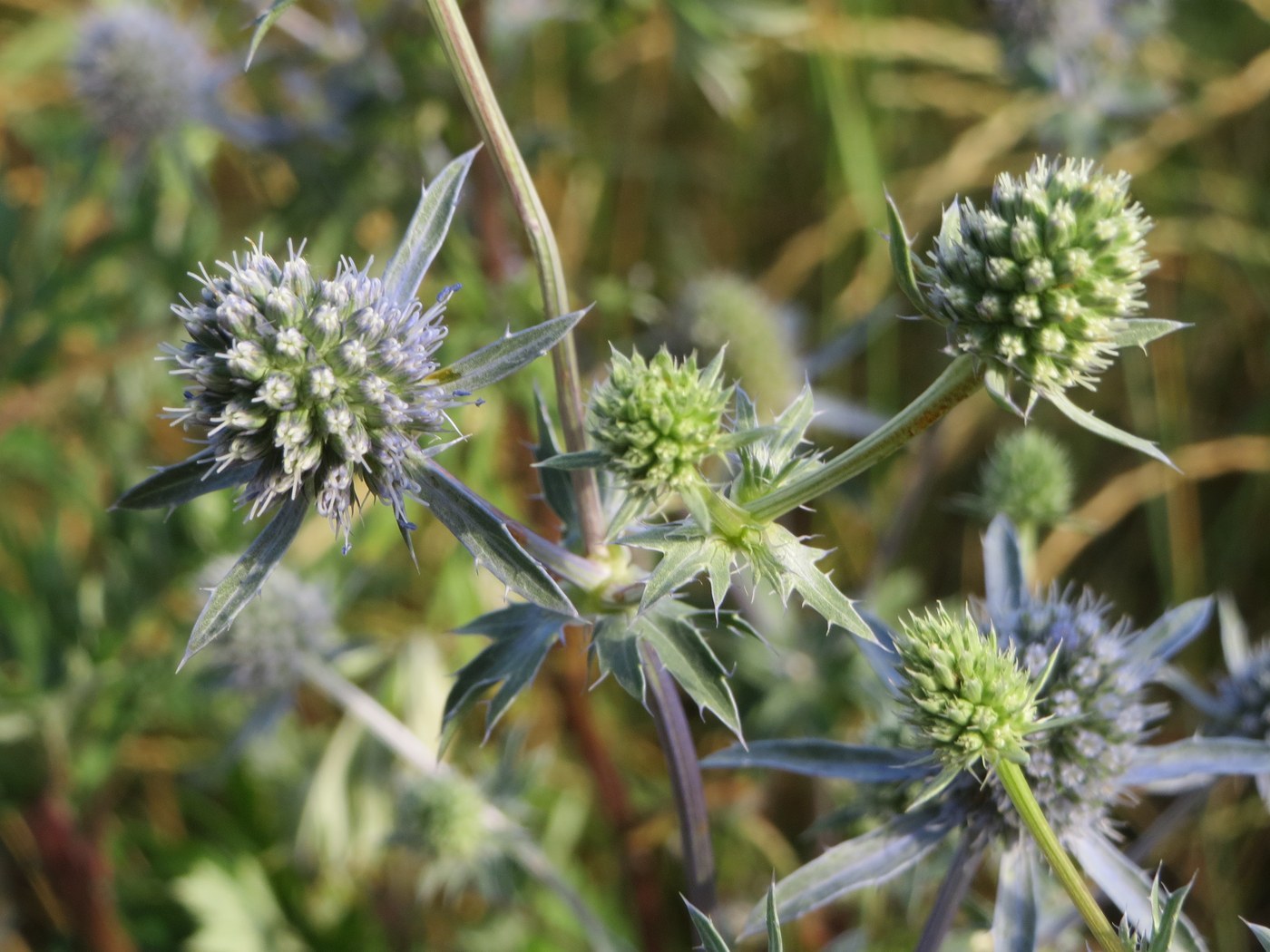
Key Identifying Features
Sea holly (Eryngium) looks thistle-like but is actually a member of the carrot family (Apiaceae). The signature is a dome- or cone-shaped flower head surrounded by a stiff, spiny, holly-like ruff of bracts, the whole plant often flushed an intense metallic silver-blue or steel-blue. Despite the name, only some species grow by the sea.
- Rigid, spiny bracts forming a starry collar beneath each flower head
- Flower head a cone or button of many tiny flowers, not a single bloom
- Often steel-blue, silvery, or amethyst metallic stems, bracts, and heads
- Foliage and bracts stiff, leathery, and prickly
Leaves & Stems
Basal leaves vary: some species (like Eryngium maritimum, true sea holly) have rounded, blue-gray, holly-shaped leaves with spiny lobes and white veins; others have long, narrow, sword-like or deeply dissected leaves. Stems are stiff, branched, and often vividly blue or silver in the upper plant during flowering. Sea holly grows from a deep, robust taproot.
Flowers & Fruit
Up close, each "flower" is really a tight head of dozens of minute flowers packed into a cylindrical or egg-shaped cone — the Apiaceae umbel compressed into a button. Ringing it is the conspicuous spiny involucre of bracts, which gives the whole structure a starburst or thistle look. Colors run steel-blue, violet, silvery-white, or green. Fruit is a small dry scaly schizocarp typical of the carrot family.
How to Tell It Apart from Look-Alikes
- True thistles (Cirsium, Carduus): have soft fluffy purple flower heads and milky/no metallic blue color; sea holly's flowers are tiny and packed into a firm cone with rigid spiny bracts, and it never has the thistle's pappus down.
- Teasel (Dipsacus): spiny egg-shaped heads but with long curved bracts and lilac flower bands, not the metallic blue ruff.
- Globe thistle (Echinops): truly spherical steel-blue heads, but the head is a perfect ball of spiky florets without the broad flat spiny collar of sea holly.
Where You'll Find It
True sea holly grows on coastal sand dunes and shingle, with waxy blue leaves adapted to salt and drought. Garden eryngiums are grown in sunny, well-drained borders, gravel gardens, and dried-flower beds, where their metallic heads and architectural form stand out and attract bees. Most need full sun and sharp drainage.
Quick ID Checklist
- Spiny, holly-like ruff of bracts under each head
- Flower head a cone/button of tiny flowers
- Metallic blue, silver, or amethyst coloring
- Stiff, leathery, prickly foliage
- Member of the carrot family, not a true thistle
Frequently asked questions
Is sea holly a type of thistle?
No. Despite the spiny, thistle-like look, sea holly (Eryngium) belongs to the carrot family (Apiaceae). Its flower head is a compressed umbel of tiny flowers ringed by spiny bracts, not a true thistle head.
Why is sea holly so blue and metallic?
Many species develop a steel-blue or silvery metallic pigmentation in the stems, bracts, and flower heads during flowering, which is one of the most distinctive features for identifying garden eryngiums.
Does all sea holly grow by the sea?
No. Only some species, like Eryngium maritimum, are true coastal dune plants. Many ornamental eryngiums are inland border perennials that simply share the spiny, blue-tinged appearance.
How do I tell sea holly from globe thistle?
Globe thistle (Echinops) has a perfectly spherical ball of spiky florets with no broad collar. Sea holly has a cone or button head surrounded by a flat, starry ruff of spiny bracts.