
Seven-Son Flower Identification Guide
Identify Heptacodium miconioides by its fragrant white late-summer flower clusters, showy rose-red calyces that follow, peeling tan bark, and distinctive three-veined leaves.
Read the full Seven-Son Flower encyclopedia entry →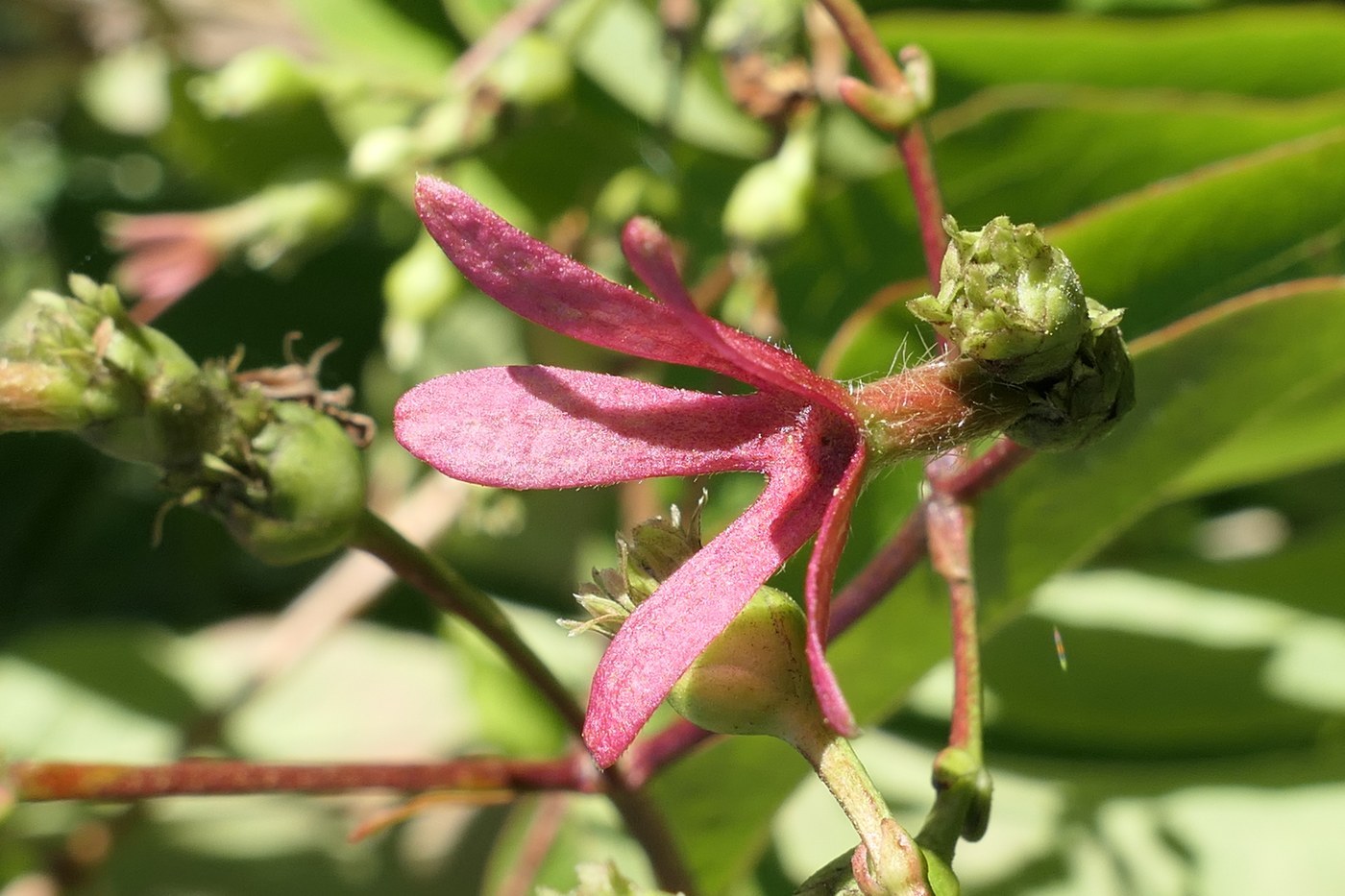
Key Identifying Features
Seven-son flower (Heptacodium miconioides) is a multi-season shrub or small tree from China, distinctive in late summer and fall. Identify it by:
- Clusters of small, fragrant, creamy-white flowers in late summer (August-September) arranged in tiered whorls — the "seven sons" refers to the seven-flower groupings
- After bloom, showy rose-pink to cherry-red enlarged sepals (calyces) that color up and outshine the flowers in fall
- Exfoliating tan-and-brown bark peeling in vertical strips on mature stems
- Opposite leaves with three prominent veins and a long-pointed tip
Leaves & Stems
Leaves are opposite, simple, ovate to lance-shaped, 3-6 inches long, with smooth or slightly wavy margins, a long tapering point, and three conspicuous arching veins from the base — a helpful feature. The foliage is dark green and somewhat glossy with a slightly puckered (corrugated) texture, holding green late with little fall color.
The bark is a year-round highlight: on older trunks it peels in long, papery, tan-to-brown strips, exposing paler wood beneath, somewhat like a crepe myrtle. The plant is typically multi-stemmed, upright, and vase-shaped, reaching 15-20 ft, with arching branches.
Flowers & Fruit
Flowers appear late, in August-September when few woody plants bloom, as branched clusters of small white, jasmine-scented tubular flowers in whorled tiers. As the flowers fade, the sepals enlarge and turn brilliant rose-pink to red, creating a second, even showier display through September-October that can be mistaken for a fresh bloom. Small dry fruits follow within the colorful calyces.
How to Tell It Apart from Look-Alikes
- Crepe myrtle (Lagerstroemia): also has peeling bark and late bloom but flowers are crinkled and showy in pink/red/white, leaves are alternate, and it lacks the three-veined opposite leaves and red calyx stage.
- Beautyberry / viburnums: opposite leaves but different flowers and berry fruit, no peeling bark or red calyx show.
- Privet: white late clusters but small simple leaves and black berries, no bark peel.
The sequence of white late-summer whorled flowers → bright red calyces → peeling bark + three-veined opposite leaves is unique to Heptacodium.
Where You'll Find It
Native to China and once rare, it is now a planted ornamental in USDA zones 5-9, valued for late-season interest in gardens, parks, and pollinator plantings (its late flowers feed bees and butterflies). It tolerates a range of soils in full sun to part shade. You will find it as a cultivated specimen, not in the wild in North America.
Quick ID Checklist
- Multi-stemmed upright shrub/small tree, 15-20 ft
- Fragrant creamy-white flowers in tiered whorls, late summer
- Showy rose-red enlarged calyces in fall (looks like a second bloom)
- Peeling tan-brown bark in vertical strips
- Opposite leaves with three prominent veins and long-pointed tips
A vase-shaped shrub blooming fragrant white in late summer, then turning cherry-red with showy sepals over peeling bark, is the seven-son flower.
Frequently asked questions
Why is it called seven-son flower?
The name translates from the Chinese reference to the way its small white flowers are arranged in clusters of about seven blooms in tiered whorls along the branching flower stalks.
Are the red parts in fall a second set of flowers?
No. After the white flowers fade, the sepals (calyces) enlarge and turn bright rose-red, creating a showy second display that is often mistaken for a fresh bloom but is actually the colorful fruiting calyx.
How do I tell it from a crepe myrtle?
Both have attractive peeling bark and late bloom, but seven-son flower has opposite leaves with three distinct veins, fragrant white whorled flowers, and a red-calyx stage, while crepe myrtle has alternate leaves and crinkled, brightly colored petals.
When does it bloom and why is that valuable?
It blooms in late summer, around August to September, when few other trees and shrubs flower, providing fragrant nectar for bees and butterflies and extending garden interest into early fall, followed by its red calyx show.